

AI Development Tools
What Is Lovable: AI App Builder for Non-Technical Founders
Build production-ready applications by describing what you want in plain English

Senior Software Developer & Trading Technology Specialist
Ethan Parker is a software developer with over 8 years of experience in building web applications, trading tools, and financial technology solutions. He specializes in Python, JavaScript, API integrations, and trading automation, helping traders improve efficiency through innovative technology.
Lovable is an AI-powered application builder that turns natural language descriptions into working full-stack web applications. You type what you want — a marketplace, a dashboard, a CRM, an e-commerce store — and the system generates React components, sets up a PostgreSQL database through Supabase, configures authentication, handles payments via Stripe, and deploys everything to a live URL. The entire process happens in a browser-based chat interface that feels more like collaborating with a senior developer than using a traditional no-code tool.
Contents
- 1. How Lovable Works: Natural Language to Production Code
- 2. Core Features: Database, Auth, Payments, Hosting
- 3. Who Uses Lovable: Founders, Designers, Product Managers
- 4. Pricing Tiers: Free, Pro, Business, Enterprise
- 5. Integrations: Supabase, Stripe, GitHub, Figma
- 6. Security and Compliance Standards
- 7. Community and Learning Resources
- 8. Comparison with Bolt, v0, Replit, Cursor
- 9. Limitations and Honest Constraints
- 10. Getting Started: First Project in 15 Minutes
- 11. Final Assessment of Lovable AI Builder
The platform launched in 2023 and quickly gained traction among founders, designers, product managers, and developers who want to move from idea to deployed product without writing boilerplate. Unlike visual drag-and-drop builders that lock you into proprietary formats, Lovable produces standard React, TypeScript, and Vite code that you can download, push to GitHub, and continue editing in any IDE. The AI handles the initial scaffolding and ongoing iterations, but you always own the code.
What distinguishes Lovable from earlier AI coding assistants is its end-to-end approach. Most tools stop at generating snippets or frontend components. Lovable manages the full stack: database schema, row-level security policies, API routes, authentication flows, payment webhooks, custom domains, and hosting. You describe a feature — "add user roles with admin permissions" — and it updates the database migration, the backend policies, the frontend components, and the navigation automatically.
How Lovable Works: Natural Language to Production Code
The interface centers on a chat panel where you describe your application in plain English. Your first prompt might be: "Build a project management tool for agencies with clients, projects, tasks, and time tracking. Clients should see only their projects. Team members see everything." Lovable responds by creating a project structure, designing the database schema, setting up Supabase authentication with role-based access, building the React frontend with Tailwind CSS, and deploying a preview URL — usually within two to three minutes.
Each subsequent message refines the application. You can say "add Stripe subscriptions so clients pay monthly" or "make the task board draggable like Trello" or "export the code to my GitHub repo." The AI maintains context across the entire conversation, understanding your data model, your UI patterns, and your integration choices. It does not hallucinate new database tables that conflict with existing ones. It does not forget that you chose Supabase over Firebase three prompts ago.
Behind the scenes, Lovable uses a combination of large language models — primarily Claude and GPT-4 variants — orchestrated with a custom code generation pipeline. The system knows the Supabase SDK, the Stripe API, the React Router patterns, and the Vite build configuration. When you request a feature, it plans the necessary changes across multiple files, generates the code, runs type checking, and presents a diff for your approval before applying changes. You can also switch to a code view at any time to make manual edits.
The preview environment updates in real time. Every change — a new component, a database migration, a styling tweak — appears instantly in the embedded browser preview. You can test authentication flows, submit forms, navigate between pages, and verify responsive behavior without leaving the chat. When satisfied, you click deploy and get a production URL on Lovable's infrastructure or your own custom domain.
Core Features: Database, Auth, Payments, Hosting
Supabase integration is the backbone. Every Lovable project gets a dedicated PostgreSQL database with real-time subscriptions, row-level security, and automatic API generation. The AI writes SQL migrations for you — creating tables, indexes, foreign keys, and policies — but you can inspect and modify any migration before it runs. This means you get the safety of version-controlled schema changes without writing SQL by hand unless you want to.
Authentication works out of the box with email/password, magic links, OAuth providers (Google, GitHub, GitLab), and multi-factor authentication. The AI configures the auth schema, sets up redirect URLs, builds login and signup pages, and protects routes based on user roles. You can say "only admins can access the analytics dashboard" and it updates both the frontend route guards and the database policies simultaneously.
Stripe integration covers subscriptions, one-time payments, checkout sessions, customer portals, and webhook handling. The AI creates the necessary Stripe products and prices, builds the checkout flow, sets up the webhook endpoint for subscription events, and syncs subscription status to your database. You describe the pricing model — "$29/month pro plan, $99/month team plan with 5 seats" — and it handles the rest.
Hosting includes automatic HTTPS, global CDN, custom domains, environment variable management, and preview deployments for every chat message. The free tier includes hosting on a lovable.app subdomain. Paid tiers add custom domains, increased compute resources, and priority support. You can also export the entire project as a standard Vite + React + TypeScript codebase and host it anywhere — Vercel, Netlify, AWS, your own server.
Scroll horizontally to see all columns
| Layer | Technology | Managed By |
|---|---|---|
| Frontend | React 18, TypeScript, Vite | Lovable AI |
| Styling | Tailwind CSS, shadcn/ui | Lovable AI |
| Database | PostgreSQL via Supabase | Lovable AI + User |
| Auth | Supabase Auth | Lovable AI |
| Payments | Stripe | Lovable AI |
| Hosting | Lovable Cloud / Custom | Lovable Platform |
| Version Control | GitHub (optional) | User |
Who Uses Lovable: Founders, Designers, Product Managers
Non-technical founders make up a large portion of the user base. They use Lovable to build MVPs without hiring a development team or learning to code. A founder can go from concept to a working SaaS product with payments and user management in an afternoon. The ability to iterate by chatting — "change the onboarding flow to ask for company size first" — means they can refine the product based on user feedback without technical bottlenecks.
Designers use it to turn Figma mockups into functional prototypes. Lovable has a Figma integration that imports designs and generates the corresponding React components with Tailwind classes. A designer can hand off a working prototype to developers, or continue building the full application themselves. The visual feedback loop — seeing the actual running app update as you describe changes — is faster than any design tool simulation.
Product managers use Lovable for internal tools, admin dashboards, and feature validation. Instead of filing tickets and waiting for engineering bandwidth, a PM can build a functional admin panel for customer support, a feature flag dashboard, or a revenue analytics view in hours. The code exports cleanly, so engineering teams can review, extend, and maintain it without rewriting.
Developers use it for scaffolding, prototyping, and learning. A senior developer might use Lovable to generate the initial project structure, authentication, and database schema for a new service, then take over the code locally for complex business logic. Junior developers use it to see how experienced engineers structure React applications, manage state, and integrate third-party services. The generated code follows modern patterns — React Query for data fetching, Zod for validation, React Hook Form for forms.
Pricing Tiers: Free, Pro, Business, Enterprise
The free tier includes unlimited projects, the chat interface, code export, GitHub integration, and hosting on a lovable.app subdomain. You get 50 AI messages per day, which is enough for substantial progress on most applications. The free tier also includes Supabase integration (using your own Supabase project) and Stripe test mode. There is no time limit — the free tier is not a trial.
Pro costs $20 per month and increases the daily message limit to 500, adds custom domains, removes the lovable.app branding, and includes priority email support. This tier suits individual builders and freelancers who ship multiple projects per month. The message limit is generous — 500 messages allows for extensive iteration across several applications.
Business costs $50 per month per seat and adds team collaboration features: shared projects, team billing, advanced permissions, and SSO via SAML/OIDC. Message limits scale with team size. This tier targets agencies, startups, and product teams where multiple people collaborate on the same applications. The SSO integration matters for companies with existing identity providers.
Enterprise pricing is custom and includes dedicated infrastructure options, advanced security controls, audit logs, SLA guarantees, on-premise deployment options, and dedicated support. Organizations in regulated industries or with strict data residency requirements typically evaluate this tier. The enterprise sales process involves a proof-of-concept phase where the team builds a real application to validate the workflow.

Integrations: Supabase, Stripe, GitHub, Figma
Supabase is the default and most deeply integrated backend. When you create a project, Lovable can either provision a new Supabase project for you or connect to an existing one. The AI has full context of your Supabase schema, so it writes migrations that reference the correct tables, columns, and policies. It also configures Supabase Edge Functions when you need server-side logic beyond what Postgres provides.
GitHub integration works two ways. You can push your Lovable project to a new or existing GitHub repository with one click. The repository contains the complete source code, package.json, TypeScript config, Tailwind config, and a README with setup instructions. You can then clone locally, make changes in your IDE, and push back. Lovable detects external changes and merges them into the chat context, so you can switch between AI-assisted development and manual coding fluidly.
Figma integration imports designs from a Figma file and generates the corresponding React components. You select frames in Figma, click the Lovable plugin, and the components appear in your project with proper Tailwind classes, responsive breakpoints, and component composition. This is not a pixel-perfect conversion — complex interactions and animations still need manual work — but it eliminates the tedious translation of static designs into component hierarchies.
Stripe integration, as mentioned, covers the full payment lifecycle. The AI also handles other integrations on request: SendGrid or Resend for email, Twilio for SMS, OpenAI or Anthropic APIs for AI features within your app, Google Maps, Algolia for search, Sentry for error tracking. You describe the integration — "send a welcome email when a user signs up" — and it adds the dependency, writes the integration code, and configures the environment variables.
Scroll horizontally to see all columns
| Integration | Setup Method | AI Coverage |
|---|---|---|
| Supabase | Auto-provision or connect existing | Full: schema, auth, RLS, functions |
| Stripe | Connect account in settings | Full: products, checkout, webhooks, portal |
| GitHub | OAuth install | Full: push, pull, sync, PR creation |
| Figma | Plugin + personal access token | Components, styling, responsiveness |
| Email (Resend/SendGrid) | Add API key in env vars | Templates, triggers, delivery tracking |
| Custom APIs | Describe endpoints and auth | Client code, types, error handling |
Security and Compliance Standards
Lovable runs on AWS infrastructure with SOC 2 Type II certification. Data in transit uses TLS 1.2+. Data at rest is encrypted with AES-256. The platform undergoes regular penetration testing and maintains a bug bounty program. For enterprise customers, additional controls include dedicated VPCs, customer-managed encryption keys, and audit logging for all administrative actions.
Row-level security in Supabase is the primary application-level security mechanism. The AI generates RLS policies automatically based on your access control descriptions. When you say "users can only edit their own posts," it creates a policy that enforces this at the database level, not just in the frontend. This means even if someone bypasses the UI — via direct API calls or a compromised frontend — the database rejects unauthorized operations.
Authentication tokens are short-lived JWTs rotated automatically. Refresh tokens are stored in httpOnly, secure, same-site cookies. The AI configures CORS policies, CSP headers, and security headers appropriate for each deployment. You can also add custom security headers through environment variables. For applications handling sensitive data, the enterprise tier supports HIPAA-compliant infrastructure configurations and GDPR data processing agreements.

Community and Learning Resources
The Lovable community forum hosts project showcases, technical discussions, and feature requests. Users share complete applications — marketplaces, CRMs, dashboards, tools — with links to live demos and GitHub repos. This is valuable for learning patterns: you can see how others structured a multi-tenant SaaS, implemented role-based permissions, or handled complex Stripe webhook flows. The forum also surfaces common issues and workarounds faster than official documentation.
Official guides cover getting started, authentication patterns, database modeling, Stripe integration, deployment, GitHub workflow, and team collaboration. The documentation is practical — each guide walks through building a specific feature end to end, with code snippets you can copy. There are also video tutorials on the Lovable YouTube channel showing real-time builds of complete applications from scratch.
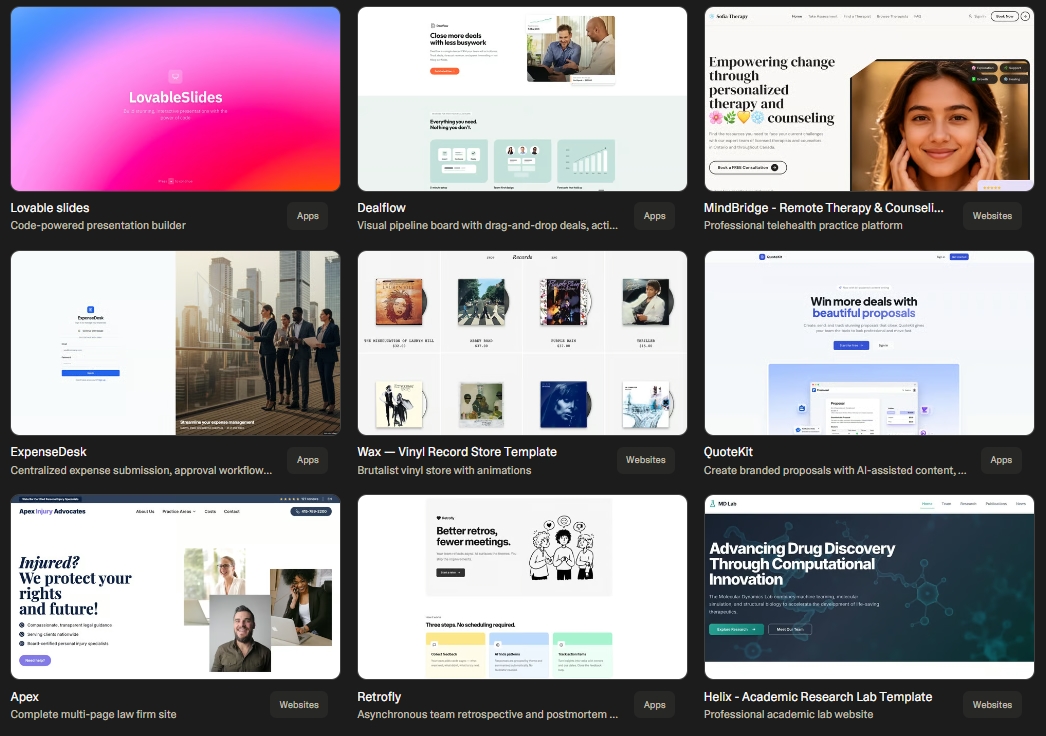
The template gallery provides starting points for common application types: SaaS starter with auth and billing, marketplace with listings and bookings, admin dashboard with charts and tables, CRM with contacts and deals, blog with MDX content, documentation site, landing page with waitlist. Each template is a complete Lovable project you can clone, customize, and deploy. Templates are maintained by the team and updated when major platform changes occur.
Comparison with Bolt, v0, Replit, Cursor
Bolt.new focuses on rapid prototyping in the browser with a similar chat interface. It excels at quick frontend experiments and visual iterations. However, Bolt does not manage a persistent backend — no database, no auth, no payments. You can connect external services manually, but the AI does not orchestrate them. Bolt is better for "show me a dashboard design" while Lovable is better for "build a dashboard that real users can log into."
v0 by Vercel generates React components from text or images. It produces beautiful, accessible UI code using shadcn/ui and Tailwind. Like Bolt, it stops at the frontend. You copy the components into your own project. v0 is excellent for design system work and component libraries. It does not build full applications with backends. Many developers use v0 for UI pieces and Lovable for the application shell.
Replit is a full cloud IDE with AI assistance. You write code, run servers, manage databases, and deploy — all in the browser. The Replit Agent can build complete applications from prompts. The difference is philosophical: Replit assumes you want to write and understand code. Lovable assumes you want to describe outcomes and let the AI handle implementation. Replit gives you a terminal and file tree. Lovable gives you a chat and a preview. Both produce deployable code.
Cursor is an AI-enhanced code editor (VS Code fork). It shines when you are already writing code and want inline completion, refactoring, and chat-based editing within your IDE. Cursor does not scaffold projects, manage infrastructure, or deploy. It is a developer tool, not an application builder. A common workflow: use Lovable to generate the initial project and infrastructure, then open the exported code in Cursor for custom business logic.
Scroll horizontally to see all columns
| Tool | Backend Management | Deployment | Code Ownership | Best For |
|---|---|---|---|---|
| Lovable | Full (DB, Auth, Payments) | Built-in + Custom Domain | Complete Export | Full-Stack Apps |
| Bolt.new | None (External Only) | Netlify/Vercel Preview | Complete Export | Frontend Prototypes |
| v0 | None | Copy Components Only | Component Code | UI Components |
| Replit Agent | Full (Built-in Services) | Replit Hosting | Complete Export | Code-Centric Devs |
| Cursor | None (Your Infra) | None (Your Infra) | Your Codebase | IDE Enhancement |
Limitations and Honest Constraints
The daily message limit on the free tier (50 messages) can feel restrictive during intensive building sessions. A complex feature — "build a real-time collaborative editor with conflict resolution" — might consume 20-30 messages in back-and-forth refinement. Pro users get 500 daily, which is rarely a bottleneck. Business and Enterprise tiers scale further. If you hit the limit, you can continue working in the exported code locally and sync back later.
The AI occasionally generates code that does not compile or introduces runtime errors. TypeScript catches most issues before preview, but logic errors — wrong query filters, incorrect Stripe webhook handling, missing loading states — require manual fixes. The diff view before applying changes helps catch obvious problems, but you still need to test the preview. This is not a "press button, get perfect app" system. It is a "press button, get 85% complete app, fix the rest" system.
Complex custom logic — algorithmic trading engines, real-time multiplayer game servers, specialized data processing pipelines — exceeds what the AI can reliably generate. You can still use Lovable for the application shell (auth, dashboard, settings, billing) and write the complex modules yourself in the exported code. The platform does not prevent you from adding arbitrary complexity; it just does not generate it for you.
Vendor lock-in concerns are minimal but not zero. Your code is standard React/TypeScript/Vite. Your database is standard PostgreSQL on Supabase. Your payments are standard Stripe. Your auth is standard Supabase Auth. You can eject at any time. The only proprietary piece is the chat history and the AI's understanding of your project context. If you leave Lovable, you lose the conversational development workflow but keep everything else.
Getting Started: First Project in 15 Minutes
Create an account at lovable.dev using GitHub, Google, or email. The dashboard shows your projects and a "New Project" button. Click it, choose "Start from Scratch" or pick a template. The chat opens with a welcome message. Type your first prompt: "Build a personal task manager with projects, tasks, due dates, and priority levels. I want to mark tasks complete and filter by project." Press Enter.
Watch the AI work. It creates the project structure, writes the database migration for projects and tasks tables with foreign keys and RLS policies, builds the React components for the project sidebar, task list, task form, and filter controls, configures the Supabase client, and deploys a preview. Within two minutes you have a working URL. Click it. Create a project. Add tasks. Mark them complete. Filter by project. It works.
Now iterate. Type: "Add drag-and-drop reordering for tasks within a project." The AI installs @dnd-kit, updates the task list component, adds the reorder mutation, and updates the database. Type: "Add user authentication so only I can see my tasks." It enables Supabase Auth, builds login/signup pages, protects the routes, and updates RLS policies. Type: "Deploy to my custom domain tasks.example.com." Add the domain in settings, configure DNS, done.
Push to GitHub. Click the GitHub icon, authorize, choose a repository name. The code appears in your GitHub account with a clean commit history. Clone it locally. Open in VS Code. Run npm install && npm run dev. The local dev server starts. Make a manual change — add a dark mode toggle. Commit and push. Return to Lovable. The chat reflects your external change. Continue building.
Frequently Asked Questions
Do I need to know how to code to use Lovable?
No. You can build complete applications using only natural language. However, understanding basic concepts — databases, APIs, frontend vs backend — helps you give better instructions and troubleshoot when the AI makes mistakes.
Can I use my own Supabase and Stripe accounts?
Yes. Lovable can connect to your existing Supabase project and Stripe account. You provide the API keys in the project settings. This gives you full control over your data and billing relationships.
What happens if I cancel my paid subscription?
Your projects remain accessible. You lose the higher message limits, custom domains, and team features. Your deployed applications continue running on the lovable.app subdomain. You can still export code and push to GitHub.
Does Lovable work for mobile apps?
Not directly. Lovable builds responsive web applications. You can wrap the web app in Capacitor or use it as a PWA, but there is no native React Native or Expo code generation. For mobile-first products, consider using Lovable for the admin dashboard and web version, then building the mobile app separately.
How does Lovable handle database migrations safely?
Every schema change generates a migration file that you can review before applying. The AI writes reversible migrations using Supabase's migration system. You can also connect an existing Supabase project with its own migration history.
Can multiple people work on the same Lovable project?
Yes, on Business and Enterprise plans. Team members can chat with the AI simultaneously, see each other's changes in real time, and manage permissions. Free and Pro plans are single-user only.
Is the generated code production-ready?
The code follows modern best practices and passes TypeScript compilation. However, you should review security-sensitive areas — RLS policies, Stripe webhook verification, authentication flows — before launching a public application. Treat it as a senior developer's first draft, not a final audit.
Final Assessment of Lovable AI Builder
Lovable occupies a distinct position in the AI development landscape. It is not a toy for demos, nor a replacement for engineering teams. It is a force multiplier for people who know what they want to build but lack the time or expertise to assemble the full stack manually. The combination of conversational development, real backend infrastructure, standard code export, and zero lock-in makes it practical for real products — not just prototypes.
The free tier is generous enough to validate the workflow on a real project. Spend a weekend building something you actually need. If the daily message limit becomes a constraint, the Pro tier at $20/month removes it. If you are building for a client or a startup, the Business tier adds team collaboration. The pricing scales with value delivered, not with artificial feature gates.
The main risk is over-reliance on the AI for architectural decisions. Lovable makes sensible defaults — React Query for data, Zod for validation, Supabase for backend — but it does not know your specific scaling requirements, compliance needs, or long-term maintenance constraints. Use it to accelerate the 80% of work that is standard boilerplate. Invest your own judgment in the 20% that defines your product.
Lovable does not eliminate the need for technical judgment. It eliminates the excuse for not starting.