

AI Development Tools
Lovable Agencies: Building Client Projects with AI App Development
A practical look at Lovable for agency workflows, pricing, security, and real-world usage patterns.


Senior Software Developer & Trading Technology Specialist
Ethan Parker is a software developer with over 8 years of experience in building web applications, trading tools, and financial technology solutions. He specializes in Python, JavaScript, API integrations, and trading automation, helping traders improve efficiency through innovative technology.
Agencies building software for clients face a constant tension: deliver quality fast enough to stay profitable, but not so fast that technical debt piles up. Lovable enters this space as an AI app builder that promises to turn natural language descriptions into working React applications with Supabase backends, GitHub integration, and deployment built in. For agencies, the question isn't whether the demo looks impressive — it's whether the tool fits into real client workflows, handles revision cycles, and produces code that can be maintained after the engagement ends.
Contents
- 1. What Lovable Agencies Means for Client Work
- 2. Speed and Iteration with AI-Assisted Development
- 3. Team Collaboration Features for Agencies
- 4. Pricing Considerations for Agency Use
- 5. Security and Compliance for Client Projects
- 6. Integrations That Matter for Agency Workflows
- 7. Templates and Starting Points for Common Projects
- 8. Real Agency Use Cases and Patterns
- 9. Limitations and Considerations
- 10. Final Assessment of Lovable for Agencies
The platform targets a range of users from non-technical founders to senior developers, but agencies sit in a unique position. They need to move quickly during discovery and prototyping, then hand off clean codebases that client teams can actually run. Lovable's approach — generating TypeScript, React, and Tailwind CSS on top of Vite — means the output isn't locked into a proprietary runtime. That matters when a client's internal engineering team needs to take over.
This article examines how Lovable fits into agency workflows, where it saves time, where it creates new friction, and what the pricing and security model looks like when you're billing clients for the work.
What Lovable Agencies Means for Client Work
Lovable doesn't have a separate "agency plan" in the traditional sense. Instead, the platform's team features, project sharing, and GitHub synchronization are the mechanisms agencies rely on. You create a project, invite team members, and everyone works against the same codebase with the AI assistant. The generated code lives in a GitHub repository the agency owns, which means version control, branching, and code review work the way developers expect.
For client-facing work, this translates to a few concrete advantages. Discovery phases shrink because you can show a working prototype in the first meeting instead of static wireframes. Revision cycles compress because the AI can implement design changes across multiple files in seconds. And handoff becomes a GitHub transfer rather than a zip file of mysterious generated code.
- Prototypes that run in the browser, not Figma
- Client stakeholders can click through flows during review sessions
- Code ownership stays with the agency or client via GitHub
- No vendor lock-in — the stack is standard React, TypeScript, Tailwind, Vite
- Supabase integration means auth, database, and edge functions ship together
The trade-off is that Lovable's AI works best when the problem space is well-understood. Complex domain logic, unusual integration requirements, or highly customized design systems still need human developers. Agencies that treat it as a replacement for engineering judgment will hit walls. Agencies that treat it as a force multiplier for their existing team will see real gains.
The partner program adds another layer. Agencies can apply for partner status, which unlocks priority support, co-marketing opportunities, and a revenue share on client subscriptions they bring in. For shops that standardize on Lovable for certain project types, the partner tier makes the economics more attractive.
Speed and Iteration with AI-Assisted Development
The core promise is speed. You describe a feature — "add a dashboard with user analytics, filterable by date range, exportable to CSV" — and Lovable generates the components, hooks, API routes, and database migrations. What used to take a day or two of scaffolding now takes minutes. But the iteration loop is where agencies actually win or lose time.
When a client asks for changes — "make the date picker a range selector instead of single date, add a loading state, move the export button to the header" — you type the request and watch the diff. The AI modifies multiple files simultaneously: the component, the types, the query logic, the styles. A senior developer reviews, commits, pushes. The client sees the update on the preview deployment within minutes.
The preview deployment model is worth understanding. Every push to GitHub triggers a new preview URL. Clients don't need to pull code locally or run Docker. They click a link, test the feature, leave feedback in a shared channel, and the cycle repeats. This alone eliminates entire categories of "it works on my machine" friction.
Team Collaboration Features for Agencies
Lovable's team model supports multiple seats per organization. Team members can be assigned to projects with different permission levels. The AI chat history is shared across the team, so context doesn't live in one person's browser session. When a developer picks up a project mid-sprint, they see the full conversation that produced the current codebase.
For agencies juggling multiple clients, project isolation matters. Each client engagement gets its own Lovable project, its own GitHub repo, its own Supabase project. There's no cross-contamination of code, secrets, or chat history. Billing rolls up to the organization level, which simplifies invoicing.
Scroll horizontally to see all columns
| Feature | Description |
|---|---|
| Shared AI Chat History | Full conversation context visible to all team members |
| Project-Level Permissions | Control who can edit, view, or deploy per project |
| GitHub Sync | Bidirectional sync — edit in Lovable or locally, changes merge |
| Preview Deployments | Automatic preview URLs on every push for client review |
| Organization Billing | Single invoice for all team seats and usage |
GitHub synchronization deserves emphasis. It's not a one-way export. You can open the repo in VS Code, make changes, push, and Lovable pulls them in. The AI assistant sees the updated codebase and continues from there. This bidirectional flow means agencies aren't forced to choose between "AI mode" and "manual mode" — they blend continuously.
Pricing Considerations for Agency Use
Lovable uses a credit-based model. The Free tier includes 50 credits monthly — enough for exploration but not production work. Pro at $25/month gives 250 credits. Business at $100/month provides 1,250 credits and adds team features. Enterprise is custom-priced with SSO, audit logs, and dedicated support. Credits consume based on AI request complexity, not time.
For an agency, the math centers on credit consumption per project. A typical CRUD application with auth, dashboard, and a few custom features might burn 100-300 credits during active development. Maintenance and minor iterations after launch are minimal. The Business tier covers roughly four to twelve active projects per month depending on complexity.
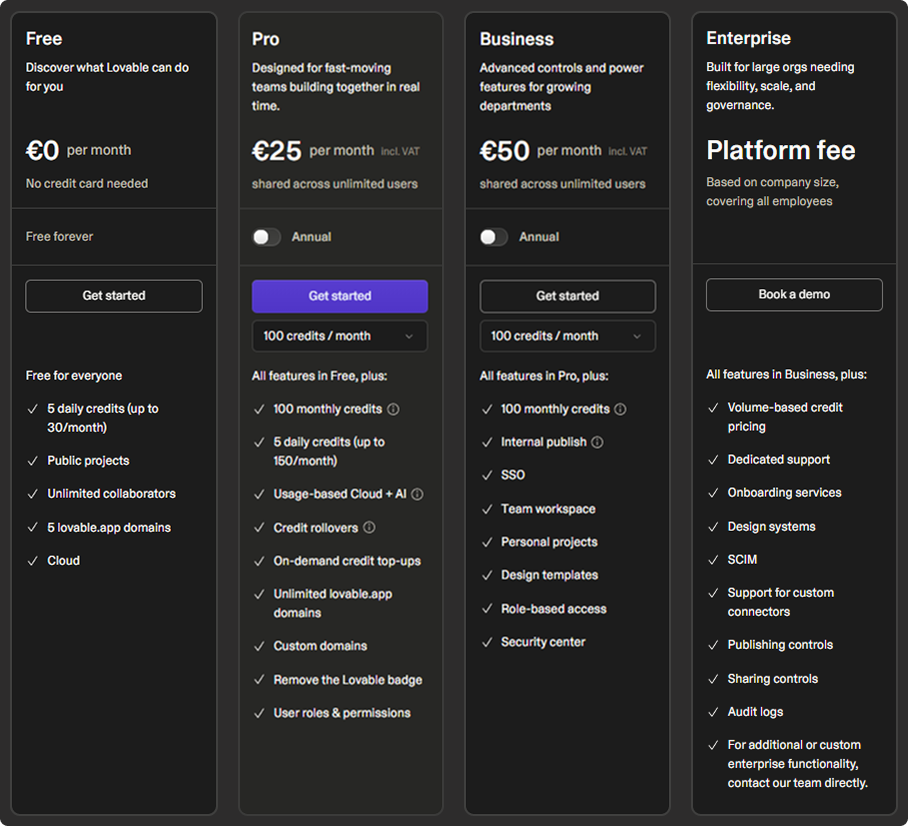
Agencies should factor Lovable credits into project estimates the same way they factor hosting or third-party API costs. Some shops pass credits through as a line item; others bake them into the rate. Either way, the cost is predictable — there are no per-seat overages or surprise usage spikes unless the team prompts the AI excessively without reviewing output.
Security and Compliance for Client Projects
Agencies handling client data need to know where code runs and how secrets are managed. Lovable projects deploy to Vercel by default, with Supabase handling the backend. Both are SOC 2 Type II certified. The generated code includes environment variable management for API keys, database URLs, and authentication secrets — nothing hardcoded.
For clients with stricter requirements — HIPAA, GDPR, FedRAMP — the Enterprise tier adds audit logging, SSO via SAML/OIDC, and the option to deploy to private infrastructure. The code itself is standard Next.js-compatible React, so it can run anywhere Node.js runs. Agencies can extract the repo and deploy to AWS, GCP, Azure, or on-premises without platform dependency.

Data residency is handled at the Supabase level. Agencies choose the region when provisioning the Supabase project — US East, US West, EU West, APAC. Lovable doesn't store database contents or user data; it only manages the code generation layer. This separation matters when clients ask where their data physically resides.
Integrations That Matter for Agency Workflows
The integration ecosystem determines whether Lovable fits into an agency's existing toolchain or creates a parallel workflow. The core integrations — GitHub, Supabase, Vercel, Stripe, Figma — cover the majority of modern web application needs. Each works through standard OAuth or API keys configured once per organization.
- GitHub: bidirectional sync, PR previews, branch protection rules
- Supabase: auto-provisioned projects, migrations generated from schema changes
- Vercel: preview and production deployments, environment variable sync
- Stripe: pre-built checkout, subscription management, webhook handlers
- Figma: design token import, component mapping (beta)
- Custom REST/GraphQL: AI can generate typed clients from OpenAPI specs
The Figma integration is worth a caveat. It imports design tokens and can map components, but it doesn't replace a designer-developer handoff process. Agencies with mature design systems will still need developers to reconcile the AI's output with the system's constraints. It's a starting point, not a complete bridge.
Templates and Starting Points for Common Projects
Lovable includes a template gallery covering SaaS dashboards, e-commerce storefronts, landing pages, CRM interfaces, and internal tools. Agencies can also create private templates from completed projects — strip client-specific logic, keep the architecture, and reuse the scaffold for similar engagements.
This template approach compounds over time. An agency that builds three B2B dashboards in a year ends up with a refined starter that includes their preferred auth pattern, error handling conventions, logging setup, and component library. The AI then works from that baseline instead of the generic default.

The Discover section surfaces community-published apps with source code visible. Agencies can fork these as learning references or starting points. Quality varies — some are polished reference implementations, others are experimental prototypes. Treat them as code reviews, not production-ready foundations.
Real Agency Use Cases and Patterns
Three patterns emerge consistently across agencies using Lovable in production. First: rapid prototyping for pitch work. A prospect describes a concept; the agency builds a clickable prototype in hours, not days. The prototype becomes the proposal artifact. Win the deal, and the same codebase evolves into the MVP.
Second: internal tooling for clients. Admin panels, reporting dashboards, content management interfaces — the CRUD-heavy applications that clients need but can't justify custom development budgets for. Lovable's admin panel patterns and Supabase auth make these viable at a fraction of traditional cost.
Third: MVP development for early-stage founders who are agency clients. The founder has domain expertise but no technical co-founder. The agency uses Lovable to ship v1 in weeks, then either hands off to the founder's future hires or stays on for iteration. The GitHub repo is the handoff artifact — clean, documented, standard stack.
The agencies winning with this tool aren't replacing developers. They're letting seniors focus on architecture and domain logic while the AI handles the boilerplate that used to consume half the sprint.
Limitations and Considerations
Lovable isn't a fit for every project. Highly customized design systems with complex component libraries fight against the AI's Tailwind-first output. Real-time collaborative features (multiplayer editing, presence, conflict resolution) require manual implementation — the AI doesn't generate WebSocket infrastructure well. Mobile-first responsive designs with intricate breakpoint behaviors need developer oversight.
Performance tuning is another area where the AI produces acceptable defaults but not optimized code. Bundle size, query optimization, caching strategies, and Core Web Vitals improvements still require a developer who understands the generated output. Agencies should budget time for a performance pass before production launch.
- Complex design systems: expect manual component reconciliation
- Real-time features: WebSocket infrastructure needs custom work
- Mobile responsiveness: AI defaults work, edge cases need review
- Performance: budget for optimization sprint before launch
- Legacy integration: SOAP, older APIs need manual adapters
- Offline-first: service worker logic not generated
Final Assessment of Lovable for Agencies
Lovable changes the economics of certain agency engagements. The projects that benefit most are those where the backend is standard (PostgreSQL, auth, REST APIs), the frontend follows predictable patterns (dashboards, forms, lists, detail views), and the value lies in domain modeling and UX — not in novel technical architecture. For these projects, the platform compresses the timeline from weeks to days without sacrificing code ownership or deployability.
The agencies that integrate it successfully treat it as a team member with specific strengths: infinite patience for boilerplate, instant recall of Supabase patterns, zero ego about rewrites. They don't ask it to make architectural decisions. They don't ship its output without review. And they build their own template library on top of it so each project starts further ahead than the last.
Pricing is reasonable for the value if you have consistent volume. The Business tier at $100/month covers a small team's active projects. Enterprise makes sense when clients demand SSO, audit logs, or private deployment. The partner program adds margin for shops that standardize. But the real ROI isn't the subscription cost — it's the projects you can now bid profitably that you'd have passed on before.
Frequently Asked Questions
Can multiple agency developers work on the same Lovable project simultaneously?
Yes. Team members share the AI chat history and can prompt changes. GitHub sync handles merge conflicts the same way as any collaborative repo — pull, resolve, push.
Who owns the code generated by Lovable for a client project?
The agency or client owns the code. It lives in a GitHub repository you control. Lovable claims no IP rights over generated output.
What happens if a client wants to leave Lovable after the project launches?
The codebase is standard React, TypeScript, Tailwind, and Vite with a Supabase backend. It runs anywhere Node.js runs. No ejection process needed — just deploy the repo to your preferred infrastructure.
How does Lovable handle environment variables and secrets for client projects?
Environment variables are managed through Vercel and Supabase dashboards. Lovable generates the code that reads them but never stores secret values. Each client project gets its own Supabase project and Vercel deployment.
Can agencies use their own design system with Lovable?
Partially. You can import design tokens from Figma and create private templates with your component patterns. However, the AI generates Tailwind utility classes by default. Custom component library integration requires manual setup and ongoing reconciliation.
What support options exist for agencies on the Business tier?
Business tier includes priority email support and access to the partner community. Enterprise adds dedicated Slack channel, SLA-backed response times, and implementation assistance for complex migrations.
How do credits work when multiple team members prompt the AI?
Credits pool at the organization level. Any team member's AI requests consume from the shared balance. The dashboard shows usage per project and per team member for accountability.