

Software Development
Lovable Australia: AI App Builder for Australian Developers
A practical look at Lovable's features, pricing, and real-world use cases for the Australian market.

Senior Software Developer & Trading Technology Specialist
Ethan Parker is a software developer with over 8 years of experience in building web applications, trading tools, and financial technology solutions. He specializes in Python, JavaScript, API integrations, and trading automation, helping traders improve efficiency through innovative technology.
Australian developers and founders have been watching the AI app builder space closely. Lovable entered the conversation with a clear promise: describe what you want in plain English, get a working React application with Supabase backend, TypeScript, and Tailwind CSS. The platform generates real code you can push to GitHub, deploy to Vercel, and iterate on without vendor lock-in. For teams in Sydney, Melbourne, Brisbane, and beyond, that pitch hits differently than the usual no-code walled gardens.
Contents
- 1. How Lovable Works for Australian Teams
- 2. Pricing in Australian Dollars
- 3. Supabase Integration and Data Residency
- 4. Authentication and User Management
- 5. GitHub Workflow and Code Ownership
- 6. Templates and Starter Kits
- 7. Stripe Integration for Australian Payments
- 8. Security Posture and Compliance
- 9. Figma Integration for Design Handoff
- 10. AI Models and Generation Quality
- 11. Team Collaboration Features
- 12. Deployment and Hosting Reality
- 13. Custom Domains and SSL
- 14. Limitations and Gaps
- 15. Australian Startup Case Patterns
- 16. Comparison with Alternatives
- 17. Community and Support Channels
- 18. Learning Curve and Onboarding
- 19. Enterprise Readiness Assessment
- 20. Future Roadmap Considerations
- 21. Final Assessment of Lovable Australia
The local context matters. Australian startups often operate with smaller teams, tighter budgets, and a need to move fast across time zones. Lovable's approach — generating standard React codebases rather than proprietary formats — means Australian developers can hire locally, use familiar tooling, and avoid the platform risk that comes with traditional no-code solutions. The platform also integrates directly with Supabase, which has strong adoption in the Australian developer community.
This article breaks down what Lovable actually delivers for Australian users: the core workflow, pricing in local context, integration reality, security posture, and where the platform still falls short. No marketing fluff — just what you need to know before committing credits or budget.
How Lovable Works for Australian Teams
The core loop is straightforward. You describe a feature or application in the chat interface. Lovable generates the React components, sets up the Supabase database schema, configures authentication, and wires up the API layer. You preview the result in a built-in browser, request changes through follow-up prompts, and when satisfied, push to GitHub. From there, standard CI/CD takes over. The generated code uses Vite, React 18, TypeScript, Tailwind CSS, and React Router — all standard choices in the Australian market.
What distinguishes this from other AI coding assistants is the full-stack awareness. Lovable doesn't just write frontend components; it creates database migrations, Row Level Security policies, Edge Functions, and authentication flows. For a solo founder in Perth building a SaaS MVP, this means going from idea to deployed application with user auth and data persistence in hours rather than weeks. The platform handles the Supabase project provisioning automatically, which removes a common friction point.
The chat history serves as a living specification. Each prompt becomes a commit-like entry you can reference, revert, or branch from. This is particularly valuable for Australian teams working asynchronously across time zones — a developer in Adelaide can pick up where a colleague in Sydney left off, with full context preserved in the conversation thread.
Pricing in Australian Dollars
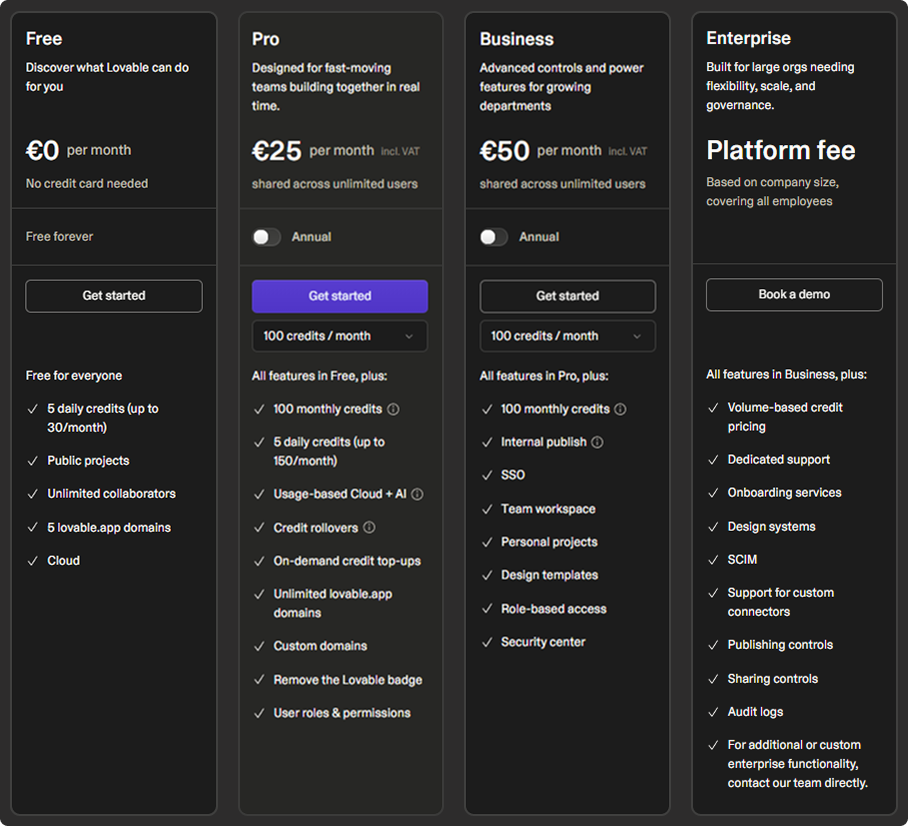
Lovable prices in USD, which means Australian users face currency conversion and potential foreign transaction fees depending on their payment method. The Free tier includes 5 credits per day with a 30-credit monthly cap — enough for light experimentation but not sustained development. The Starter plan at $20 USD monthly (roughly $30-32 AUD) provides 100 credits monthly. Launch at $50 USD (~$75-80 AUD) gives 250 credits. Scale at $100 USD (~$150-160 AUD) provides 500 credits. Enterprise pricing requires a sales conversation.
Credit consumption varies significantly by task complexity. A simple landing page might cost 3-5 credits. A multi-page application with authentication, database schema, and several API endpoints can consume 20-50 credits in a single session. Australian teams should budget accordingly — a two-person startup building a serious MVP over a month will likely need the Launch tier at minimum. The platform does not currently offer Australian dollar billing or local payment methods like BPAY.
Scroll horizontally to see all columns
| Tier | Monthly Cost (USD) | Estimated AUD | Monthly Credits | Best For |
|---|---|---|---|---|
| Free | $0 | $0 | 30 (daily cap) | Learning and prototypes |
| Starter | $20 | $30-32 | 100 | Solo founders, small MVPs |
| Launch | $50 | $75-80 | 250 | Active development, small teams |
| Scale | $100 | $150-160 | 500 | Production apps, growing teams |
| Enterprise | Custom | Custom | Unlimited | Large orgs, compliance needs |
Supabase Integration and Data Residency
Lovable provisions Supabase projects automatically in AWS regions. As of writing, Supabase offers regions in Sydney (ap-southeast-2), Singapore, Tokyo, Frankfurt, and US East/West. For Australian applications handling local user data, selecting the Sydney region keeps data onshore — important for privacy compliance and latency. Lovable's interface lets you choose the region during project creation, though the default may not be Sydney.
The integration goes beyond provisioning. Lovable generates Supabase migrations for every schema change, configures Row Level Security policies based on your auth requirements, and creates Edge Functions for server-side logic. You can open the Supabase dashboard directly from Lovable to inspect tables, run SQL, configure storage, or adjust auth providers. This two-way link means Australian teams aren't locked into Lovable's abstraction — they can drop to raw SQL or Supabase CLI when needed.
The Supabase integration is where Lovable earns its keep for serious projects. You get the speed of AI generation with the escape hatch of a real Postgres database.
Authentication and User Management
Lovable supports the full Supabase Auth suite: email/password, magic links, OAuth providers (Google, GitHub, Microsoft, Apple, and more), phone auth, and SAML for Enterprise tiers. For Australian B2B applications, the Microsoft Entra ID (Azure AD) integration is particularly relevant — many local enterprises use the Microsoft ecosystem. The platform generates the auth UI components, protected routes, and session management automatically.
Row Level Security policies are created based on your natural language descriptions. Tell Lovable "users can only see their own projects" and it writes the corresponding RLS policy. This is a significant time saver, though complex multi-tenant scenarios still require manual review. Australian teams building multi-tenant SaaS should budget time to audit generated policies against their specific data isolation requirements.
GitHub Workflow and Code Ownership
Every Lovable project connects to a GitHub repository. The platform pushes commits on your behalf, maintaining a clean history with descriptive messages. You own the repository completely — there's no platform lock-in. If Lovable disappeared tomorrow, your codebase remains fully functional, deployable, and maintainable with standard React tooling. This is a fundamental difference from platforms like Bubble or Webflow where the generated artifact is tied to the platform.
The GitHub integration supports branch management. You can create feature branches in Lovable, work on isolated changes, and merge back to main. For Australian teams using trunk-based development or GitFlow, this fits existing workflows. The platform also respects .gitignore, README, and other repository conventions. One limitation: Lovable doesn't currently support GitLab or Bitbucket, which some Australian enterprises prefer.
Code review workflows work naturally. Since Lovable pushes standard commits, your existing CI/CD pipelines — GitHub Actions, Vercel preview deployments, code quality checks — run without modification. Australian teams with established engineering practices won't need to rewrite their deployment infrastructure.
Templates and Starter Kits
Lovable provides a template library covering common application patterns: SaaS dashboards, e-commerce stores, CRM systems, landing pages, internal tools, and mobile-responsive web apps. Each template includes a pre-configured Supabase schema, authentication setup, and core UI components. For Australian founders, the SaaS template with Stripe integration is particularly relevant — it handles subscription billing, customer portal, and webhook configuration out of the box.
Templates are not rigid starting points. You can install a template, then use chat to modify any aspect — add fields, change layouts, integrate additional APIs. The template simply provides a structured foundation rather than a blank slate. Community templates are also available, though quality varies. The platform doesn't yet have a formal template marketplace with ratings or verified publishers.
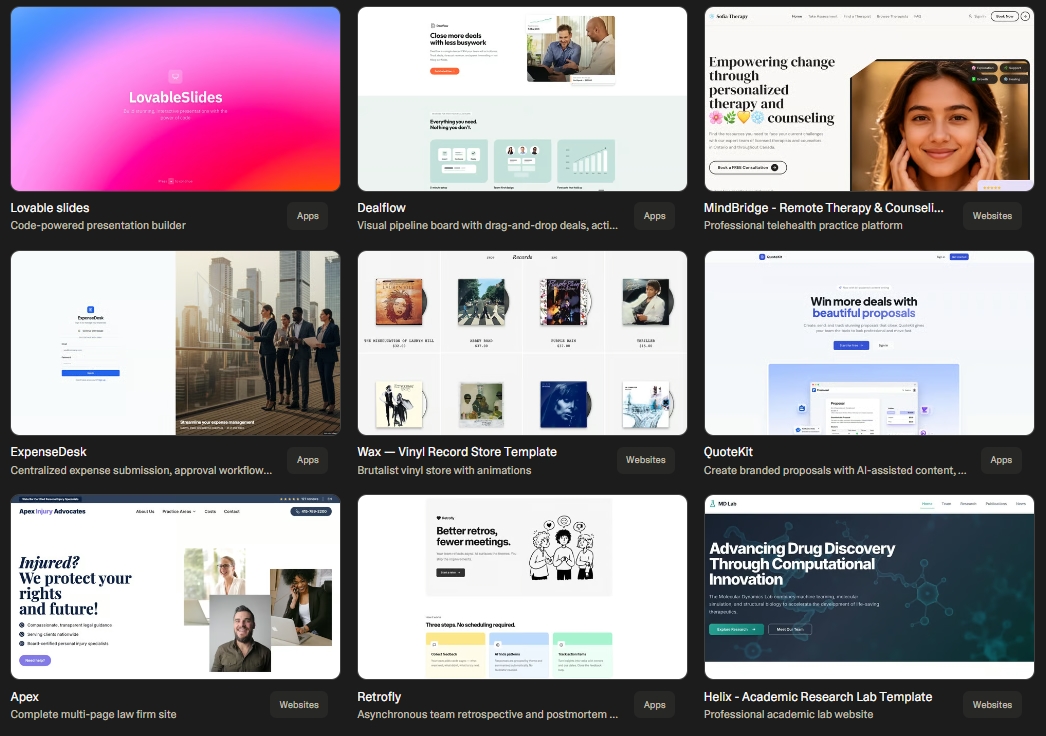
For teams building internal tools — a common use case in Australian mining, logistics, and financial services — the admin panel and dashboard templates provide CRUD interfaces, role-based access, and data visualization components. These can be customized to connect to existing APIs or databases via Supabase Edge Functions.
Stripe Integration for Australian Payments
Lovable's Stripe integration supports the full Stripe catalog: one-time payments, subscriptions, usage-based billing, and Stripe Connect for marketplaces. For Australian businesses, Stripe supports local payment methods including BPAY (via PaymentIntents), direct debit via BECS, and standard card networks. The generated code includes checkout sessions, customer portal, webhook handlers for subscription events, and server-side verification using Supabase Edge Functions.
GST handling requires attention. Stripe doesn't automatically calculate Australian GST — you need to configure tax behavior in the Stripe dashboard or implement custom tax logic in Edge Functions. Lovable generates the integration scaffolding but doesn't automate tax compliance. Australian SaaS founders should plan to spend time on this regardless of the platform.
Security Posture and Compliance
Lovable itself is SOC 2 Type II certified. The platform runs on AWS with data encryption at rest and in transit. For Australian users, the critical compliance layer is Supabase — your application data lives in Supabase projects, not Lovable's infrastructure. Supabase is also SOC 2 Type II certified and offers HIPAA-compliant configurations on dedicated plans. Neither platform currently holds ISO 27001 certification or Australian IRAP assessment.
For Australian government contracts or regulated industries (finance, healthcare, critical infrastructure), the lack of IRAP assessment and onshore data sovereignty guarantees may be a blocker. Enterprise tier conversations can address dedicated infrastructure options, but standard tiers run on shared multi-tenant infrastructure in AWS regions. Teams with strict compliance requirements should engage Lovable's enterprise sales early to understand the roadmap.

Application-level security depends largely on generated code quality. Lovable creates Row Level Security policies, implements authentication correctly, and follows React security best practices (XSS protection via React's escaping, CSRF protection via SameSite cookies). However, the platform cannot guarantee business logic security — authorization flaws, data validation gaps, and API abuse vectors still require human review. Australian teams should treat generated code as a first draft requiring security audit.
Figma Integration for Design Handoff
Lovable can import Figma designs and generate corresponding React components with Tailwind CSS. The workflow: select frames in Figma, copy as SVG or use the Lovable Figma plugin, paste into Lovable chat with a prompt like "build this as a responsive landing page." The platform extracts layout, colors, typography, and spacing, then produces functional components. For Australian agencies and product teams with dedicated designers, this reduces the design-to-code iteration cycle significantly.
The integration has limits. Complex interactions, animations, and responsive breakpoints often need manual refinement. Figma's auto-layout maps reasonably to Flexbox/Grid, but absolute positioning and custom effects don't translate cleanly. Australian design systems using custom design tokens will need those tokens mapped to Tailwind config manually. The plugin is useful for initial scaffolding, not pixel-perfect production handoff.
AI Models and Generation Quality
Lovable uses a combination of Claude 3.5 Sonnet and GPT-4o for code generation, with a proprietary orchestration layer that manages context, file operations, and Supabase integration. The model selection is not user-configurable. Generation quality is generally high for standard CRUD applications, authentication flows, and common UI patterns. It struggles with complex algorithmic logic, real-time synchronization, WebSocket implementations, and highly customized design systems.
Context window management matters for larger projects. Lovable maintains a working context of your codebase, but very large applications (50+ files) can exceed effective context limits, leading to inconsistencies. The platform mitigates this with file-level targeting — you can ask for changes to specific components — but architectural refactoring across many files remains challenging. Australian teams building complex applications should plan for manual architecture work alongside AI generation.
Lovable excels at the 80% of application code that follows patterns. The remaining 20% — business logic, edge cases, performance optimization — still needs a developer.
Team Collaboration Features
The Launch and Scale tiers support team workspaces with role-based access (owner, admin, member). Team members share credits from a pooled balance. Collaboration happens through the shared chat history — anyone in the workspace can continue a conversation, request changes, or branch from previous states. There's no real-time multiplayer editing (like Figma's multiplayer), but the async model works well for distributed Australian teams.
Enterprise tier adds SSO (SAML/OIDC), audit logs, and dedicated support. For Australian companies with existing identity providers (Okta, Azure AD, Auth0), the SSO integration simplifies onboarding and offboarding. Audit logs track who made what changes when — valuable for compliance but only available at Enterprise pricing. The platform doesn't currently offer granular permissions like "can generate code but not push to GitHub" or "can view but not modify production projects."
Deployment and Hosting Reality
Lovable doesn't host your application. It generates code configured for Vercel deployment with zero-config setup — connect your GitHub repository to Vercel, and deployments happen automatically on push. The platform also supports Netlify, Cloudflare Pages, and any static hosting that serves a Vite-built React app. For Australian users, Vercel's Sydney edge region (syd1) provides low-latency serving to local users.
Supabase hosting is separate. Your database, auth, storage, and Edge Functions run on Supabase's infrastructure in your chosen region. The Sydney region (ap-southeast-2) keeps data and compute onshore. Latency between Vercel Sydney and Supabase Sydney is typically under 5ms. For applications serving Australian users primarily, this architecture performs well. Global applications may need multi-region strategies that neither platform automates fully.
Custom Domains and SSL
Custom domains are configured at the hosting layer (Vercel, Netlify, etc.), not in Lovable. The generated code includes no platform-specific domain logic. Australian domains (.com.au, .net.au, .org.au) work identically to global TLDs. SSL provisioning is automatic via Let's Encrypt on Vercel/Netlify. For Enterprise customers requiring custom SSL certificates or advanced DNS configurations, those are handled at the hosting provider level.
One practical note: Australian domain registration requires an ABN/ACN for .com.au and .net.au domains. This is unrelated to Lovable but affects deployment timelines for new Australian ventures. Factor 1-2 business days for domain eligibility verification if registering a new .au domain.
Limitations and Gaps
Lovable is not a complete replacement for senior engineering judgment. The platform cannot: design database indexes for query performance, implement complex caching strategies, handle background job processing (no native queue system), manage database migrations in production with zero-downtime guarantees, or provide observability tooling (logging, metrics, tracing) beyond what Supabase and Vercel offer natively.
Mobile development is limited to responsive web applications. Lovable does not generate React Native code, Capacitor configurations, or native mobile builds. Australian teams needing iOS/Android apps will need separate mobile development — though the Supabase backend and API layer are reusable. The platform also lacks native support for server-side rendering (Next.js) or static site generation (Astro), though the generated React code can be migrated to those frameworks manually.
Debugging AI-generated code presents unique challenges. When something breaks, the stack trace points to code you didn't write. Lovable provides a "view generated code" panel and GitHub diff view, but there's no integrated debugger. Australian developers should be comfortable reading React, TypeScript, and Supabase SQL to effectively troubleshoot.
Scroll horizontally to see all columns
| Capability | Support Level | Notes |
|---|---|---|
| React + TypeScript + Tailwind | Native | Primary output format |
| Supabase Postgres + Auth + Storage | Native | Auto-provisioned |
| Stripe Payments + Subscriptions | Native | Template + chat generation |
| GitHub Integration | Native | Bidirectional sync |
| Figma Import | Beta | Layout extraction only |
| React Native / Mobile | Not Supported | Web-only output |
| Next.js / SSR | Not Supported | Client-side React only |
| Background Jobs / Queues | Not Supported | Requires custom Edge Functions |
| Real-time (WebSockets) | Partial | Via Supabase Realtime only |
| Multi-region Deployment | Manual | Not automated |
Australian Startup Case Patterns
Early Australian adopters fall into recognizable patterns. Solo founders use Lovable to build and launch SaaS MVPs in 2-4 weeks, validating demand before hiring. Agencies use it to accelerate client deliverables — internal tools, marketing sites, and prototype applications — billing the time savings. Product managers at funded startups use it for rapid prototyping and internal tooling, reducing dependency on engineering sprint cycles. Non-technical founders in accelerator programs (Startmate, Antler, Fishburners) use it to build demonstrable products without technical co-founders.
A Sydney-based fintech startup used Lovable to build their customer dashboard and admin panel in three weeks, connecting to an existing Node.js API via Supabase Edge Functions. A Melbourne agency delivered a custom CRM for a logistics client in half the estimated hours using the CRM template as a base. A Brisbane founder built a two-sided marketplace MVP with Stripe Connect, launching to 50 beta users before raising a pre-seed round. These patterns share a common thread: Lovable handles the boilerplate, humans handle the differentiation.
The teams getting the most value treat Lovable as a force multiplier for developers, not a replacement for them.
Comparison with Alternatives
Bolt.new offers similar chat-to-code generation but targets browser-based development with WebContainer technology. It's faster for pure frontend prototypes but lacks the Supabase backend integration that makes Lovable viable for full-stack applications. Replit provides a full IDE with AI assistance and hosting, better for developers who want granular control, but slower for initial scaffolding. v0 by Vercel generates excellent UI components but stops at the frontend — no backend, no database, no auth. Cursor is an AI-enhanced IDE for existing codebases, not a generator from scratch.
For Australian teams, the decision often comes down to: do you need a working backend with real data persistence from day one? If yes, Lovable's Supabase integration is the differentiator. If you're building a marketing site, landing page, or frontend-only prototype, v0 or Bolt may be faster. If you have an existing codebase and want AI assistance within your IDE, Cursor or GitHub Copilot are the better fit.
Scroll horizontally to see all columns
| Platform | Backend Included | Code Ownership | Deployment | Best For |
|---|---|---|---|---|
| Lovable | Yes (Supabase) | Full (GitHub) | Vercel/Netlify | Full-stack SaaS, MVPs |
| Bolt.new | Limited | Full (GitHub) | Netlify/Cloudflare | Frontend prototypes |
| v0 | No | Full (Copy/paste) | Vercel | UI components, landing pages |
| Replit | Yes (Built-in) | Full (Git/Export) | Replit Hosting | Full-stack with IDE control |
| Cursor | Your existing backend | Full (Your repo) | Your infrastructure | Existing codebase enhancement |
Community and Support Channels
Lovable's community centers on Discord (active, ~50k members) and GitHub Discussions. Australian timezone coverage is community-driven — there's no official APAC support team. Response times for technical questions in AEST business hours depend on community volunteers. Enterprise tier includes dedicated Slack channels with guaranteed response SLAs. The documentation covers getting started, integration guides, and API references, but advanced patterns (complex RLS, Edge Function architecture, multi-tenant patterns) are under-documented.
Local Australian community is nascent. No official meetups, user groups, or conferences exist yet. Some Australian developers connect through the #australia channel in Discord, but activity is low. For teams needing local peer support, this is a gap. The broader Supabase community has stronger Australian presence — Supabase hosts occasional APAC events and has Australian developer advocates.
Learning Curve and Onboarding
Developers familiar with React, TypeScript, and Supabase become productive in Lovable within 2-4 hours. The chat interface is intuitive, but understanding how to prompt effectively for complex features takes practice. Non-technical founders face a steeper curve — they can build impressive prototypes but hit walls when custom logic, debugging, or deployment configuration is needed. Lovable provides video tutorials and a prompt engineering guide, but no structured curriculum.
For Australian teams onboarding junior developers, Lovable can accelerate contribution to real features. Juniors can work on well-scoped UI components and simple CRUD features generated through chat, while seniors handle architecture, complex logic, and code review. This mentorship model works better than throwing juniors into a complex existing codebase.
The platform includes a guided tutorial project (a task manager) that walks through the full workflow: prompting, preview, GitHub push, Vercel deploy. Completing this tutorial takes 30-45 minutes and is worth the time before starting a real project.
Enterprise Readiness Assessment
Australian enterprises evaluating Lovable should assess against their specific requirements. SSO/SAML: Enterprise tier only. Audit logs: Enterprise tier only. Dedicated infrastructure: Custom enterprise agreement. Data residency guarantees: Supabase Sydney region available on all tiers, but no contractual sovereignty guarantee. IRAP/ISO 27001: Not currently certified. Vendor security questionnaire: Lovable provides SOC 2 Type II report on request. Procurement: USD billing only, no purchase order support on self-serve tiers.
For proof-of-concept and internal tooling, standard tiers suffice. For customer-facing production applications in regulated sectors, engage enterprise sales early. The gap between self-serve and enterprise capabilities is significant — there's no middle tier with SSO or audit logs. Australian government and enterprise procurement cycles (often 6-18 months) may not align with Lovable's current enterprise maturity.
Future Roadmap Considerations
Lovable's public roadmap hints at several features relevant to Australian users: Next.js/SSR support for SEO-critical applications, React Native generation for mobile, improved multi-region deployment automation, enhanced team permissions, and a template marketplace with verified publishers. The company ships updates weekly. However, roadmap timelines are not guaranteed, and Australian-specific features (AUD billing, local payment methods, IRAP pursuit) have not been publicly announced.
Supabase's roadmap also affects Lovable users. Supabase is investing in read replicas, point-in-time recovery, and improved multi-region support — all valuable for Australian production workloads. Lovable benefits automatically from Supabase platform improvements since it uses standard Supabase APIs.
Frequently Asked Questions
Can I use Lovable with an existing Supabase project?
Yes. When creating a new Lovable project, you can connect an existing Supabase project instead of provisioning a new one. This allows you to use Lovable for specific features within a larger application.
Does Lovable support Australian dollar billing?
No. All pricing is in USD. Australian users pay via credit card in USD and may incur foreign transaction fees depending on their card provider.
Can I deploy to Australian cloud regions?
Yes. Supabase offers a Sydney region (ap-southeast-2) for database, auth, storage, and Edge Functions. Vercel offers a Sydney edge region (syd1) for frontend hosting. Both keep data and compute onshore.
Is Lovable suitable for non-technical founders?
For prototypes and MVPs, yes. Non-technical founders can build functional applications. For production scaling, debugging, and custom logic, technical expertise becomes necessary. Many non-technical founders use Lovable to validate ideas before hiring developers.
What happens to my code if I cancel my subscription?
Your GitHub repository remains yours with full code history. You lose access to Lovable's chat interface and credit-based generation, but the deployed application continues running on your hosting and Supabase projects.
Does Lovable generate tests?
Not automatically. You can prompt for test files (Vitest, Playwright) and Lovable will generate them, but test generation is not part of the default workflow. Production applications should have a dedicated testing strategy.
Can I use Lovable for client work as an agency?
Yes. The Launch and Scale tiers support team workspaces. You can build client projects, push to client GitHub repositories, and transfer ownership. Ensure your client understands the Supabase and Vercel costs they'll inherit.
Final Assessment of Lovable Australia
Lovable delivers on its core promise: working full-stack React applications from natural language prompts, with real code ownership and standard tooling. For Australian developers and founders, the Supabase integration with Sydney region support, GitHub-based workflow, and absence of vendor lock-in make it a pragmatic choice for MVPs, internal tools, and SaaS foundations. The USD pricing and lack of local compliance certifications are the main friction points for enterprise adoption. Teams should enter with clear expectations — Lovable accelerates the patterned 80% of development; the remaining 20% still requires engineering judgment. For the right use case at the right stage, it's a genuine productivity multiplier.