

AI Development Tools
Lovable United Kingdom: AI App Builder for British Developers
A practical guide to Lovable's features, pricing, and UK-specific considerations for builders


Senior Software Developer & Trading Technology Specialist
Ethan Parker is a software developer with over 8 years of experience in building web applications, trading tools, and financial technology solutions. He specializes in Python, JavaScript, API integrations, and trading automation, helping traders improve efficiency through innovative technology.
British developers and founders have been watching the AI app builder space closely. Lovable entered the conversation with a proposition that sounds almost too direct: describe what you want in plain English, and the system writes the code, sets up the database, configures authentication, and deploys the result. For teams in London, Manchester, Edinburgh, and beyond, the question isn't whether the demo works. It's whether the platform holds up when the project moves from prototype to something that pays the bills.
Contents
- 1. How Lovable Works for UK Development Teams
- 2. Supabase Integration and Data Residency
- 3. Authentication Patterns for British Applications
- 4. Stripe Integration and UK VAT Handling
- 5. GitHub Workflow and Team Collaboration
- 6. Pricing in Pounds: What UK Users Actually Pay
- 7. Templates and the UK Marketplace Context
- 8. Custom Domains, Hosting, and UK Performance
- 9. Figma Integration for UK Design Agencies
- 10. Internal Tools and Operations Workflows
- 11. Security Posture and UK Compliance Considerations
- 12. AI Models and Token Economics
- 13. Comparing Alternatives in the UK Market
- 14. Community, Support, and Learning Resources
- 15. Enterprise Adoption in UK Organisations
- 16. Founders and Non-Technical Builders in the UK
- 17. Agency Workflows and Client Delivery
- 18. Limitations UK Teams Should Know
- 19. Future-Proofing Your Lovable Investment
- 20. Final Assessment: Lovable for UK Builders
The UK market has its own constraints. Data residency requirements, FCA considerations for fintech projects, VAT handling for SaaS subscriptions, and the simple fact that many British companies still run on legacy .NET or Java stacks that need to talk to whatever new tool gets adopted. Lovable doesn't solve all of those by itself. What it does is compress the time between an idea and a working React application backed by Supabase, with Stripe billing and GitHub version control already wired in. That compression matters when you're a solo founder in Bristol trying to validate a concept before the next rent payment, or a product manager at a Manchester agency needing to show a client something tangible by Friday.
This article walks through what Lovable actually delivers for UK-based builders. It covers the core workflow, the integration ecosystem, pricing in practical terms, where the platform shines, and where you'll still need to write code or bring in other tools. The goal isn't to sell you on the vision. It's to give you enough concrete detail to decide whether Lovable fits your stack, your compliance needs, and your budget.
How Lovable Works for UK Development Teams
The core loop is straightforward. You open the chat interface, describe the application you want — maybe a client portal for a Birmingham consultancy, or a marketplace for Edinburgh artisans — and Lovable generates a React codebase with TypeScript, Vite, and Tailwind CSS. It creates the Supabase project, sets up Row Level Security policies, configures authentication providers, and deploys a preview URL. You can then iterate by asking for changes in natural language: add a dashboard, change the colour scheme, integrate Stripe Checkout for subscriptions, connect a custom domain.
What distinguishes this from past no-code tools is that you're not locked into a proprietary runtime. The code lives in a GitHub repository you own. You can clone it, run it locally, add custom logic that the AI hasn't mastered yet, and deploy wherever you want. For UK teams with existing CI/CD pipelines or hosting contracts, that portability removes a major adoption barrier. You're not committing to a walled garden; you're accelerating the boilerplate phase of a standard React project.
The AI models powering this — primarily Claude and GPT variants — have been trained on vast amounts of React, TypeScript, and Supabase patterns. They understand the ecosystem conventions: how to structure a Vite project, when to use React Query versus SWR, how to write Supabase migrations that don't break existing data. But they also hallucinate. They'll invent API methods that don't exist, assume Supabase features that haven't shipped, or generate Tailwind classes that conflict. The workflow expects you to catch these. You run the preview, spot the error, paste it back into chat, and the model corrects itself. It's pair programming with a very fast, occasionally confident junior developer.
Supabase Integration and Data Residency
Every Lovable project spins up a Supabase backend. That means PostgreSQL, real-time subscriptions, authentication, storage, and edge functions. For UK teams, the critical question is where that data lives. Supabase offers regions including London (eu-west-2) and Dublin (eu-west-1). When you create a project through Lovable, you can select the region. Choose London if your compliance requirements demand UK data residency. Choose Dublin if latency to your users is the priority and EU residency satisfies your obligations. The platform doesn't make this choice for you, but it surfaces the option at project creation.
Row Level Security policies get generated automatically based on your data model descriptions. If you tell Lovable that users should only see their own orders, it writes the RLS policies. If you need multi-tenancy with organisation-level isolation, describe it and the policies adapt. The generated SQL is visible and editable in the Supabase dashboard. You're not locked into the AI's interpretation. For regulated sectors — financial services, health tech, legal tech — this transparency matters. Your compliance officer can review the actual policies, not just trust a vendor claim.
Authentication Patterns for British Applications
Lovable configures Supabase Auth out of the box. The default flow uses email and password with magic links. You can add OAuth providers — Google, GitHub, GitLab, Azure, and others — through the chat interface. For UK enterprise contexts, Azure AD integration is the one that matters. Many British corporations standardise on Microsoft 365. Adding Azure AD as an auth provider means employees sign in with their existing corporate credentials. No separate passwords, no shadow IT accounts. The AI generates the Supabase configuration and the React auth components. You'll still need to register the application in Azure AD, configure redirect URIs, and supply the client secret. That part happens in the Microsoft portal, not in Lovable.
Magic links work well for consumer-facing UK applications. They avoid password reset flows and reduce support overhead. But they rely on email deliverability. If your transactional emails land in spam folders — common with new domains — users get stuck. Lovable doesn't manage your email reputation. You'll want to configure a dedicated transactional email service (Resend, SendGrid, Postmark) with proper SPF, DKIM, and DMARC records on your custom domain. The platform gives you the auth components; the deliverability infrastructure remains your responsibility.
Stripe Integration and UK VAT Handling
Ask Lovable to add subscriptions and it wires up Stripe Checkout, creates the webhook endpoints, and builds a billing portal page. The generated code handles the happy path: customer clicks subscribe, completes payment on Stripe's hosted page, returns to your application with an active subscription. For UK businesses, the complexity starts after that. Stripe supports UK VAT automatically when you configure your tax settings in the Stripe dashboard and enable automatic tax calculation. Lovable's generated code passes the customer's address to Stripe. Stripe determines the VAT rate. That works for B2C. For B2B, you need to collect and validate VAT numbers. The AI can generate a VAT number field and call Stripe's validation API, but you'll need to describe the requirement explicitly.
One practical gap: the generated billing portal uses Stripe's hosted customer portal. It's functional but not customisable beyond branding colours. If you need invoice customisation with UK-specific fields — company registration number, VAT registration number, PO number references — you'll need to build your own invoice generation using Stripe's API and a PDF library. Lovable can scaffold that if you ask, but it's not in the default output. The same applies to Strong Customer Authentication (SCA) handling. Stripe manages the 3D Secure flow on their hosted pages. If you build custom payment forms, you're responsible for the SCA integration. The default Lovable approach avoids this by using Stripe Checkout.
Scroll horizontally to see all columns
| Feature | Included by Default | Requires Custom Work |
|---|---|---|
| Stripe Checkout (subscriptions) | Yes | No |
| Stripe Checkout (one-time payments) | Yes | No |
| Customer billing portal | Yes | No |
| Automatic VAT calculation | Via Stripe config | No |
| B2B VAT number validation | No | Yes |
| Custom UK invoice PDFs | No | Yes |
| SCA on custom payment forms | No | Yes |
GitHub Workflow and Team Collaboration
Every Lovable project connects to a GitHub repository. The initial push creates the full codebase. Subsequent changes from the chat interface commit to a feature branch and open a pull request. You review, merge, and your CI/CD pipeline takes over. This is where UK development teams — especially agencies and consultancies — find the workflow familiar. Code review, branch protection rules, required status checks, automated testing: all work exactly as they do for hand-written React projects. The AI commits look like normal commits. The diff shows generated components, updated types, modified Supabase migrations. Nothing proprietary in the repository itself.
For teams using GitHub Enterprise with SAML SSO — common in UK financial services and public sector — the integration works because it's a standard GitHub App installation. Your organisation approves the Lovable GitHub App, grants it access to specific repositories, and developers authenticate through your IdP. No separate Lovable credentials needed for the GitHub connection. The chat interface itself uses its own authentication (email, GitHub OAuth, Google OAuth), but the repository operations respect your organisation's GitHub policies.
The GitHub integration is the difference between a toy and a tool. You get the speed of AI generation without surrendering your engineering standards.
Pricing in Pounds: What UK Users Actually Pay
Lovable prices in US dollars. As of writing, the tiers are Free (0 credits/month), Pro ($25/month for 100 credits), Teams ($50/user/month for 300 credits each), and Enterprise (custom). Credits consume based on AI interactions — each chat turn, each generation, each iteration. A typical project might burn 10-30 credits to reach a deployable state, then 2-5 credits per feature addition. For a UK solo founder, the Pro tier at roughly £20/month (depending on exchange rate) is the entry point for serious work. The Free tier allows exploration but hits limits quickly once you're iterating on a real product.
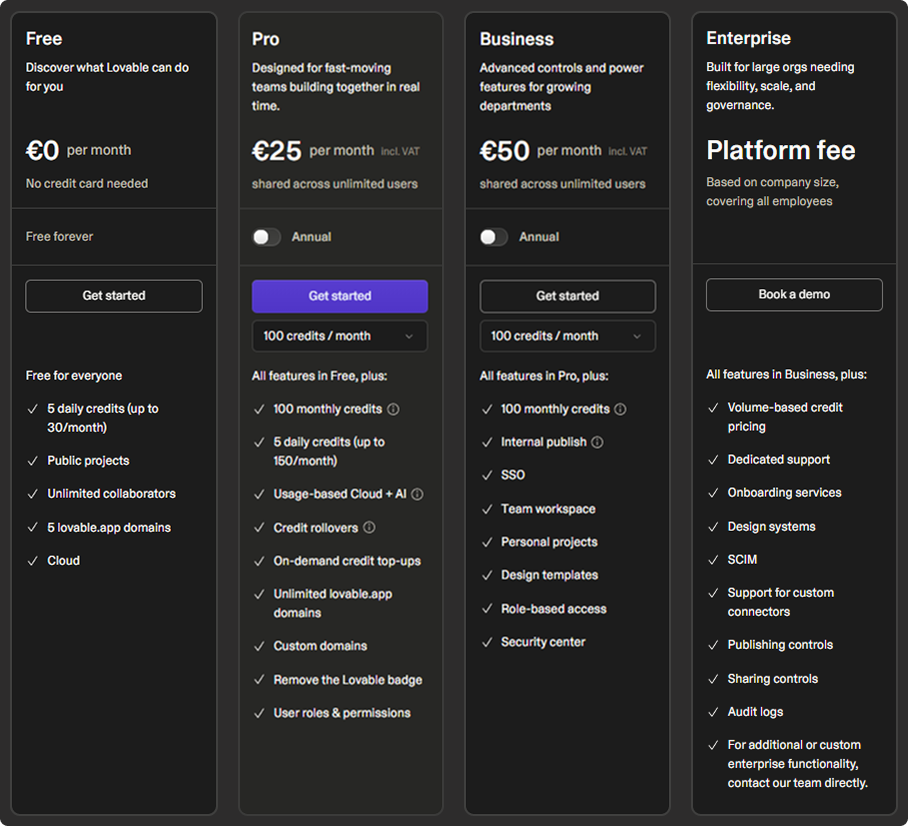
VAT applies to digital services sold to UK consumers. Lovable handles this through their payment processor. UK business customers can provide a VAT number to zero-rate the supply under the reverse charge mechanism. The invoice shows the VAT treatment. For accounting purposes, this is a standard B2B SaaS expense. No unusual tax treatment. The Teams tier at $50/user/month becomes approximately £40/user/month. For a five-person UK agency team, that's £200/month plus VAT. Compare that to the cost of a mid-level React developer (£4,000-£6,000/month) and the ROI calculation is straightforward if the tool saves even a few days per project.
Templates and the UK Marketplace Context
Lovable offers a template gallery — starter kits for SaaS dashboards, marketplaces, CRM systems, landing pages, internal tools. These aren't just UI kits. Each template includes the Supabase schema, authentication configuration, and deployment setup. For UK agencies, templates accelerate client work. A Birmingham agency building a property management portal for a letting agent can start from the CRM template, adapt the data model for UK tenancy types (AST, assured tenancy, company let), and deliver a working prototype in days rather than weeks. The template code is yours to modify. No attribution requirements, no licensing restrictions.
The community also publishes templates. Some are free, some are paid through the Lovable marketplace. Quality varies. The official templates are maintained by the Lovable team and updated when Supabase or React patterns change. Community templates may abandon. For production work, start with official templates or treat community ones as reference implementations you'll rewrite. The marketplace takes a 30% cut on paid templates. If you're a UK developer selling templates, you'll receive payouts via Stripe Connect. Standard self-employment tax rules apply — declare the income, pay Income Tax and National Insurance through Self Assessment.

For UK-specific templates, the gallery is thin. There's no "UK VAT-compliant SaaS" or "FCA-ready fintech starter" template. You build those by combining the SaaS template with custom Stripe tax configuration, custom compliance documentation, and the specific regulatory logic your sector demands. The platform gives you the foundation. The regulatory layer remains yours to implement.
Custom Domains, Hosting, and UK Performance
Lovable deploys previews to a lovable.app subdomain automatically. For production, you connect a custom domain. The platform manages the DNS verification and SSL certificate via Let's Encrypt. The hosting runs on a global edge network (Cloudflare). For UK users, this means fast loads from London, Manchester, and Edinburgh PoPs. There's no option to pin deployment to a UK-only edge. If your compliance requires that all traffic terminates in UK data centres, you'll need to export the code and host it yourself — on AWS London, Azure UK South, or a UK-based provider like Krystal or Mythic Beasts. The exported code is a standard Vite React application. It builds to static assets. Any static host works.
Custom domain setup is straightforward in the dashboard. Add the domain, add the CNAME record Lovable provides, wait for verification. The platform handles www/apex redirection. One limitation: you can't configure custom headers, CSP policies, or edge redirects through the Lovable interface. If you need strict Content Security Policy for a UK public sector contract, or you need to inject security headers for Cyber Essentials Plus compliance, you'll need to host externally. The export path is clean — download the repository, build, deploy. But it breaks the zero-ops promise.
Figma Integration for UK Design Agencies
Many UK design agencies work in Figma. Lovable's Figma integration lets you import designs and generate React components that match. You select frames in Figma, run the plugin, and Lovable creates the corresponding components with Tailwind classes. The generated code uses your design tokens — colours, spacing, typography — if you've set them up as Figma variables. For agencies handing off to developers (or acting as developers themselves), this closes the design-to-code gap. The output isn't pixel-perfect. Complex layouts, absolute positioning, and custom animations often need manual adjustment. But the structural components — navigation, cards, forms, data tables — come out close enough to save hours.
The integration works both ways. You can also push Lovable-generated components back to Figma as components, keeping the design system in sync. For UK agencies working with public sector clients who mandate GDS (Government Design System) compliance, you can import the GDS Figma kit, generate components, and then adapt them in Lovable. The GDS React components exist separately, but the Figma-to-code path gives you a starting point that matches the design spec.
Internal Tools and Operations Workflows
A significant portion of UK Lovable usage isn't customer-facing products. It's internal tools: admin panels for Manchester logistics companies, reporting dashboards for London fintechs, content management for Edinburgh publishers, approval workflows for Birmingham manufacturers. The platform excels here because internal tools tolerate rougher edges, the user count is known and small, and the data models are often straightforward CRUD on top of existing databases. Lovable can connect to external PostgreSQL databases (not just Supabase) through connection strings. You describe the schema, and it generates the admin interface.
For operations teams, the ability to iterate via chat is transformative. The ops manager in Leeds asks for a new filter on the orders table, a CSV export button, a Slack notification when stock drops below threshold. Each request is a chat message. The tool updates. No Jira ticket, no sprint planning, no developer availability wait. This is where Lovable replaces Retool, AdminJS, or custom Django admin builds for many UK SMEs. The cost comparison: Retool starts at $10/user/month (approx £8) for the Team plan with limited features. Lovable Pro at £20/month gives you unlimited internal tools for one builder. If you're the sole technical person building tools for a 50-person company, the economics are compelling.
Internal tools are the quiet killer use case. They don't win awards, but they save UK businesses thousands of hours of manual spreadsheet work every month.
Security Posture and UK Compliance Considerations
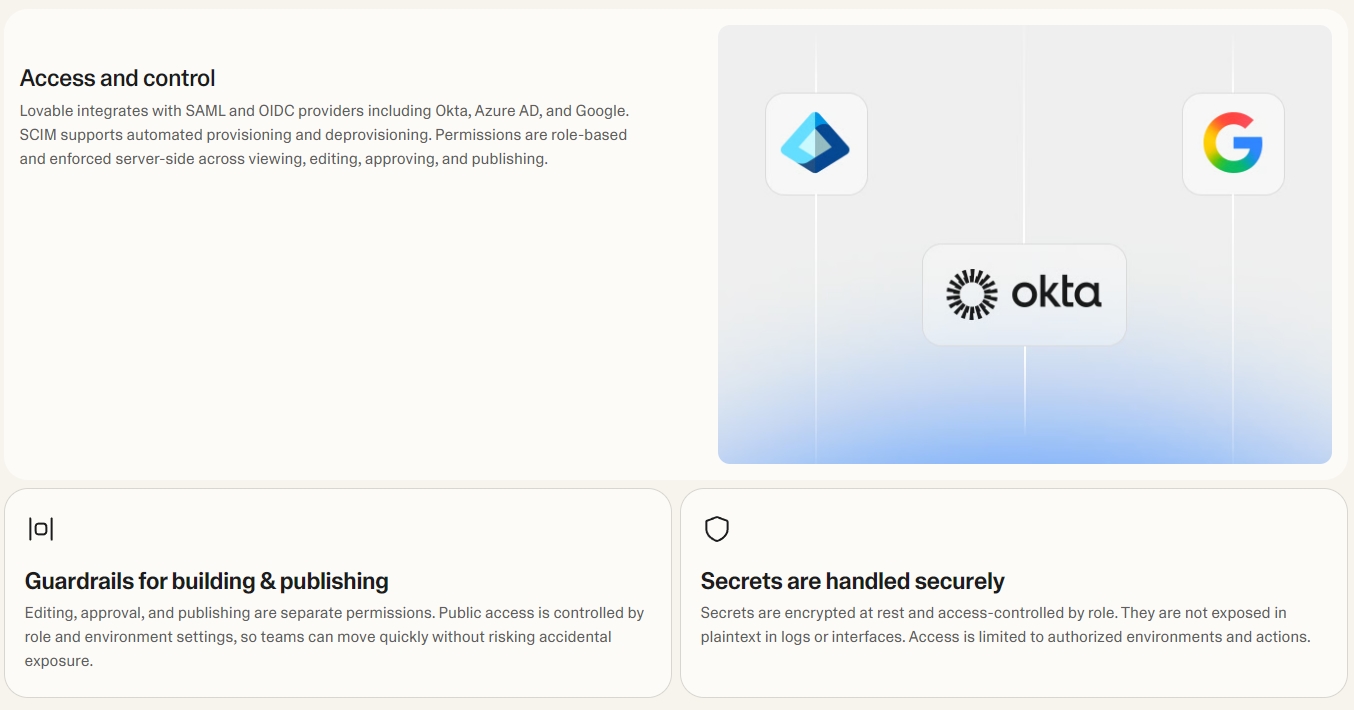
Lovable is SOC 2 Type II certified. The certification covers the platform infrastructure, not your generated applications. Your application's security depends on the code the AI writes and the configuration you approve. Supabase provides the database security layer — RLS, SSL enforcement, encryption at rest. Lovable generates RLS policies based on your descriptions. If you describe them incorrectly, the policies are wrong. The platform doesn't audit your logic. For UK businesses targeting Cyber Essentials or Cyber Essentials Plus, you'll need to verify: RLS policies enforce least privilege, authentication uses MFA where required, API keys are rotated, dependencies are scanned for vulnerabilities, and deployment pipelines include security gates.
The AI can introduce vulnerabilities. It might generate a component that trusts user input without validation, or an API route that exposes more data than intended. The preview environment lets you test. But automated security testing — SAST, DAST, dependency scanning — should run in your CI/CD pipeline after the code lands in GitHub. Lovable doesn't run these for you. GitHub Advanced Security, Snyk, or Trivy integrate easily. For UK public sector suppliers, you'll need to evidence these controls in your DSPT (Data Security and Protection Toolkit) submission or equivalent.
Data processing agreements: Lovable provides a DPA on request. Supabase provides its own DPA. For UK GDPR compliance, you need both if you're a controller using Lovable and Supabase as processors. The subprocessors list includes Anthropic, OpenAI, GitHub, Cloudflare, and Stripe. All have UK/EU data processing terms. Review them against your vendor risk assessment requirements. Nothing unusual for a modern SaaS stack, but the chain is longer than a self-hosted application.
AI Models and Token Economics
Lovable uses a mix of Claude (Anthropic) and GPT (OpenAI) models. The specific model for each task isn't user-selectable. Complex reasoning tasks — architecture decisions, debugging, multi-file changes — tend to route to Claude. Simpler generations — component creation, style adjustments — may use GPT-4o or similar. You don't control this routing. For UK teams with data sovereignty concerns about sending code to US-based AI providers, this is a consideration. The code context (your repository files, Supabase schema, chat history) goes to these models during generation. Anthropic and OpenAI both offer EU data residency for their API products, but Lovable's enterprise agreements with them aren't public. If your policy prohibits sending proprietary code to US AI APIs, you'll need to self-host the generated code and avoid the chat iteration features for sensitive modules.
Token consumption drives credit usage. A large codebase context consumes more tokens per request. The platform summarises and truncates context to manage costs, but complex projects hit limits. You'll notice the AI "forgetting" earlier decisions in long sessions. The workaround: start a new chat for each distinct feature, reference the relevant files explicitly, or break the project into smaller repositories. This isn't a UK-specific issue, but it affects UK enterprise teams working on larger codebases more acutely.
Comparing Alternatives in the UK Market
UK developers evaluating Lovable typically compare it against Bolt.new, v0.dev, Replit Agent, and Cursor. Bolt and v0 are browser-based generators that output code you copy out. They don't manage the backend, deployment, or GitHub sync. Replit Agent runs a full development environment in the browser with AI assistance — closer to Lovable but tied to Replit's hosting. Cursor is an AI-enhanced IDE (VS Code fork) that runs locally. It's the choice for developers who want AI assistance without surrendering the local workflow. Lovable sits between: more integrated than Bolt/v0, less flexible than Cursor, more opinionated than Replit.
Scroll horizontally to see all columns
| Platform | Backend Included | GitHub Sync | Self-Host Option | UK Data Residency | Best For |
|---|---|---|---|---|---|
| Lovable | Yes (Supabase) | Native | Full export | Via Supabase region | Full-stack React apps |
| Bolt.new | No | Manual | Copy code | No | Rapid prototyping |
| v0.dev | No | Manual | Copy code | No | UI component generation |
| Replit Agent | Yes (Replit DB/Postgres) | Git integration | Limited | No | Browser-based dev |
| Cursor | Bring your own | Native (local Git) | Native | Full control | Professional developers |
For UK agencies, the decision often comes down to client handoff. If the client expects a GitHub repository they can audit, host, and extend, Lovable and Cursor both deliver. If the client wants a running URL with zero technical involvement, Lovable's managed hosting wins. If the client has strict data residency requiring UK-only infrastructure, Cursor with self-hosted Supabase on AWS London gives the most control. Lovable with Supabase London region is a close second, but you're trusting Lovable's platform layer.
Community, Support, and Learning Resources
Lovable's community centres on Discord. There's a UK channel where British developers share templates, debug Supabase RLS issues, discuss Stripe UK VAT configurations, and organise local meetups. The team monitors Discord and responds to bugs quickly. There's no phone support, no SLA on the Pro tier. Enterprise tier includes dedicated Slack connect and faster response times. For UK businesses that need contractual support guarantees, the Enterprise tier is the only option with written commitments.
Documentation covers the happy paths well. Edge cases — custom Supabase migrations, complex Stripe webhook handling, edge function deployment failures — are thinner. The guides section includes walkthroughs for common patterns: SaaS auth, marketplace payments, real-time chat, file uploads. Video tutorials on YouTube supplement the written docs. For UK-specific scenarios (Making Tax Digital integration, Companies House API, NHS login), you're on your own. The platform doesn't have UK-specific integrations built in. You build them like any other API integration.
The Discord community is the real documentation. Search there before you open a ticket. Someone in Glasgow or Cardiff has already hit your error.
Enterprise Adoption in UK Organisations
UK enterprises — banks, retailers, telcos, government contractors — approach Lovable differently than startups. They run proof-of-concept projects: internal hackathons, innovation lab experiments, shadow IT initiatives. The procurement process involves security questionnaires, data processing agreements, penetration test requests, and vendor risk assessments. Lovable's Enterprise tier addresses some of this: SSO (SAML/OIDC), audit logs, dedicated support, custom contracts, and the option to run in a dedicated tenancy (though details are negotiated per account). The platform doesn't yet offer UK-specific data processing addendums or public sector framework agreements (G-Cloud, DOS). If you're a UK public sector buyer, you'll need to run a direct award or further competition, and Lovable may not be on the framework.
A practical pattern emerging in UK enterprises: developers use Lovable locally (via the GitHub sync) to accelerate feature work, but the code goes through the standard CI/CD, security scanning, and approval gates. The AI is a productivity tool, not a deployment pipeline. This keeps security and compliance teams comfortable while developers get the speed benefit. The Teams tier at $50/user/month fits this model — each developer gets their own credit allocation, repositories stay in the organisation's GitHub Enterprise, and the Lovable platform is just a generator.
Founders and Non-Technical Builders in the UK
The UK has a growing cohort of non-technical founders — domain experts in property, logistics, healthcare, education — who use Lovable to build their own MVPs without hiring a CTO or agency. The learning curve is real. You need to understand: what a database migration is, why RLS policies matter, how Stripe webhooks work, what a GitHub pull request does. Lovable abstracts the syntax but not the concepts. A founder who's never seen a PostgreSQL schema will struggle when the AI generates a migration that conflicts with existing data. The platform assumes you can read the code it produces.
For these founders, the UK ecosystem offers support. Lovable's "Founders" program provides credits, office hours, and introductions to agencies that specialise in Lovable builds. UK accelerators (Entrepreneur First, Seedcamp, Tech Nation) have portfolio companies using the platform. Some UK-based no-code/low-code agencies now offer "Lovable development" as a service — they build the v1, hand over the repository, and stay on retainer for features the founder can't manage. This hybrid model works well: the founder keeps ownership and understanding, the agency handles the hard parts.
Student founders at UK universities get a discount through the GitHub Student Developer Pack (verify status, claim credits). It's not a full Pro subscription but enough to build a thesis project or society tool. The educational angle matters because UK computer science curricula still teach React, TypeScript, and SQL — the exact stack Lovable generates. Students who learn with Lovable graduate understanding both the AI-assisted workflow and the underlying code.
Agency Workflows and Client Delivery
UK digital agencies — from Shoreditch shops to Manchester boutiques — are integrating Lovable into their delivery model. The typical pattern: discovery phase defines requirements, designers create Figma files, developers use Lovable to generate the React/Supabase foundation, then the team customises, tests, and deploys. The agency bills for outcomes, not hours saved. Clients benefit from faster delivery. Agencies benefit from higher margins on fixed-price projects. The risk: clients who discover Lovable themselves and ask "why am I paying you if AI does it?" The answer agencies give: AI writes code. We architect, secure, test, maintain, and take responsibility when it breaks at 2am.
White-label considerations: Lovable's managed hosting shows Lovable branding on preview URLs. Production custom domains hide it. The GitHub repository has no Lovable branding unless you leave the default README. For agencies presenting work as custom development, the output is clean. Some agencies add a "Built with Lovable" badge in the footer as a credibility signal — "we use modern tools" — others don't mention it. No contractual restriction either way.
Agencies that treat Lovable as a secret weapon lose. Agencies that treat it as a standard tool in the kit win. Clients care about outcomes, not your stack.
Limitations UK Teams Should Know
Lovable doesn't do mobile apps. It generates React web applications. You can wrap the output in Capacitor or React Native WebView for app store distribution, but the UI components, navigation patterns, and native integrations need manual work. For UK teams building consumer apps where App Store presence is mandatory, this is a gap. The platform also doesn't do native desktop (Tauri/Electron) out of the box. Same workaround applies.
Complex state management — think collaborative editing, offline-first sync, real-time multiplayer — exceeds what the AI reliably generates. You'll write that code yourself. The platform is honest about this: it's a CRUD application accelerator. If your UK startup's differentiator is a novel sync algorithm or a WebGL visualisation, Lovable builds the shell. You build the core.
Legacy integration is another boundary. If your UK client has a 15-year-old SOAP API, an AS/400 green screen, or a custom XML feed from a logistics partner, Lovable won't generate the adapter. You'll write the Node.js/TypeScript middleware, deploy it as a Supabase Edge Function or separate service, and connect it. The platform handles the modern stack. The legacy bridge is yours.
Future-Proofing Your Lovable Investment
The platform evolves weekly. New Supabase features, new AI model capabilities, new integration templates. For UK teams building long-lived products, the question is lock-in. The answer is in the GitHub repository. If Lovable disappeared tomorrow, your code remains. It's a standard Vite + React + TypeScript + Supabase project. You continue development in Cursor, VS Code, or any IDE. The Supabase project remains. The Stripe integration remains. The custom domain remains. You lose the chat-based iteration, the managed preview deployments, and the template gallery. That's inconvenient, not catastrophic.
The greater risk is skill atrophy. Developers who only prompt and never read the generated code lose the ability to debug, optimise, and extend. UK engineering leads report this pattern: junior developers who lean entirely on the AI produce working features but can't explain the architecture, spot the N+1 query, or design the migration for a schema change. The mitigation: code review standards that require understanding, not just approval. Pair programming where the human drives occasionally. Treating Lovable as a powerful autocomplete, not a replacement for engineering judgement.
Frequently Asked Questions
Does Lovable support UK data residency for GDPR compliance?
Yes. Supabase projects created through Lovable can be deployed to the London (eu-west-2) region, keeping database, auth, storage, and edge functions in the UK. You select the region at project creation.
Can I use Lovable for FCA-regulated fintech applications?
Lovable generates the application code and Supabase backend. FCA compliance depends on your implementation — audit trails, data encryption, access controls, regulatory reporting. The platform provides SOC 2 infrastructure and RLS policies, but you must implement and evidence the specific regulatory requirements.
How does VAT work on Lovable subscriptions for UK businesses?
Lovable charges in USD. UK business customers can provide a VAT number for reverse charge (0% VAT). UK consumers pay UK VAT at 20% through the payment processor. Invoices reflect the correct treatment for your accounting.
Can I connect Lovable to an existing UK-hosted PostgreSQL database?
Yes. You can configure an external PostgreSQL connection string in the project settings. Lovable will introspect the schema and generate the admin interface. The database must be accessible from Lovable's infrastructure.
Is there a UK-specific template for Making Tax Digital or Companies House integration?
No. The template gallery covers general patterns (SaaS, marketplace, CRM). UK-specific integrations like MTD, Companies House API, or NHS login are built as custom API integrations using the generated codebase.
What happens to my code if I cancel my Lovable subscription?
Your GitHub repository remains yours with full history. The Supabase project remains active (billed separately by Supabase). You lose access to Lovable's chat interface, managed previews, and template gallery. You continue development locally or in any IDE.
Can UK public sector organisations buy Lovable through G-Cloud or Digital Outcomes?
As of writing, Lovable is not listed on G-Cloud or Digital Outcomes and Specialists frameworks. Public sector procurement would require a direct award or separate tender process.
Final Assessment: Lovable for UK Builders
Lovable delivers on its core promise: it compresses the boilerplate phase of building React applications with Supabase backends. For UK developers, the Supabase London region solves the data residency requirement. The GitHub integration fits existing workflows. The pricing, while in dollars, translates to reasonable monthly costs for the productivity gain. The platform is honest about what it generates — standard, readable code you own — and what it doesn't — regulatory compliance, legacy integration, novel algorithms.
The teams getting the most value in the UK are: solo founders validating concepts before raising, agencies delivering fixed-price projects faster, internal tool builders in SMEs replacing spreadsheet processes, and enterprise developers using it as an accelerated scaffold within governed pipelines. The teams struggling are those expecting the AI to handle UK-specific regulatory logic automatically, those with strict UK-only infrastructure mandates that exclude the Lovable platform layer, and those whose core product differentiation lies in areas the AI doesn't handle well (complex algorithms, native mobile, legacy bridges).
If you're a UK builder evaluating Lovable, spend a weekend on the Pro tier. Build something real — not a todo app, but a project with auth, payments, and a few domain-specific features. Push to GitHub. Deploy to a custom domain. Hand the repository to a colleague and ask them to add a feature. That test tells you more than any review. The platform either fits your workflow or it doesn't. The code doesn't lie.