

AI Development Tools
Lovable United States: AI App Builder for American Developers
Complete guide to Lovable's platform, pricing tiers, and ecosystem for the United States market.


Senior Software Developer & Trading Technology Specialist
Ethan Parker is a software developer with over 8 years of experience in building web applications, trading tools, and financial technology solutions. He specializes in Python, JavaScript, API integrations, and trading automation, helping traders improve efficiency through innovative technology.
Lovable has emerged as one of the more notable AI-powered application builders in recent months, and its presence in the United States reflects the broader trajectory of generative AI tools moving from experimental novelties to practical development infrastructure. The platform lets users describe an application in natural language and watches it generate working React code with TypeScript, Tailwind CSS, and Vite — complete with authentication, database connections, and deployment pipelines. For American developers, founders, and product teams, the appeal is straightforward: compress the weeks of scaffolding and boilerplate into hours, then iterate on real code rather than locked-in no-code abstractions.
Contents
- 1. What Is Lovable and How It Works in the US
- 2. Lovable Pricing Plans for United States Users
- 3. Key Features for American Developers and Teams
- 4. Lovable Integrations Popular in the US Market
- 5. Security and Compliance for US Companies
- 6. Use Cases: Startups, Agencies, and Enterprise
- 7. Community and Support for US-Based Users
- 8. Comparing Lovable to Alternatives in the US
- 9. Getting Started with Lovable in the United States
- 10. Final Assessment of Lovable for United States Developers
The United States market matters disproportionately for any developer tool. It contains the densest concentration of early-stage startups, the largest pool of professional developers, and the venture capital ecosystem that funds experiments in productivity software. Lovable's pricing page shows tiers denominated in dollars, its documentation assumes familiarity with GitHub and Vercel workflows common in US teams, and its community channels are active during North American business hours. None of this is accidental. The company has positioned itself squarely in the conversation around AI-assisted development that dominates San Francisco, New York, Austin, and Seattle meetups.
What follows is a detailed look at how Lovable functions for users in the United States — pricing structure, feature set, integration ecosystem, security posture, community resources, and the practical realities of adopting it inside American companies. The goal is not to sell the platform but to map the territory so that a CTO in Boston, a solo founder in Denver, or an agency lead in Chicago can decide whether it belongs in their stack.
What Is Lovable and How It Works in the US
At its core, Lovable is a chat-to-code interface backed by large language models. You describe what you want — "a SaaS dashboard with user authentication, Stripe billing, and a Postgres database" — and it produces a repository structure you can push to GitHub. The generated code uses React, TypeScript, Tailwind, and Vite by default. Supabase handles authentication and database. Stripe handles payments. Vercel or Netlify handles deployment. These are not proprietary runtimes; they are the standard modern web stack that US developers already know.
The distinction from traditional no-code tools matters. Bubble, Webflow, and Retool abstract away code entirely. Lovable writes code you can read, modify, and own. If the AI produces something wrong, you fix it in your IDE. If you outgrow the platform, you take the repository and leave. This philosophy aligns with how many US engineering teams think: they want acceleration, not lock-in. The platform also supports importing Figma designs, which matters for teams that work with dedicated designers — a common pattern in funded US startups.
For US-based users, the latency of the AI generation is generally low because the inference infrastructure runs in regions close to major population centers. The platform also respects US data residency expectations — Supabase projects can be provisioned in US regions, and Vercel deployments default to US edge networks. These details rarely appear in marketing materials but they determine whether a tool passes a security review at a Series A company.
Lovable Pricing Plans for United States Users
Pricing is denominated in US dollars and structured around monthly credit allowances. The Free tier provides 30 credits per month — enough for roughly 10-15 small generation sessions. The Starter tier at $20/month provides 100 credits. Launch at $50/month provides 300 credits. Scale at $100/month provides 800 credits. Enterprise pricing is custom and includes dedicated support, SSO, audit logs, and private deployment options. Credits reset monthly and do not roll over, which is a common point of frustration for users who have uneven workloads.
A credit roughly corresponds to one AI generation turn — a prompt and its response. Complex multi-file changes consume more credits. In practice, a solo founder building an MVP might burn through 100 credits in a weekend of intensive iteration, then use 10-20 per week during maintenance. A five-person team sharing a Scale plan will typically find 800 credits sufficient unless they are generating entirely new applications every sprint. The Enterprise tier exists for organizations that need predictable billing, compliance features, or volume discounts.
Scroll horizontally to see all columns
| Plan | Monthly Cost | Credits | Best For |
|---|---|---|---|
| Free | $0 | 30 | Exploration, learning |
| Starter | $20 | 100 | Solo founders, side projects |
| Launch | $50 | 300 | Active MVP development |
| Scale | $100 | 800 | Small teams, multiple projects |
| Enterprise | Custom | Custom | Compliance, SSO, dedicated support |
Compared to hiring a contractor or junior developer, the math is stark. A US-based junior developer costs $5,000-8,000/month fully loaded. The Scale plan at $100/month is two orders of magnitude cheaper. But the comparison is flawed — Lovable does not replace a developer. It accelerates one. The real comparison is against the hours a senior developer spends on scaffolding, authentication wiring, and CRUD generation. If Lovable saves ten hours per week at a $150/hour effective rate, the Scale plan pays for itself in 40 minutes.
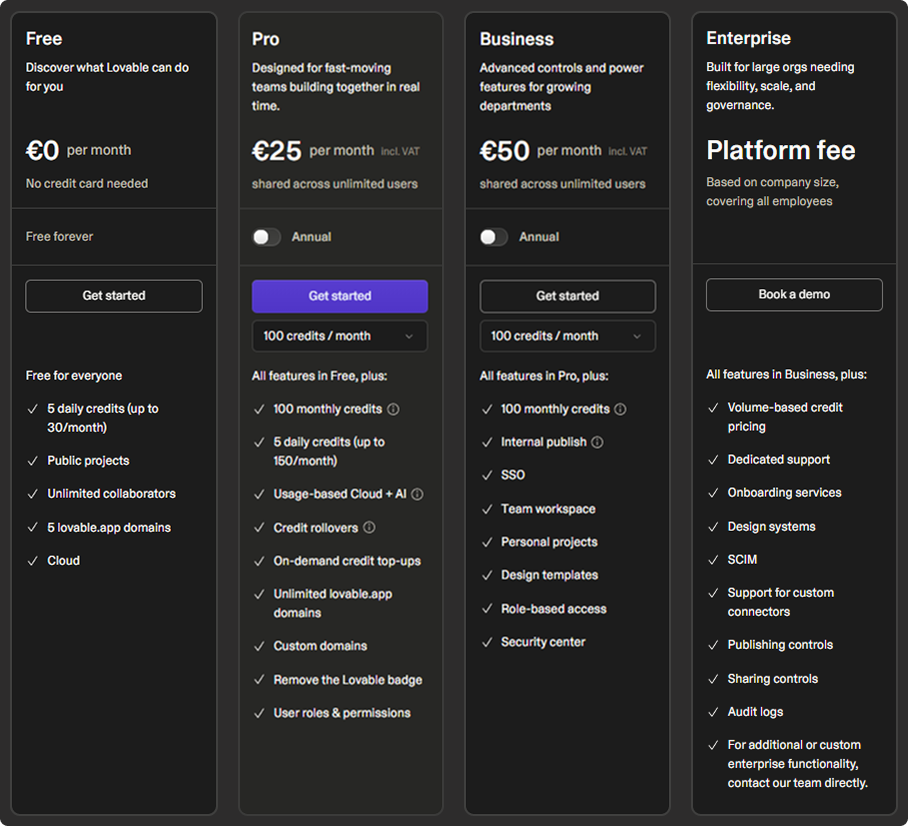
One practical note for US companies: billing is handled through Stripe and receipts are suitable for expense reporting. There are no annual contracts below Enterprise, so teams can upgrade or downgrade month to month. This flexibility matters for startups with runway constraints. The Free tier also serves as an extended trial — 30 credits per month indefinitely lets a team validate the workflow on a real feature before committing budget.
Key Features for American Developers and Teams
The feature set maps closely to what US full-stack teams build daily. Authentication comes pre-configured with Supabase Auth — email/password, OAuth providers (Google, GitHub, Microsoft), magic links, and row-level security policies. Database schema generation creates Postgres tables with proper indexes, foreign keys, and RLS policies. API routes follow REST conventions with TypeScript types shared between client and server. Stripe integration includes checkout sessions, webhook handling, subscription management, and customer portal links.
GitHub integration is bidirectional. Lovable can create a repository, push initial code, and open pull requests for subsequent changes. Developers can also work locally, push to GitHub, and have Lovable continue from the updated state. This round-trip capability is essential for teams that do code review — a standard practice in US engineering organizations. The platform also supports custom domains through Vercel or Netlify, with automatic SSL and CDN distribution.
- React 18 with TypeScript and Vite 5
- Tailwind CSS with shadcn/ui component library
- Supabase Postgres with row-level security
- Supabase Auth with 20+ OAuth providers
- Stripe Checkout, Billing, and webhooks
- Vercel/Netlify deployment with preview URLs
- GitHub two-way sync with PR workflow
- Figma import for design-to-code workflow
- Custom domain and SSL management
- Environment variable management per environment
The component library deserves specific attention. Lovable uses shadcn/ui — a collection of copy-pasteable React components built on Radix UI primitives. This is not a proprietary component system. Every component exists as source code in your repository. You can modify the button component, delete the dialog, or replace the entire library. For US teams that have design systems or accessibility requirements, this transparency is a prerequisite. The generated code also passes TypeScript strict mode by default, which reduces the class of runtime errors that plague dynamically typed AI output.
The best AI coding tools don't hide the code — they help you write more of it, faster, while keeping you in control of the result.
Lovable Integrations Popular in the US Market
The integration ecosystem reflects the preferences of US-based developers. Supabase is the default backend — Postgres, Auth, Realtime, Storage, and Edge Functions all in one platform. This is not coincidental; Supabase has deep penetration in the US startup market and its pricing aligns with early-stage budgets. Stripe dominates US payment processing, and Lovable's Stripe integration covers the full subscription lifecycle. Vercel and Netlify split the deployment market, and Lovable supports both with zero-config deployments.
Beyond the core trio, the platform connects to GitHub for source control, Figma for design handoff, and various AI model providers. The AI model selection is noteworthy — users can choose between Claude, GPT-4, and other models for generation. This matters because different models excel at different tasks: Claude tends to produce cleaner TypeScript, GPT-4 handles complex multi-file refactors better. US teams with existing model preferences or enterprise agreements with Anthropic or OpenAI can route generation accordingly.
Scroll horizontally to see all columns
| Integration | Category | US Market Share Context |
|---|---|---|
| Supabase | Backend/Database | Leading Postgres platform for US startups |
| Stripe | Payments | Dominant in US SaaS and e-commerce |
| Vercel | Deployment | Preferred by React/Next.js teams |
| Netlify | Deployment | Strong in static sites and edge functions |
| GitHub | Source Control | Near-universal in US professional teams |
| Figma | Design | Standard for US product design teams |
The connector system also supports custom REST APIs and GraphQL endpoints. This means a US enterprise with internal services — a legacy inventory system, a proprietary pricing engine, a compliance checking service — can expose them as connectors and have Lovable generate code that calls them. The platform does not yet have a marketplace of pre-built connectors comparable to Zapier or Make, but the custom connector approach works for teams that own their APIs.
Security and Compliance for US Companies
Security posture is where many AI development tools fail US enterprise requirements. Lovable's architecture helps because the generated code runs in your infrastructure — Supabase, Vercel, your GitHub organization. Lovable itself never hosts your application or database. The platform does have access to your prompts, generated code, and repository during active sessions, which means its own security practices matter.
The Enterprise tier includes SOC 2 Type II compliance, SAML/SSO with Okta/Azure AD/Google Workspace, audit logging, and data processing agreements. For US companies in regulated industries — fintech, healthtech, govtech — these are often non-negotiable. The Free through Scale tiers do not include these features. A Series B fintech startup would need Enterprise. A pre-seed consumer app would not. The gap between Scale and Enterprise is significant in both price and procurement process.

Data residency is handled at the infrastructure layer. Supabase projects can be created in US-East (Virginia), US-West (Oregon), or other regions. Vercel deployments use their global edge network with US points of presence. Lovable does not store generated application data — only the conversation history and code artifacts needed for the chat interface. For teams with strict data sovereignty requirements, this architecture is more favorable than platforms that host the application themselves.
- SOC 2 Type II on Enterprise tier only
- SAML/SSO with major identity providers
- Audit logs for compliance tracking
- Data processing agreements available
- Supabase region selection (US-East, US-West)
- Vercel/Netlify US edge deployment
- No application data stored by Lovable
- Conversation history retained for context
Use Cases: Startups, Agencies, and Enterprise
The platform fits different US organizational profiles in different ways. Early-stage startups — pre-seed to Series A — use it to build MVPs without hiring a full founding engineering team. A non-technical founder with domain expertise can produce a working prototype in days, then hire a developer to take over the repository. This pattern appears frequently in Y Combinator and Techstars batches. The cost is negligible compared to the alternative of a $15,000/month contract developer.
Agencies and consultancies represent a growing segment. US digital agencies building custom software for clients use Lovable to accelerate discovery and delivery phases. A two-week discovery sprint that previously produced wireframes and estimates can now produce a working prototype with real data. Clients can interact with it, request changes, and approve scope before the agency commits engineering hours. The agency retains the repository and can hand it off to their developers or the client's team.
Enterprise adoption follows a different curve. Internal tools teams — the groups that build admin panels, dashboards, and workflow automation for operations, sales, and support — find Lovable useful for rapid iteration on low-stakes applications. A sales operations team needs a commission calculator with Salesforce integration. An HR team needs an onboarding checklist with Workday sync. These are not customer-facing products, so the risk profile is lower. The barrier is usually procurement: Enterprise pricing requires a contract, security review, and legal approval — a 3-6 month cycle in many Fortune 500 companies.
Scroll horizontally to see all columns
| Organization | Typical Use Case | Adoption Barrier |
|---|---|---|
| Early-stage startup | MVP, prototype, investor demo | Low — credit card signup |
| Digital agency | Client prototypes, discovery deliverables | Low — team plan expense |
| Internal tools team | Admin panels, dashboards, workflow apps | Medium — IT approval needed |
| Enterprise product team | Customer-facing features, experiments | High — security, legal, procurement |
Agencies have quietly become power users. They sell the speed to clients, but they keep the code quality for their own developers.
Community and Support for US-Based Users
The community layer matters more for developer tools than most categories. Lovable's Discord server is active during US hours with several thousand members. The team runs weekly office hours, publishes video tutorials, and maintains a template gallery with starter kits for SaaS, marketplaces, dashboards, and AI agents. The documentation covers the happy path well but has gaps on edge cases — custom Supabase migrations, complex Stripe webhook handling, monorepo structures. US-based users often fill these gaps in Discord or GitHub Discussions.
There is also a partner program for agencies and consultants who want to build on Lovable professionally. It includes revenue sharing, co-marketing, and priority support. For US-based agencies, this can offset the tool cost and provide a differentiator in proposals. The affiliate program offers 30% recurring commission for referrals, which has created a cottage industry of YouTube tutorials and comparison videos from US-based creator-developers.
- Discord community active in US time zones
- Weekly office hours with product team
- Template gallery: SaaS, marketplace, dashboard, AI agents
- Video tutorials on YouTube and documentation site
- Partner program for agencies (revenue share, co-marketing)
- Affiliate program: 30% recurring commission
- GitHub Discussions for technical Q&A
- Email support on paid tiers, priority on Enterprise
Comparing Lovable to Alternatives in the US
The competitive landscape in the US splits along two axes: code ownership vs. abstraction level, and AI-first vs. traditional. Bolt.new and v0.dev are the closest direct competitors — both generate React/Next.js code from prompts, both use similar stacks. Bolt runs in the browser with WebContainer technology; v0 is tightly coupled to Vercel's ecosystem. Lovable differentiates with the Supabase-first backend approach and the bidirectional GitHub sync. For a US team already on Supabase, Lovable feels more native.
Cursor and GitHub Copilot occupy a different niche — they are AI assistants inside your IDE, not chat-to-app generators. They excel at line-level completion, refactoring, and explaining existing code. Lovable excels at scaffolding entire features from scratch. Many US developers use both: Lovable for the initial structure, Cursor for the daily coding. The platforms are complementary, not competitive.
Traditional no-code platforms — Bubble, Webflow, Retool — serve a different buyer. They target non-technical builders who will never write code. Lovable targets developers and technical founders who want to move faster but retain code ownership. The pricing reflects this: Bubble's production plans start at $129/month with limits on data and workflows; Lovable's Scale plan at $100/month has no application limits, only credit limits on generation.
Scroll horizontally to see all columns
| Tool | Category | Code Ownership | Best For |
|---|---|---|---|
| Lovable | AI App Builder | Full — your repo | Developers, technical founders |
| Bolt.new | AI App Builder | Full — your repo | Browser-based workflow fans |
| v0.dev | AI App Builder | Full — your repo | Vercel/Next.js ecosystem teams |
| Cursor | AI IDE Assistant | Full — your repo | Daily coding, refactoring |
| GitHub Copilot | AI IDE Assistant | Full — your repo | Enterprise GitHub shops |
| Bubble | No-Code Platform | None — platform lock-in | Non-technical builders |
| Retool | Internal Tools Builder | Partial — export limited | Internal admin panels |
The decision matrix is simple: if you want to own the code and you know React, use an AI app builder. If you never want to see code, use no-code. If you write code daily, add an AI assistant to your IDE.
Getting Started with Lovable in the United States
The onboarding flow is straightforward for US users. Sign up with GitHub, Google, or email. The Free tier activates immediately with 30 credits. The first prompt can be as vague as "build a SaaS landing page with pricing tiers" or as specific as "create a multi-tenant dashboard with role-based access, Stripe subscriptions, and audit logging using Supabase RLS." The platform responds with a file tree, code preview, and a deploy button. One click pushes to GitHub and triggers Vercel deployment.
A practical first session for a US-based team: create a Supabase project in US-East, connect it in Lovable's settings, add Stripe test keys, and generate a simple feature — user registration with email verification. This exercises the full stack: auth, database, email, deployment. The generated code is readable enough that a mid-level React developer can extend it immediately. The most common stumbling point is environment variable management across local, preview, and production environments — Lovable handles this through the Vercel/Netlify integration but the mental model takes one cycle to internalize.
- Sign up with GitHub (recommended for repo sync)
- Create Supabase project in US region
- Add Stripe test keys for payment flows
- Write first prompt — start specific, not vague
- Review generated file structure before deploy
- Push to GitHub, verify Vercel preview deployment
- Clone locally, run npm install, verify dev server
- Invite team members to GitHub repo, not Lovable
Final Assessment of Lovable for United States Developers
Lovable occupies a specific and useful niche in the US developer tool landscape. It is not a replacement for engineers. It is a force multiplier for the scaffolding and integration work that consumes disproportionate time on every project. For a solo founder in Austin building a SaaS MVP, it can compress two months of solo development into two weeks. For a five-person team in Seattle, it can eliminate the sprint zero overhead on every new service. For an agency in Miami, it changes the economics of discovery phases.
The limitations are real and should factor into adoption decisions. Credit-based pricing creates unpredictable costs during heavy iteration periods. The Enterprise gap — both price and procurement complexity — means mid-market companies often cannot access compliance features they need. The connector ecosystem is thin for enterprise systems. The AI still hallucinates API signatures and produces code that compiles but behaves incorrectly in edge cases. These are not fatal flaws; they are the current boundary of the technology.
The strategic question for a US engineering leader is not whether Lovable is perfect. It is whether the time saved on boilerplate exceeds the time spent reviewing and correcting AI output. For teams building standard CRUD applications with Supabase and Stripe — which describes a large fraction of new US SaaS products — the answer is increasingly yes. For teams building novel algorithms, real-time collaboration, or hardware-adjacent software, the answer is likely no. The platform earns its place in the stack by being honest about what it is: a code generator for the modern web stack, not an application platform.
Frequently Asked Questions
Does Lovable work with existing React codebases or only new projects?
Lovable works best starting from a fresh repository. It can connect to an existing GitHub repo and continue development, but the AI expects the standard Lovable stack (React, TypeScript, Vite, Tailwind, Supabase). Significant deviations from this stack will reduce generation quality.
Can I use Lovable without Supabase if my company uses a different database?
Supabase is deeply integrated into the generation pipeline — auth, database types, RLS policies, and edge functions all assume Supabase. You can eject and replace the backend after generation, but you lose the AI's ability to modify database-related code afterward. Custom database connectors are not currently supported.
How do credits work when multiple team members use the same account?
Credits are pooled at the account level. All team members share the monthly allowance. There is no per-seat credit allocation. Teams typically manage this by coordinating heavy generation sessions or upgrading to a higher tier when credits run low mid-month.
Is Lovable SOC 2 compliant on the Scale plan?
No. SOC 2 Type II compliance, SAML/SSO, audit logs, and data processing agreements are only available on the Enterprise tier. The Scale plan includes priority email support but not compliance features.
Can I deploy to AWS, Google Cloud, or Azure instead of Vercel/Netlify?
The one-click deployment targets Vercel and Netlify. However, the generated code is a standard Vite/React application that builds to static assets. You can configure any CI/CD pipeline to deploy to AWS Amplify, CloudFront, Google Cloud Run, Azure Static Web Apps, or Kubernetes. The GitHub integration makes this straightforward.
What happens to my code if I cancel my subscription?
Your code remains in your GitHub repository. You lose access to the Lovable chat interface and future generation credits, but the application continues to run on your infrastructure. There is no vendor lock-in on the generated code.
Does Lovable support mobile app development with React Native?
Not currently. The platform generates web applications using React, Vite, and Tailwind CSS. React Native support is on the roadmap but no public timeline has been announced. For mobile, teams typically build a responsive web app with Lovable and wrap it with Capacitor or build a separate React Native frontend against the same Supabase backend.