

AI Development Tools
Lovable India: AI App Builder for Indian Developers
A practical look at features, costs, and real workflows for builders in India.

Senior Software Developer & Trading Technology Specialist
Ethan Parker is a software developer with over 8 years of experience in building web applications, trading tools, and financial technology solutions. He specializes in Python, JavaScript, API integrations, and trading automation, helping traders improve efficiency through innovative technology.
Lovable has quietly become one of the more practical AI app builders on the market. For Indian developers, founders, and product teams, the platform offers a way to move from idea to working application without wrestling with boilerplate, authentication flows, or deployment pipelines. The core promise is straightforward: describe what you want in natural language, and Lovable generates a React codebase with TypeScript, Tailwind CSS, and Vite — ready to push to GitHub and deploy.
Contents
- 1. What Lovable Brings to Indian Builders
- 2. Core Features That Matter for Local Projects
- 3. Pricing in Indian Rupees and Value Comparison
- 4. Templates and Starters for Common Indian Use Cases
- 5. Supabase, Stripe, and GitHub Integration Workflows
- 6. Security and Compliance Considerations
- 7. Community, Support, and Learning Resources
- 8. How Indian Founders Are Using Lovable Today
- 9. Comparing Lovable with Alternatives Available in India
- 10. Getting Started: From Sign-Up to First Deploy
- 11. Limitations and Honest Trade-Offs
- 12. Final Assessment of Lovable for Indian Teams
What makes this relevant in an Indian context is not just the technology but the economics. The free tier provides enough credits to build and ship real projects. Paid plans scale in a way that fits early-stage startups and agencies operating on rupee budgets. The platform also integrates directly with Supabase for database and auth, Stripe for payments, and GitHub for version control — tools already standard in most Indian dev workflows.
This article walks through what Lovable actually delivers for teams building in India. It covers pricing converted to local purchasing power, templates that match common regional use cases, integration patterns that work with existing stacks, and the honest limitations you should know before committing credits to a project.
What Lovable Brings to Indian Builders
At its core, Lovable is a chat-to-code interface backed by Claude and GPT models. You describe a feature — "add a dashboard with user analytics and export to CSV" — and it writes the components, hooks, and API calls. The generated code lands in a GitHub repository you own. There is no vendor lock-in at the code level. If Lovable disappeared tomorrow, your repo remains fully functional.
For Indian teams, this ownership model matters. Many no-code platforms trap logic in proprietary runtimes. Lovable outputs standard React and TypeScript. Your engineers can read, modify, and extend it without learning a new paradigm. The platform also handles the tedious parts: setting up ESLint, Prettier, TypeScript configs, Tailwind theming, and the initial project structure that usually consumes the first day of any new build.
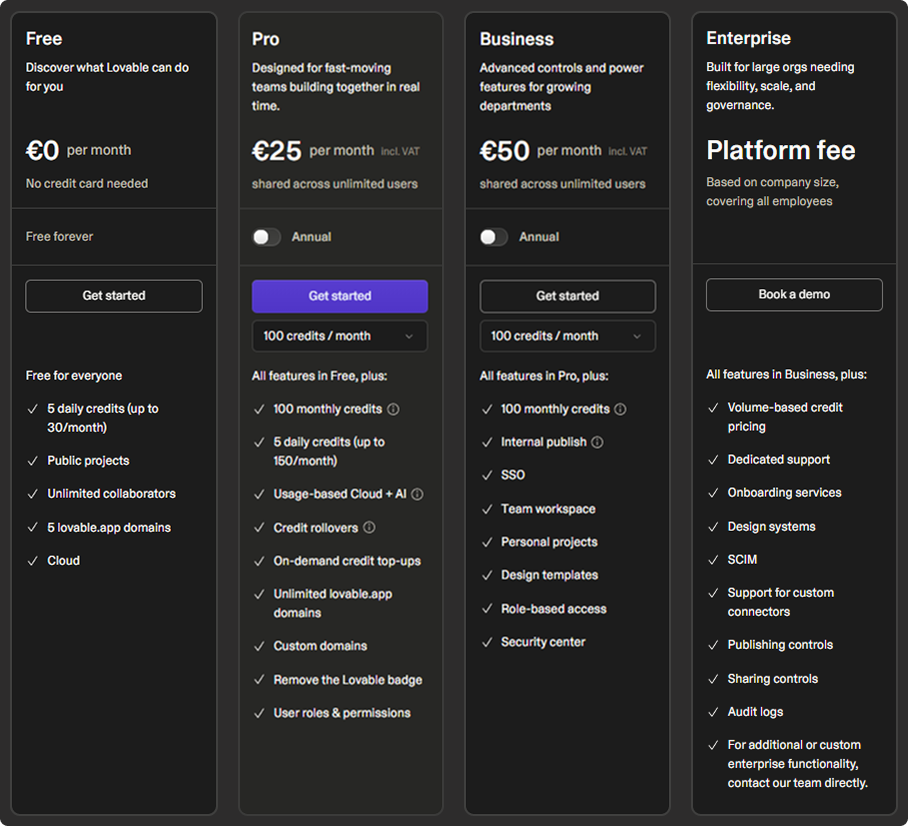
The free plan includes 30 credits per month. One credit roughly equals one generation cycle — a prompt and its resulting code changes. That is enough to prototype several small applications or iterate on one larger project. The Starter plan at $20 monthly (approximately ₹1,650) raises the limit to 100 credits. Launch at $50 (₹4,100) provides 250 credits. Scale at $100 (₹8,200) gives 500 credits. Enterprise pricing is custom.
Core Features That Matter for Local Projects
The feature set aligns well with what Indian SaaS founders and agencies need daily. Authentication comes pre-configured with Supabase — email/password, OAuth providers (Google, GitHub), magic links, and row-level security policies. Database schema generation works through natural language: "create a table for orders with user_id, items, total, and status" produces the SQL migration and TypeScript types automatically.
- React 18 with TypeScript and Vite for fast builds
- Tailwind CSS with configurable design tokens
- Supabase integration for Postgres, auth, storage, and realtime
- Stripe checkout, subscriptions, and webhook handling
- GitHub two-way sync — push from Lovable, pull local changes
- Custom domain support on paid plans with automatic SSL
- Environment variable management per project
- Team collaboration with role-based access on Scale and Enterprise
The GitHub sync is bidirectional. You can open the repo in VS Code, make changes locally, push, and Lovable picks them up. This matters for teams where some developers prefer AI assistance and others write code manually. The platform does not force a single workflow.
Pricing in Indian Rupees and Value Comparison
Pricing is listed in USD, but the effective cost for Indian users depends on card forex rates and GST. At current rates, the Starter plan lands around ₹1,650–1,750 monthly including fees. Launch sits near ₹4,100–4,300. Scale reaches ₹8,200–8,600. For context, a mid-level React developer in Bangalore or Pune costs ₹80,000–1,50,000 monthly. If Lovable saves even two developer days per month, the Starter plan pays for itself.
Scroll horizontally to see all columns
| Plan | Monthly USD | Est. INR (incl. fees) | Credits | Best For |
|---|---|---|---|---|
| Free | $0 | ₹0 | 30 | Learning, small prototypes |
| Starter | $20 | ₹1,750 | 100 | Solo founders, freelancers |
| Launch | $50 | ₹4,300 | 250 | Early-stage startups |
| Scale | $100 | ₹8,600 | 500 | Growing teams, agencies |
| Enterprise | Custom | Custom | Unlimited | Large orgs, compliance needs |
The credit system is the main constraint to understand. Complex prompts — "build a multi-tenant dashboard with role-based access, audit logs, and Stripe billing portal" — can consume 5–10 credits in one go as Lovable iterates through files. Simpler requests like "add a loading skeleton to the user table" use one credit. Planning prompts to batch related changes stretches credits further.
Templates and Starters for Common Indian Use Cases
The template library includes starting points that map directly to problems Indian builders solve repeatedly. There are SaaS boilerplates with authentication, billing, and admin panels. E-commerce starters with product catalogs, cart, and Stripe checkout. Internal tool templates for admin dashboards, CRUD interfaces, and reporting views. Landing page kits with waitlist forms, testimonials, and SEO-ready structure.

For the Indian market specifically, a few templates stand out. The multi-tenant SaaS starter handles organizations, invitations, and role-based access — common in B2B products targeting Indian SMEs. The marketplace template supports two-sided platforms with seller onboarding, listings, and commission logic — relevant for the growing number of vertical marketplaces in Tier 2 and 3 cities. The internal tools template accelerates admin panels that operations teams in logistics, fintech, and edtech constantly request.
- SaaS Boilerplate — auth, billing, teams, admin panel
- E-Commerce Store — products, cart, checkout, orders
- Marketplace — two-sided platform with seller dashboard
- Internal Admin — CRUD, filters, exports, permissions
- Landing Page — hero, features, pricing, waitlist, blog
- Dashboard Analytics — charts, date ranges, export
- CRM Lite — contacts, deals, pipeline, activities
- Documentation Site — MDX, search, versioning
Supabase, Stripe, and GitHub Integration Workflows
The three integrations that define the Lovable stack are Supabase, Stripe, and GitHub. Each works through a connection flow that takes under a minute. For Supabase, you paste the project URL and anon key. Lovable then reads your schema and can generate migrations, types, and client code. For Stripe, you provide the secret key and webhook endpoint. The platform creates checkout sessions, subscription management, and billing portal links. GitHub connects via OAuth and pushes to a repo you designate.
A typical workflow for an Indian fintech prototype might look like this: create a Supabase project in the Mumbai region for data residency. Connect it to Lovable. Prompt: "Build a KYC verification flow with document upload, admin review queue, and webhook to update user status." Lovable generates the storage bucket policies, database tables, admin UI, and Stripe webhook handler for identity verification fees. Push to GitHub. Deploy to Vercel or Netlify. The entire flow stays within tools Indian teams already use.
- Supabase: Mumbai region available for data residency
- Stripe: INR support, UPI via Payment Links, local compliance
- GitHub: Private repos included, Actions for CI/CD
- Vercel/Netlify: Free tier handles most early deployments
- Custom domains: Configure DNS, SSL auto-provisioned
Security and Compliance Considerations
Security is where many AI builders fall short. Lovable takes a different approach: it generates code that follows security defaults rather than trying to be a security platform itself. Row-level security policies in Supabase are created automatically for multi-tenant data. Environment variables are encrypted at rest. GitHub tokens use fine-grained permissions. The platform does not store your database credentials or API keys beyond what is needed for the active session.

For Indian companies handling financial or health data, the compliance story depends on your infrastructure choices. Lovable itself is not SOC 2 certified as of this writing. However, the code it produces runs on your Supabase project (which can be HIPAA-ready on dedicated plans), your Stripe account (PCI DSS Level 1), and your cloud provider. The responsibility chain is clear: you own the data, you choose the regions, you control the compliance posture.
Community, Support, and Learning Resources
The Lovable community has grown rapidly since late 2023. Discord is the primary hub — active channels for help, showcases, feature requests, and direct access to the founding team. The documentation covers prompting patterns, integration guides, and troubleshooting. Video tutorials walk through full builds. For Indian users, the time zone overlap with the core team (European hours) means late evening or early morning for real-time help, but async responses on Discord and GitHub issues typically arrive within hours.

There is also a growing subset of Indian builders sharing templates and patterns specific to local needs — GST invoice generation, Aadhaar masking components, UPI deep links, pincode-based delivery validation. These community contributions often fill gaps faster than official feature requests. The affiliate program offers 20% recurring commission, which some Indian agencies and educators have turned into a meaningful revenue stream by teaching Lovable workflows.
- Discord: 50,000+ members, active help channels
- Documentation: Prompting guide, API reference, examples
- YouTube: Full build walkthroughs, feature deep dives
- Blog: Changelog, case studies, best practices
- GitHub: Issue tracking, feature requests, community PRs
- Affiliate program: 20% recurring on referred subscriptions
How Indian Founders Are Using Lovable Today
Conversations in the community and public showcases reveal a few dominant patterns. Solo founders in Bangalore and Delhi use Lovable to ship MVP SaaS products in weeks instead of months — typically B2B tools for SME digitization, edtech platforms, or fintech dashboards. Agencies in Mumbai and Hyderabad use it to accelerate client projects, delivering admin panels and customer portals as part of larger contracts. Product managers at funded startups prototype internal tools without waiting for engineering bandwidth.
The shift is not that non-technical people are building production apps alone. It is that technical founders are compressing the zero-to-one phase from weeks to days, then handing off clean React codebases their teams can actually maintain.
A concrete example: a Delhi-based logistics startup needed a driver onboarding portal with document verification, route assignment, and earnings tracking. Their two-person engineering team used Lovable to generate the React frontend and Supabase schema in three days. They spent the next week customizing business logic, adding offline support for patchy connectivity, and integrating with their existing dispatch system. Total credits used: roughly 60. The alternative was three to four weeks of manual scaffolding.
Comparing Lovable with Alternatives Available in India
The AI builder landscape has several players. Bolt.new runs in the browser with a similar chat interface but keeps the code in its own runtime — export is possible but the development loop stays on their platform. v0 from Vercel excels at UI generation but does not handle backend, database, or auth. Replit Agent offers a full cloud IDE with AI but targets a different workflow — more REPL-driven, less product-focused. Cursor is an AI-enhanced editor for developers who already write code.
Scroll horizontally to see all columns
| Tool | Code Ownership | Backend Included | Pricing (INR est.) | Learning Curve |
|---|---|---|---|---|
| Lovable | Full (GitHub repo) | Yes (Supabase) | ₹0–8,600/mo | Low |
| Bolt.new | Export only | Limited (Netlify functions) | Free / $20/mo | Low |
| v0 | React components only | No | Free / $20/mo | Low |
| Replit Agent | Repl ownership | Yes (built-in) | Free / $25/mo | Medium |
| Cursor | Full (local files) | No (bring your own) | Free / $20/mo | High (devs only) |
For an Indian founder deciding between these, the question usually reduces to: do you want to own the codebase from day one? Lovable and Cursor give you that. Bolt and v0 are faster for pure UI exploration but require ejection for production backends. Replit sits in the middle — you own the repl but the environment is proprietary. If your team already uses GitHub, Vercel, and Supabase, Lovable fits the existing stack with zero friction.
Getting Started: From Sign-Up to First Deploy
The onboarding flow is intentionally minimal. Sign up with GitHub or email. The dashboard shows your projects and credit balance. Click "New Project" and you land in the chat interface. The first prompt can be vague — "SaaS dashboard for gym management" — and Lovable will ask clarifying questions before generating. This conversational refinement is where the product shines: it catches missing requirements early instead of generating wrong code.
After the initial generation, you see a file tree on the left, the chat in the center, and a live preview on the right. The preview runs in a sandbox with hot reload. You can click elements in the preview to highlight the corresponding code. When satisfied, click "Push to GitHub" — this creates or updates the repo. From there, connect Vercel or Netlify for automatic deployments on push. Custom domains configure in the project settings on paid plans.
- Sign up via GitHub (recommended) or email
- Create first project — start with a template or blank chat
- Refine through conversation — Lovable asks questions
- Review generated files in the sidebar
- Test in live preview — click to inspect components
- Push to GitHub — creates repo with full history
- Connect Vercel/Netlify for auto-deploy
- Add custom domain on Starter plan or above
Limitations and Honest Trade-Offs
No tool is perfect, and Lovable has clear boundaries. The credit system can feel restrictive during heavy iteration. Complex refactors — "migrate from JavaScript to TypeScript across the codebase" — consume credits rapidly because each file change counts. The AI sometimes hallucinates Supabase RPC functions that do not exist or generates Tailwind classes that conflict with your design system. These are fixable but require developer oversight.
Mobile responsiveness is another area where the first pass often needs manual adjustment. Lovable generates desktop-first Tailwind. You will need to prompt specifically for mobile breakpoints or edit the CSS yourself. The platform also does not yet support native mobile app generation — React Native or Expo projects require ejection and manual adaptation. For teams targeting India's mobile-first user base, this is a genuine gap.
Offline development is not supported. You need an internet connection to use the chat interface. The generated code works offline once in your local repo, but any new AI-assisted changes require connectivity. This matters for developers working from locations with unreliable internet — still common outside major metros.
Final Assessment of Lovable for Indian Teams
Lovable occupies a practical middle ground for Indian builders. It is not a magic wand that turns non-technical founders into full-stack engineers. It is a force multiplier for people who already understand product architecture, data models, and React fundamentals. The free tier lets you validate the workflow risk-free. The paid tiers cost less than a single senior developer day per month. The code ownership model means you never paint yourself into a corner.
For early-stage SaaS founders in India, the platform compresses the most expensive phase — going from zero to a deployable, extensible codebase with auth, billing, and database. For agencies, it turns fixed-bid internal tool projects from loss-leaders into profitable engagements. For product managers, it enables credible prototypes that engineers can actually build on rather than rewrite.
The main reasons to pass: if your team needs native mobile apps today, if you cannot tolerate any credit-based limits, or if your compliance requirements demand a SOC 2 certified vendor. For everyone else building web applications on the modern React/Supabase/Stripe stack, Lovable is worth a serious two-week evaluation. Start with a real project on the free plan. The credits will tell you whether the workflow fits.
Frequently Asked Questions
Does Lovable work with Indian payment methods like UPI or RuPay?
Lovable subscriptions are billed in USD via Stripe, which accepts international cards. UPI and RuPay are not directly supported for platform subscriptions. However, the Stripe integration in your generated apps supports UPI, NetBanking, and wallets for your end customers.
Can I host the generated application on Indian cloud providers like AWS Mumbai or Azure Pune?
Yes. The output is a standard React + Vite build that deploys anywhere — Vercel, Netlify, AWS Amplify, Azure Static Web Apps, or your own Kubernetes cluster. Data residency depends on your Supabase project region, which includes Mumbai.
Is there a student discount for Indian universities?
Lovable offers a student discount program globally. You need a verified academic email address. The discount typically provides the Starter plan free for one year. Check the pricing page for current terms and verification process.
How does Lovable handle GST invoices for Indian businesses?
Stripe (the payment processor) generates invoices that include GST details when you provide your GSTIN during checkout. The invoice format complies with Indian tax requirements. Consult your CA for specific filing guidance.
Can I use Lovable to build apps for the Government e-Marketplace (GeM) or ONDC?
Technically yes — the generated code is standard React and can implement any API specification. However, GeM and ONDC have specific certification and security audit requirements. Lovable does not provide compliance certifications. You would need to handle audits on your deployed infrastructure.
What happens to my projects if I cancel a paid plan?
Your GitHub repositories remain yours with full history. You lose access to the Lovable chat interface for those projects and credit-based generation. The deployed applications continue running on your hosting provider. You can always re-subscribe later to resume AI-assisted development.
Does Lovable support regional languages like Hindi, Tamil, or Bengali in generated UIs?
The AI can generate i18n-ready components with translation keys. You provide the translation files. Lovable does not auto-translate. For RTL languages or complex scripts, you may need to adjust Tailwind config and font loading manually.