

AI Development Tools
Lovable Germany: AI App Builder for German Founders
Everything German builders need to know about Lovable's AI app development platform.


Senior Software Developer & Trading Technology Specialist
Ethan Parker is a software developer with over 8 years of experience in building web applications, trading tools, and financial technology solutions. He specializes in Python, JavaScript, API integrations, and trading automation, helping traders improve efficiency through innovative technology.
German founders and developers have been watching the AI app builder space closely. Lovable entered the conversation with a promise: describe your application in natural language, and watch it generate working React code with Supabase backend integration. The platform has gained traction globally, but the German market brings specific requirements — GDPR compliance, local payment methods, German-language support, and data residency considerations. This guide covers what Lovable offers specifically for builders in Germany, based on current platform capabilities and community feedback.
Contents
- 1. Lovable Availability and Access in Germany
- 2. GDPR Compliance and Data Residency
- 3. Pricing Structure for German Users
- 4. Integrations Relevant to German Market
- 5. Use Cases: German Founders Building with Lovable
- 6. Community and Learning Resources in Germany
- 7. Security Architecture for German Enterprise Requirements
- 8. Comparison with Alternatives in German Market
- 9. Limitations German Teams Should Know
- 10. Getting Started: Practical First Steps for German Builders
- 11. Final Assessment: Lovable for German Founders
The platform positions itself as a full-stack AI engineer rather than a simple code generator. You describe features in plain English or German, and Lovable produces typed TypeScript components, sets up database schemas, configures authentication, and handles deployment. For German teams, the question isn't whether the technology works — it's whether the practical details align with local business requirements. Let's examine the specifics.
Lovable Availability and Access in Germany
Lovable operates as a web-based platform accessible from Germany without restrictions. No VPN required, no regional blocking. The signup process accepts German email addresses and phone numbers for verification. Payment processing works with standard European cards and SEPA direct debit through Stripe, which handles the VAT compliance automatically for German customers. The interface currently runs in English, though the AI understands German prompts fluently — you can describe your app requirements in German and receive code with German-language UI text.
Latency from German locations to Lovable's infrastructure is typically under 50ms for the editor interface. The generated applications deploy to Vercel's global edge network, which includes Frankfurt and Munich points of presence. This means your end users in Germany experience fast load times without additional configuration. Database connections route through Supabase's EU regions, with Frankfurt as the primary option for GDPR-conscious projects.
One practical note: the platform's documentation, community forums, and support channels operate primarily in English. German-speaking users comfortable with technical English will navigate this easily. Teams requiring German-language support contracts should evaluate the Enterprise tier, which includes dedicated support channels. The free and Pro tiers rely on community Discord and email support, both English-language environments.
GDPR Compliance and Data Residency
This is where German teams need clarity. Lovable itself acts as a data processor for the code generation service. Your prompts, project descriptions, and generated code pass through their systems. The platform's privacy policy references standard contractual clauses for international transfers. For many German companies, the critical question centers on where the generated application's runtime data lives — not where the AI assistant processes your prompts.
When you deploy through Lovable, the application hosts on Vercel. You can select the Frankfurt region during project setup, keeping user data within Germany. Supabase databases similarly deploy to EU regions by default. This architecture means your application's personal data — user accounts, transaction records, analytics — can remain in German data centers. Lovable does not store your application's runtime database. The platform only retains your project description and generation history for the AI service.
For regulated industries — healthcare, finance, public sector — additional due diligence applies. Lovable's Enterprise tier offers SOC 2 Type II compliance and custom data processing agreements. Teams building MVPs for later migration to self-hosted infrastructure should note that the generated code is standard React, TypeScript, and Supabase SQL — no vendor lock-in at the code level. You own the generated code completely and can migrate it to any hosting provider.
Pricing Structure for German Users
Lovable's pricing uses a credit system tied to AI generation actions. The Free tier provides 50 credits monthly — enough for small experiments or learning the platform. The Pro tier at $20 monthly (approximately €18-19 depending on exchange rate) includes 500 credits, custom domains, and priority generation queue. The Business tier at $50 monthly adds team collaboration, increased limits, and advanced deployment controls. Enterprise pricing starts around $200 monthly with custom contracts, dedicated support, and compliance features.
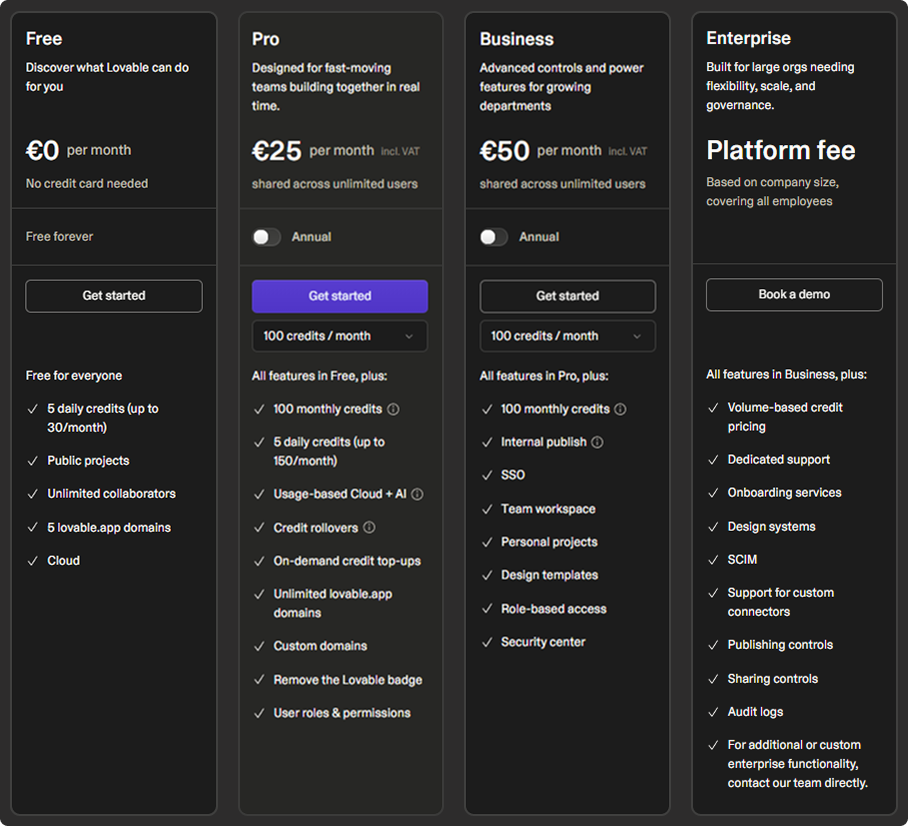
German VAT (19%) applies automatically through Stripe. Invoices include proper German VAT IDs and are downloadable for accounting. The credit system means costs scale with usage intensity rather than seat count. A solo founder building one application might stay on Pro for months. A team generating multiple prototypes weekly could exhaust Pro credits quickly. Unused credits do not roll over — they reset monthly. This favors consistent usage patterns over burst workflows.
Scroll horizontally to see all columns
| Tier | Monthly Cost | Credits | Key Features |
|---|---|---|---|
| Free | €0 | 50 | Basic generation, public projects, community support |
| Pro | ~€19 | 500 | Custom domains, private projects, priority queue |
| Business | ~€47 | 2000 | Team seats, advanced deploy, analytics |
| Enterprise | Custom | Unlimited | SSO, DPA, dedicated support, SLA |
Compared to hiring a German development agency — typical day rates €800-1,500 — even the Business tier represents minimal cost for validated prototypes. The calculation shifts when you consider that Lovable generates code you still need to review, test, and often modify. It accelerates development but doesn't eliminate the need for technical judgment. German founders report the highest ROI when using Lovable for initial MVP validation before committing to full development contracts.
Integrations Relevant to German Market
Lovable's native integrations cover the modern stack: Supabase for database and auth, Stripe for payments, GitHub for version control, Vercel for deployment. For German applications, specific integration considerations arise. Stripe handles SEPA direct debit, SOFORT, and Giropay automatically when you configure the payment methods in your Stripe dashboard. The generated Stripe integration code supports these methods without additional work — you enable them in Stripe, and the Lovable-generated checkout flow adapts.
Supabase's EU regions include Frankfurt, which satisfies data residency requirements for most German compliance scenarios. The generated authentication supports email/password, magic links, OAuth providers (Google, GitHub, GitLab), and can be extended for German identity providers like Verimi or Yes.com through custom OAuth configuration. Date formatting, number localization, and currency display (EUR) work out of the box with proper locale configuration in the generated React components.
For enterprise German teams, the GitHub integration enables standard workflows: pull requests, code reviews, CI/CD pipelines. The generated code follows conventional React/TypeScript patterns, making it readable for German developers accustomed to typical enterprise codebases. Teams can eject from Lovable's managed deployment at any point — the GitHub repository contains the full application source, ready for self-hosted Kubernetes, AWS, or Azure deployments common in larger German organizations.
Use Cases: German Founders Building with Lovable
The German startup ecosystem has distinct patterns: B2B SaaS, marketplace platforms, internal tools for Mittelstand companies, and regulated industry applications. Lovable fits several of these scenarios well. Founders building B2B SaaS MVPs report generating functional dashboards, user management, subscription billing, and admin panels in days rather than weeks. The Supabase backend handles multi-tenancy patterns common in German B2B applications — row-level security policies generate automatically when you describe tenant isolation requirements.
Internal tools for German SMEs represent another strong use case. A typical scenario: a manufacturing company needs a custom inventory dashboard connecting to their existing ERP via API. Lovable generates the React frontend, authentication, and API integration layer. The developer then focuses on the ERP connection specifics rather than building CRUD interfaces from scratch. Several German agencies now use Lovable as a prototyping accelerator for client projects, delivering clickable prototypes in initial workshops.
- B2B SaaS MVP with multi-tenant architecture and German invoicing
- Internal admin panels for Mittelstand digitalization projects
- Marketplace platforms with SEPA payouts to German sellers
- Compliance dashboards for GDPR, GoBD, or ISO 27001 documentation
- Customer portals with German identity provider integration
- Rapid prototypes for agency client presentations
E-commerce applications work but require more customization. The generated Stripe integration handles payments, but German e-commerce requires specific legal pages (Impressum, AGB, Widerrufsbelehrung), Trusted Shops integration, and specific checkout flows. Lovable generates the technical foundation; the legal compliance layer remains manual work. Founders building German marketplaces should budget additional development time for these requirements.
Community and Learning Resources in Germany
The German Lovable community is growing but remains smaller than the US base. The official Discord has a German-language channel with several hundred active members. Questions about GDPR, German payment integration, and local hosting options receive quick responses from both community members and occasional Lovable team members. Several German developers publish tutorials on YouTube and personal blogs — search "Lovable Deutschland" or "Lovable German tutorial" for current content.
Lovable's official documentation includes guides for Supabase EU regions, Stripe European payment methods, and Vercel Frankfurt deployment. These aren't Germany-specific but cover the technical configurations German teams need. The platform's template library includes starter kits for SaaS, marketplaces, dashboards, and landing pages — all adaptable to German requirements. Templates save significant time on boilerplate: authentication flows, database schemas, and deployment pipelines come pre-configured.
For teams preferring structured learning, several German coding bootcamps and corporate training providers have started incorporating Lovable into their curricula. The platform's low barrier to entry — natural language prompting instead of syntax memorization — makes it accessible for product managers, designers, and non-technical founders who want to build functional prototypes without learning React. This democratization aspect resonates with German initiatives around digital literacy and founder enablement.
Security Architecture for German Enterprise Requirements
German enterprise procurement processes typically require security questionnaires covering data handling, encryption, access controls, and incident response. Lovable's Enterprise tier provides the documentation package: SOC 2 Type II report, penetration test summaries, data processing agreements with EU standard contractual clauses, and subprocessor lists. The platform encrypts data in transit (TLS 1.3) and at rest (AES-256). Generated applications inherit Vercel and Supabase security postures, both of which maintain extensive compliance certifications.

Role-based access control within Lovable projects allows German teams to separate concerns: developers with generation access, reviewers with read-only access, admins with billing and deployment control. Audit logs track generation actions, deployments, and permission changes. For regulated environments, the Enterprise tier supports SAML/SSO integration with corporate identity providers (Azure AD, Okta, Auth0) — standard in German enterprise IT landscapes.
Scroll horizontally to see all columns
| Feature | Free | Pro | Business | Enterprise |
|---|---|---|---|---|
| TLS Encryption | Yes | Yes | Yes | Yes |
| Private Projects | No | Yes | Yes | Yes |
| Team Access Control | No | No | Yes | Yes |
| Audit Logs | No | No | Limited | Full |
| SSO/SAML | No | No | No | Yes |
| Custom DPA | No | No | No | Yes |
| SOC 2 Report Access | No | No | No | Yes |
A practical consideration: the AI generation process sends your prompts to Lovable's LLM providers (currently Anthropic's Claude and OpenAI's models). Enterprise customers can request data processing agreements covering these sub-processors. For highly sensitive projects — defense, healthcare patient data, banking core systems — some German organizations prefer self-hosted AI coding assistants. Lovable's cloud-only architecture may not satisfy the strictest air-gap requirements. Evaluate this early in procurement.
Comparison with Alternatives in German Market
German founders evaluating Lovable typically compare it against Bolt.new, v0.dev, Replit Agent, and Cursor. Each has different positioning. Bolt.new runs entirely in-browser with WebContainer technology — no cloud generation, which appeals to teams with strict data policies. v0.dev focuses on UI component generation from shadcn/ui patterns, less on full-stack applications. Replit Agent provides a full development environment with AI assistance, closer to a traditional IDE. Cursor is an AI-enhanced code editor for developers who write code themselves.
Lovable differentiates through its full-stack orientation: database, auth, payments, and deployment handled automatically. For a German founder wanting to validate a SaaS idea in two weekends, this end-to-end automation matters more than the specific LLM model underneath. The trade-off is less granular control over the generated architecture. Teams with strong opinions on folder structure, state management libraries, or testing frameworks will spend time adjusting Lovable's output.
Lovable feels like hiring a junior full-stack developer who works instantly but needs code review. For MVP validation, that's exactly what you want.
Pricing comparison favors Lovable for solo founders and small teams. Bolt.new and v0.dev offer generous free tiers but charge per seat for team features. Replit's pricing scales with compute resources. Cursor charges per seat. Lovable's credit model aligns cost with AI usage rather than team size — a solo founder generating heavily pays more than a five-person team generating lightly. German agencies running multiple client prototypes should model their expected credit consumption against seat-based alternatives.
Limitations German Teams Should Know
No platform fits every scenario. Lovable's current limitations affect German teams in specific ways. The English-only interface creates friction for non-technical German stakeholders participating in the development process. Product managers, designers, or business founders who don't speak technical English cannot directly use the platform. They must work through a technical intermediary or wait for localization — which Lovable has not announced a timeline for.
Complex German regulatory requirements — GoBD-compliant accounting exports, ELSTER tax interface integration, specific healthcare data standards (KV-SafeNet, TI-Messenger) — require custom development beyond what Lovable generates. The platform provides the application shell; domain-specific integrations remain manual work. Teams building for regulated German sectors should allocate 40-60% of development time for compliance features regardless of the AI generator used.
Credit consumption can surprise new users. Complex prompts — "build a multi-tenant SaaS with role-based permissions, Stripe subscriptions, admin dashboard, and email notifications" — may consume 50-100 credits in a single generation cycle as the AI iterates through files. The Pro tier's 500 monthly credits support roughly 5-10 complex feature generations. Teams should start with focused, incremental prompts rather than attempting entire applications in one request. This prompting discipline develops quickly but costs credits during the learning curve.
Getting Started: Practical First Steps for German Builders
Start with the Free tier. Create a simple project — a landing page with contact form, or a basic CRUD application for a familiar domain. Use German prompts to test the AI's language capability. Deploy to Vercel's Frankfurt region. Connect a custom German domain (.de) to verify the DNS and SSL flow. This end-to-end test takes 30-60 minutes and validates the complete pipeline before committing to a paid tier.
Join the Discord German channel early. Ask specific questions about your use case — "Has anyone built a German marketplace with SEPA payouts?" or "How do you handle GoBD-compliant audit logs?" The community responds with practical experience, not marketing claims. Save successful prompts and generated patterns. Build a personal library of prompt templates for common German application patterns: multi-tenant SaaS, admin dashboards, customer portals, marketplace cores.
- Sign up Free tier → test German prompts → deploy to Frankfurt
- Verify custom .de domain and SSL certificate
- Test Stripe SEPA payment flow in sandbox mode
- Configure Supabase EU region for database
- Join Discord #german channel for community support
- Build prompt library for your recurring patterns
- Evaluate Pro tier after 2-3 real project cycles
For teams, establish prompting conventions early. Define whether prompts use English or German consistently. Document the project structure Lovable generates so team members can navigate the codebase. Set up GitHub repository with branch protection and code review requirements — the generated code merges like any other contribution. Treat Lovable as a team member who writes first drafts, not a replacement for architectural decisions.
Final Assessment: Lovable for German Founders
Lovable delivers genuine acceleration for German founders building modern web applications. The platform handles the undifferentiated heavy lifting — authentication scaffolding, database schema generation, payment integration boilerplate, deployment pipeline configuration — allowing teams to focus on domain logic and German market specifics. GDPR compliance is achievable through Frankfurt hosting regions and Supabase EU data centers. The credit-based pricing aligns with German startup budget cycles. The generated code is portable, standard React/TypeScript that German developers can maintain long-term.
The gaps are real but manageable. English-only interface, missing German legal templates, and credit unpredictability during learning phase create friction. Teams building for regulated German industries need clear-eyed assessment of compliance workload beyond the generated foundation. For MVP validation, internal tools, B2B SaaS prototypes, and agency client work, Lovable provides measurable velocity improvement. The decision framework: if your alternative is hiring a German agency at €1,000/day for 4-6 weeks of MVP development, Lovable's Pro tier at ~€19/month plus a few days of prompting and review represents compelling economics. If your alternative is a senior developer building clean architecture from scratch in two weeks, the comparison shifts toward code quality and long-term maintainability.
The platform doesn't replace German engineering rigor — it moves it upstream into prompt design and code review.
German founders should approach Lovable as a force multiplier for technical teams, not a replacement for technical judgment. The most successful adopters treat generated code as a sophisticated starting point: reviewed, tested, refactored, and extended with domain expertise. That mindset — pragmatic, quality-conscious, compliant — aligns well with how German software engineering operates at its best.
Frequently Asked Questions
Does Lovable support German language in the interface?
The interface is English-only currently. However, the AI understands German prompts fluently and generates German-language UI text in your application. Documentation and support channels operate in English.
Can I deploy my Lovable app to a German data center?
Yes. Vercel deployment offers Frankfurt region selection, and Supabase databases deploy to EU regions including Frankfurt. This keeps runtime user data within Germany for GDPR compliance.
How does Lovable handle German VAT for subscriptions?
Stripe processes payments and automatically applies German VAT (19%) based on your billing address. Invoices include proper VAT IDs and are downloadable for German accounting requirements.
Are SEPA direct debit and SOFORT supported in generated apps?
Yes. The Stripe integration supports SEPA, SOFORT, Giropay, and Klarna. Enable these payment methods in your Stripe dashboard — the generated checkout code adapts automatically.
What happens to my code if I cancel my Lovable subscription?
You own all generated code completely. The GitHub repository remains yours with full source code. You can continue developing, deploying, and maintaining the application independently of Lovable.
Is Lovable suitable for German enterprise procurement requirements?
The Enterprise tier provides SOC 2 Type II reports, custom DPAs, SSO/SAML integration, and audit logs. For strict air-gap requirements, note that Lovable is cloud-only and sends prompts to external LLM providers.
How many credits does a typical German SaaS MVP consume?
A focused MVP with auth, database, payments, and admin dashboard typically consumes 200-400 credits across multiple generation cycles. Start with Free tier (50 credits/month) to learn prompting efficiency before upgrading.