

AI Development Tools
Lovable Reviews: What Users Say About the AI App Builder
An honest look at Lovable reviews across platforms to help you decide if this AI builder fits your workflow.


Senior Software Developer & Trading Technology Specialist
Ethan Parker is a software developer with over 8 years of experience in building web applications, trading tools, and financial technology solutions. He specializes in Python, JavaScript, API integrations, and trading automation, helping traders improve efficiency through innovative technology.
Lovable has quickly become one of the most talked-about AI app builders in the developer community. The promise is straightforward: describe what you want in plain English, and the platform generates a working React application with TypeScript, Tailwind CSS, and Vite. But marketing claims only tell half the story. To understand whether Lovable actually delivers, you need to look at what people who use it daily are saying — on Trustpilot, Reddit, GitHub discussions, and in private Discord channels.
Contents
- 1. What Lovable Actually Does
- 2. Trustpilot and Public Review Aggregators
- 3. Reddit Community Feedback
- 4. Pricing and Value Perception
- 5. Features Users Consistently Praise
- 6. Common Complaints and Limitations
- 7. Comparison with Alternatives
- 8. Enterprise and Team Feedback
- 9. Security and Reliability Reviews
- 10. Learning Curve by User Type
- 11. Community and Support Experience
- 12. Final Assessment of Lovable Reviews
This article aggregates those conversations. I've read through hundreds of reviews, forum threads, and social media posts to pull out patterns that matter. The goal isn't to sell you on the tool or steer you away. It's to give you a clear picture of where Lovable shines, where it frustrates people, and whether it fits the kind of work you do.
Most reviews cluster around a few themes: speed to first prototype, code quality, pricing fairness, integration depth, and the learning curve for non-technical founders. The consensus shifts depending on who you ask. A solo founder building an MVP sees something different than a senior engineer trying to maintain a production codebase. Both perspectives are valid, and both appear in the feedback below.
What Lovable Actually Does
Before diving into reviews, it helps to understand the product. Lovable is a browser-based AI agent that writes, edits, and deploys full-stack web applications. You chat with it like a pair programmer. It scaffolds React components, sets up Supabase for database and auth, configures Stripe for payments, and pushes everything to GitHub. The generated code is yours — you can download it, self-host, or keep iterating in the Lovable editor.
The platform targets a wide spectrum: non-technical founders who want to validate ideas without hiring developers, product managers building internal tools, designers turning Figma files into live interfaces, and engineers who want to skip boilerplate. That breadth shows up in the reviews. People evaluate Lovable against different baselines, which explains why some call it revolutionary while others call it a toy.
The core loop is simple: prompt, preview, refine, deploy. But the details matter. Lovable uses a combination of Claude and GPT models under the hood, with a custom orchestration layer that understands project structure, dependencies, and deployment targets. It's not just a code generator — it maintains context across files, handles migrations, and manages environment variables. That architectural awareness is what separates it from simpler prompt-to-code tools.
Trustpilot and Public Review Aggregators
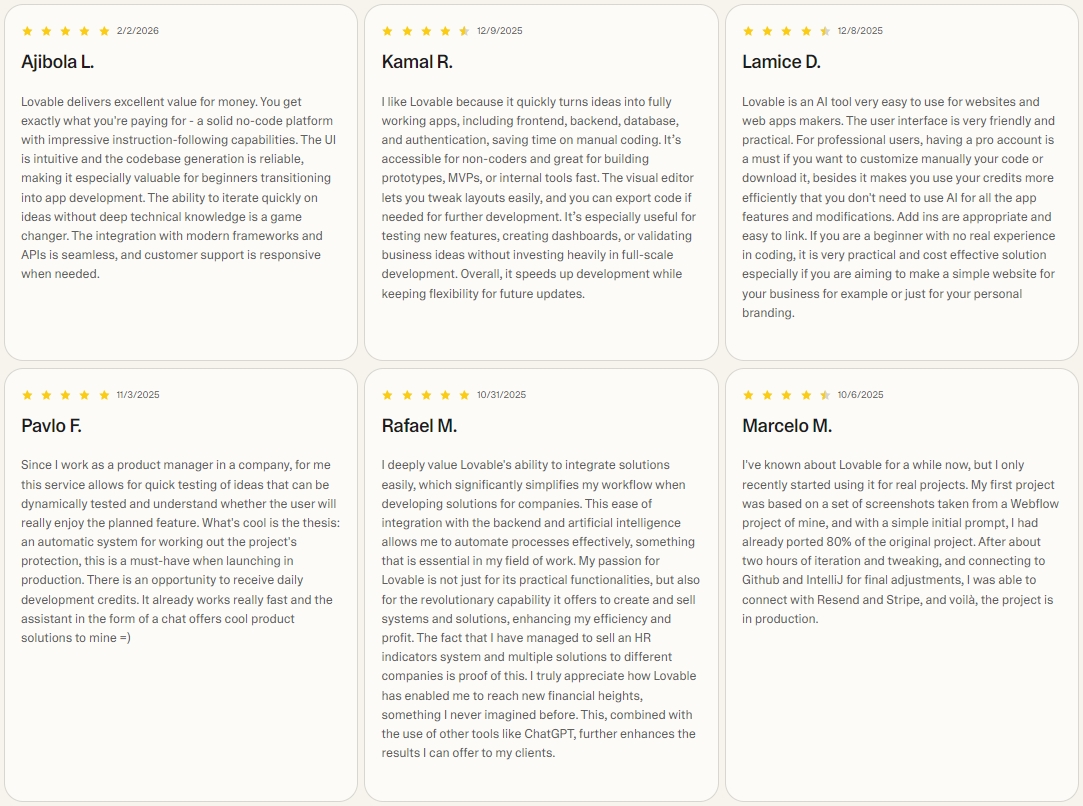
Trustpilot is where most non-technical users leave feedback. As of early 2025, Lovable sits around 4.3 stars across a few hundred reviews. That's solid for a dev tool, but the distribution tells a more interesting story. The five-star reviews tend to come from founders who shipped an MVP in days instead of months. The one- and two-star reviews cluster around billing confusion, token limits, and the gap between demo videos and real-world complexity.
A recurring complaint on Trustpilot involves the credit system. Lovable charges per generation, and complex requests can burn through credits faster than expected. Several reviewers mention hitting limits mid-project and feeling pressured to upgrade. Others note that the free tier is generous enough to build a meaningful prototype, but the jump to paid plans feels steep for solo builders. The enterprise pricing is opaque — you have to book a demo — which frustrates teams trying to budget.
Positive reviews consistently highlight the Supabase integration. Users appreciate that database schema, authentication, and real-time subscriptions work without manual configuration. The Stripe integration gets similar praise for handling checkout sessions and webhooks automatically. These aren't trivial — setting up auth and payments manually takes days. Lovable compresses that to minutes, and reviewers notice.
Reddit Community Feedback
Reddit discussions on r/LovableDev, r/SaaS, and r/IndieHackers reveal a more technical conversation. Developers here care about code ownership, Git hygiene, and whether the AI produces maintainable architecture. The sentiment is cautiously optimistic. Most agree Lovable is exceptional for 0-to-1 prototyping. Opinions diverge on 1-to-N scaling.
A common thread: Lovable generates clean React code with proper TypeScript types, but it sometimes over-engineers simple components or creates unnecessary abstraction layers. Senior engineers report spending time refactoring AI-generated patterns before committing to production. Junior developers and non-technical founders rarely notice — they're just glad it works. This split appears repeatedly in Reddit threads about 'lovable dev trustpilot' comparisons.
GitHub integration gets mixed marks. The sync works reliably for most, but merge conflicts arise when you edit locally and in Lovable simultaneously. The platform now warns about this, but it's still a workflow friction point. Several Reddit users recommend a discipline: either work entirely in Lovable or pull the repo, work locally, and push — don't mix. That's reasonable for a tool in this category, but worth knowing before you start.
- Excellent for rapid prototyping and MVP validation
- Code quality good but sometimes over-abstracted
- GitHub sync works if you pick one workflow
- Supabase and Stripe integrations save significant time
- Credit system can be unpredictable for complex apps
- Enterprise pricing lacks transparency
Pricing and Value Perception
Pricing comes up in almost every review thread. Lovable offers a free tier with daily credits, then Pro at $20/month, Business at $50/month, and Enterprise by quote. The credit model means you pay for AI generations, not seat count. That aligns cost with usage, but it creates unpredictability. A simple CRUD app might cost a few dollars in credits. A complex dashboard with real-time features and multiple integrations can burn through a Pro month's allowance in a weekend.
Reviewers who come from traditional SaaS tools (where you pay per seat) find the credit model confusing at first. Once they understand it, most accept it — but they want better visibility. The dashboard shows credit consumption per project, but not per prompt. Several users have requested prompt-level breakdowns to optimize their prompting strategy. Lovable has acknowledged this feedback but hasn't shipped granular reporting yet.
Scroll horizontally to see all columns
| Tier | Monthly Cost | Credits Included | Best For |
|---|---|---|---|
| Free | $0 | Daily allowance | Learning, small prototypes |
| Pro | $20 | Monthly pool | Solo founders, indie hackers |
| Business | $50 | Larger pool + team features | Small teams, agencies |
| Enterprise | Custom | Unlimited + SLA + support | Organizations, production apps |
The value calculation changes dramatically based on your alternative. If you're comparing against hiring a freelance developer at $75-150/hour, even the Business tier pays for itself in hours saved. If you're a developer who would write the code yourself, the calculation is about time-to-first-deploy versus long-term maintenance burden. Most reviews agree: for 0-to-1, the ROI is obvious. For ongoing development, it depends on how much you fight the AI.
Features Users Consistently Praise
Across every platform, certain features earn consistent praise. The Supabase integration tops the list. Reviewers describe spinning up a PostgreSQL database with row-level security, authentication providers, and real-time subscriptions in a single prompt. That's genuinely difficult to replicate manually without deep Supabase knowledge. Lovable's abstraction handles migrations, types, and client configuration automatically.
The Figma-to-code workflow is another standout. Designers paste a Figma frame URL, and Lovable generates pixel-perfect React components with Tailwind classes. It's not perfect — complex auto-layout structures sometimes need manual adjustment — but it eliminates the tedious translation layer between design and implementation. Several agency reviewers say this alone justifies the Business tier for their workflow.
The Figma integration turned our design handoff from a two-day process into a thirty-minute review. We still tweak spacing, but the structure is there.
Deployment simplicity rounds out the top three. One-click deploy to Vercel, Netlify, or custom domains with automatic environment variable management. Reviewers who've wrestled with CI/CD pipelines appreciate not thinking about build configs, preview deployments, or SSL certificates. It works the way you'd expect modern hosting to work.

The component library and template marketplace also get positive mentions. Lovable ships with pre-built patterns for dashboards, landing pages, auth flows, and e-commerce checkouts. You can browse, preview, and fork templates directly in the editor. Community-contributed templates extend this further. For teams building similar apps repeatedly, this creates a reusable starting point that compounds over time.
Common Complaints and Limitations
No tool escapes criticism, and Lovable's limitations are worth understanding before you commit. The most frequent complaint: the AI sometimes hallucinates API calls or imports packages that don't exist. This happens less with each model update, but it still occurs on complex prompts. Experienced developers catch these quickly. Non-technical users can get stuck debugging errors they don't understand.
Context window limits create another friction point. Lovable maintains project context, but very large codebases exceed what the underlying models can hold in a single conversation. The platform chunks context intelligently, but reviewers report degradation on projects with 50+ files. Workarounds exist — modular architecture, focused prompts — but they require discipline. This is a fundamental constraint of current LLM architecture, not a Lovable-specific bug.
Mobile responsiveness is another area where reviews diverge. Lovable generates Tailwind classes with responsive breakpoints, but complex layouts sometimes break at unusual viewport sizes. The AI can fix these when prompted, but it's iterative. Several reviewers note they still open browser dev tools and manually adjust breakpoints for production polish. If you need pixel-perfect responsive behavior across every device, budget time for manual QA.
Comparison with Alternatives
Reviewers inevitably compare Lovable to Bolt, v0, Replit Agent, and Cursor. Each serves a slightly different persona. Bolt excels at rapid prototyping with a more conversational interface but lacks Lovable's deployment and integration depth. v0 (by Vercel) generates beautiful UI components but stops at the frontend — no backend, database, or auth. Replit Agent offers a full IDE in the browser with AI assistance, appealing to developers who want more control. Cursor is an AI-enhanced VS Code fork for local development.
Scroll horizontally to see all columns
| Tool | Best For | Backend Support | Deployment | Pricing Model |
|---|---|---|---|---|
| Lovable | Full-stack MVPs, non-technical founders | Supabase, Stripe, custom APIs | Vercel, Netlify, custom | Credits + subscription |
| Bolt | Quick prototypes, UI exploration | Limited (Supabase beta) | Netlify only | Subscription |
| v0 | UI components, design systems | None (frontend only) | Vercel only | Subscription |
| Replit Agent | Developers wanting full IDE control | PostgreSQL, any stack | Replit hosting | Subscription + compute |
| Cursor | Local AI-assisted development | Any (your machine) | Your infrastructure | Subscription |
The consensus on Reddit: Lovable wins for non-technical founders building complete products. Bolt wins for designers exploring UI concepts. v0 wins for design system work. Replit Agent wins for developers who want a cloud IDE. Cursor wins for existing codebases. No single tool dominates every use case, and most serious builders use multiple tools in their workflow.
Enterprise and Team Feedback
Team and enterprise reviews are thinner on public platforms — most happen in private Slack channels or direct conversations with Lovable's sales team. But patterns emerge. Organizations value the GitHub sync, role-based access, and audit logs. They also ask for SSO, SOC 2 compliance, and dedicated support. Lovable has shipped SSO and is pursuing SOC 2. Audit logs exist but reviewers say they're basic.
A notable gap: no self-hosted option. Enterprises with strict data residency requirements can't run Lovable on-premise. The platform is cloud-only. For some organizations, that's a blocker. For others, the productivity gain outweighs the constraint. Several enterprise reviewers mention evaluating Lovable for internal tooling rather than customer-facing products, where compliance requirements differ.
We use Lovable for internal admin panels and dashboards. It's not customer-facing, so compliance is simpler. Our engineers review the PRs. Works well for that scope.
Team collaboration features are evolving. Real-time co-editing exists but feels early — reviewers report occasional cursor conflicts and sync delays. Comment threads on specific lines work better. The workflow most teams settle on: one person drives in Lovable, others review the GitHub PR. That's not a criticism; it's how most AI-assisted development works today. But if you expect Google Docs-style collaboration, adjust expectations.
Security and Reliability Reviews
Security discussions appear mostly in technical forums. Lovable generates code that follows React and Supabase security best practices by default: parameterized queries, row-level security policies, secure auth flows. But the AI doesn't audit your business logic. If you prompt it to build an admin panel without proper authorization checks, it will. Several security-conscious reviewers emphasize: treat Lovable output as a first draft, not a security review.

Reliability metrics are harder to find in reviews. Lovable doesn't publish uptime SLAs for non-enterprise tiers. Community consensus: the platform is stable for development, but production deployments depend on Vercel/Netlify/Supabase — not Lovable itself. Once you deploy, you're on those platforms' infrastructure. That's by design. Lovable is a build-time tool, not a runtime platform.
Learning Curve by User Type
Reviews segment cleanly by user background. Non-technical founders describe a steep but rewarding learning curve. The first week involves understanding concepts like components, state, props, and API routes — not because Lovable requires you to write them, but because effective prompting requires mental models of what you're asking for. Founders who invest in learning basic React concepts get dramatically better results.
Designers transition smoothly. The Figma integration speaks their language. They struggle more with backend concepts: database relationships, authentication flows, server-side logic. Lovable abstracts much of this, but complex features still require understanding the data model. Several designer reviewers mention pairing with a developer for the backend-heavy portions.
Developers have the easiest onboarding but the highest standards. They spot AI mistakes instantly. They also have the strongest opinions on code style, architecture patterns, and tooling. Senior engineers tend to use Lovable for scaffolding, then take over manually. Junior engineers use it as a learning accelerator — reading generated code to understand patterns. Both approaches work; neither is wrong.
Community and Support Experience
Lovable's Discord community is active, with staff regularly answering questions. Reviewers praise the responsiveness — bug reports often get fixes within days. The documentation has improved significantly over the past year, with video guides, prompt libraries, and architecture deep-dives. But gaps remain for advanced use cases: custom Supabase functions, complex Stripe webhook handling, multi-tenant architectures.
Email support exists for paid tiers. Response times vary — Pro users report 24-48 hours, Business users get faster responses. Enterprise includes dedicated Slack channels. No phone support at any tier. For a developer tool, that's standard. But non-technical founders sometimes expect more hand-holding. The mismatch between expectation and reality shows up in negative reviews.
Discord is the real support channel. Staff are there daily. Documentation covers 80% of cases. The last 20% you figure out in the community or by reading the generated code.
Final Assessment of Lovable Reviews
The review landscape paints a consistent picture. Lovable is genuinely useful for a specific job: turning ideas into working full-stack applications fast. It excels at 0-to-1. It handles the boring parts — auth, database, payments, deployment — so you can focus on product logic. For non-technical founders, it's often the difference between shipping and not shipping. For developers, it's a powerful scaffolding tool that requires oversight.
The credit model creates real unpredictability. If you're building a complex app with many iterations, budget for the Business tier or expect to hit limits. The enterprise story is incomplete — no self-hosting, basic audit logs, SOC 2 in progress. Teams with compliance needs should evaluate carefully. But for the vast majority of indie hackers, startups, and internal tool builders, those constraints don't apply.
Code quality is good enough for production if you review it. The AI doesn't replace engineering judgment. It accelerates the parts that don't require judgment. That's the right mental model. Reviewers who treat Lovable as an autonomous engineer get burned. Reviewers who treat it as a senior pair programmer who types fast but occasionally hallucinates get exceptional leverage.
Frequently Asked Questions
Is Lovable worth it for non-technical founders?
Yes, if you're willing to learn basic product concepts. The learning curve is real but manageable. Most non-technical founders who stick with it for two weeks report being able to build functional MVPs independently.
How does Lovable compare to hiring a freelance developer?
For MVP validation, Lovable is faster and cheaper. For production-grade products with complex requirements, a skilled developer still produces better architecture. Many teams use Lovable for v1, then hire developers to rebuild or scale.
Can I export my code and leave Lovable?
Yes. Your code lives in GitHub. You can clone, self-host, and continue development without Lovable. No vendor lock-in on the generated code.
What happens when I hit my credit limit?
Generation pauses until your monthly reset or upgrade. You can still view and edit projects, but AI features are disabled. The free tier resets daily; paid tiers reset monthly.
Does Lovable work for mobile apps?
Lovable builds responsive web apps. You can wrap them in Capacitor or React Native WebView for app store distribution, but it doesn't generate native mobile code directly.
Is the generated code maintainable long-term?
It follows modern React patterns and TypeScript best practices. Senior developers report it's cleaner than expected but sometimes over-abstracted. Plan for a refactor pass before scaling the team.
What integrations does Lovable support natively?
Supabase (database, auth, storage, real-time), Stripe (payments, subscriptions), GitHub (version control, CI/CD), Vercel/Netlify (deployment), Figma (design import), and custom REST/GraphQL APIs.