

AI Development Tools
Lovable Enterprise: AI App Building for Large Teams
Everything teams need to know about scaling AI-powered development with Lovable's enterprise tier.

Senior Software Developer & Trading Technology Specialist
Ethan Parker is a software developer with over 8 years of experience in building web applications, trading tools, and financial technology solutions. He specializes in Python, JavaScript, API integrations, and trading automation, helping traders improve efficiency through innovative technology.
Lovable Enterprise represents the top tier of an AI-powered application builder that has gained traction among developers and non-technical founders alike. The platform lets users describe applications in natural language and watches working code generate in real time. For individual builders and small teams, the Free, Pro, and Business plans cover most needs. Enterprise exists for organizations that need dedicated infrastructure, advanced security controls, compliance certifications, and contractual guarantees that standard plans cannot provide.
Contents
- 1. What Changes at the Enterprise Tier
- 2. Pricing Structure and Commercial Terms
- 3. Security Architecture and Compliance
- 4. Team Collaboration at Scale
- 5. Integration Ecosystem and Extensibility
- 6. Use Cases That Justify Enterprise
- 7. Migration Path from Lower Tiers
- 8. Support Model and Operational Partnership
- 9. Governance and Policy Enforcement
- 10. AI Model Selection and Data Handling
- 11. Real-World Deployment Patterns
- 12. Comparison with Alternative Approaches
- 13. Implementation Timeline and Milestones
- 14. Final Assessment of Lovable Enterprise
The jump to Enterprise is not simply about more credits or higher limits. It introduces a different relationship between the organization and the platform. Dedicated support channels, custom deployment options, data residency choices, and legal agreements all become part of the package. This article walks through what changes at the Enterprise level, who should consider it, and what the practical implications look like for engineering leads, security teams, and procurement.
Most teams discover Lovable through the free tier, building prototypes or internal tools without writing boilerplate. As those projects move toward production, the constraints of shared infrastructure and standard support become apparent. Enterprise addresses those constraints directly, but it also introduces new considerations around cost, commitment, and organizational readiness that deserve honest evaluation.
What Changes at the Enterprise Tier
The Enterprise plan removes the credit-based metering that governs lower tiers. Instead of tracking AI generation credits, organizations get unlimited generations within fair use boundaries defined in the master services agreement. This shift matters for teams running daily builds, automated testing pipelines, or continuous preview deployments where credit consumption becomes unpredictable.
Infrastructure isolation is the most significant technical difference. Enterprise customers can deploy to dedicated clusters in specific cloud regions, including AWS GovCloud for public sector requirements. Data never shares compute or storage with other tenants. For companies in regulated industries — healthcare, financial services, defense — this isolation often determines whether Lovable can be used at all.
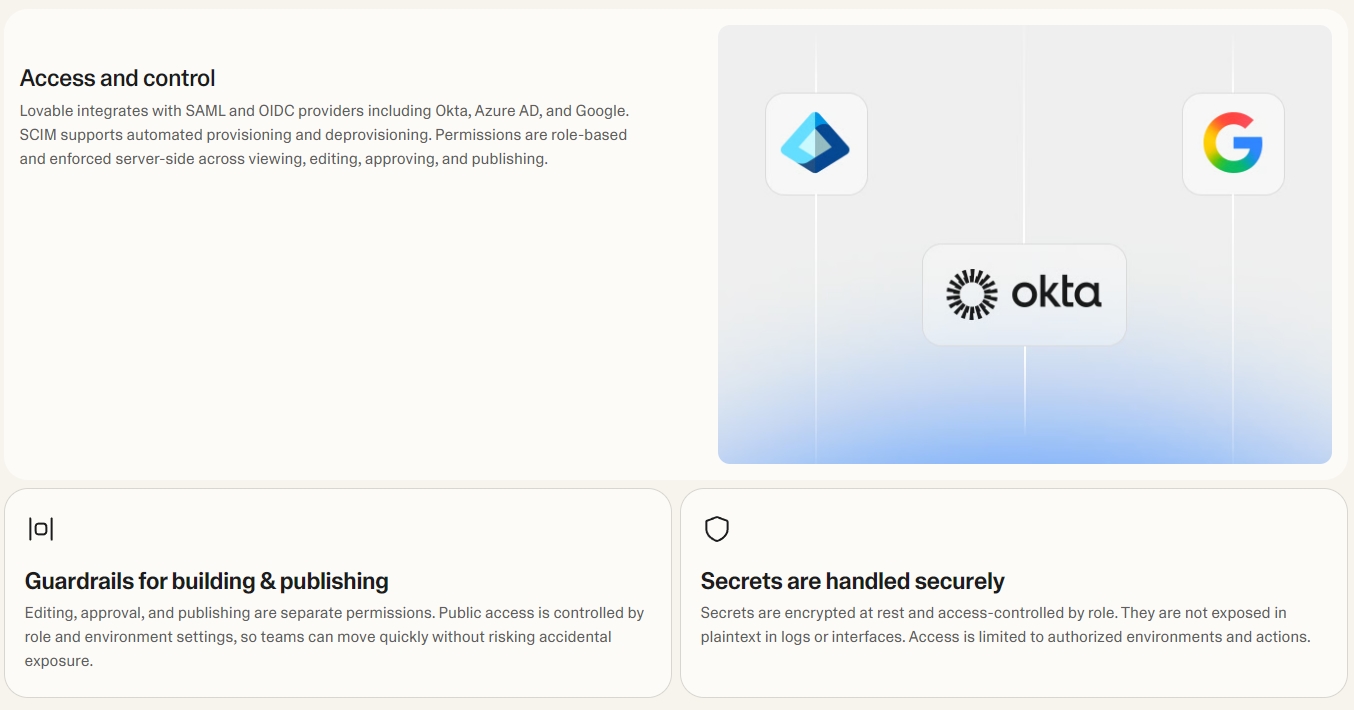
Security controls expand considerably. Single sign-on via SAML 2.0 and OIDC becomes available, with SCIM provisioning for automated user lifecycle management. Audit logs capture every generation, deployment, and access event with retention periods configurable up to seven years. Customer-managed encryption keys (CMEK) let organizations maintain control over data at rest. These features map directly to SOC 2 Type II, ISO 27001, and HIPAA compliance requirements that procurement teams routinely request.
Pricing Structure and Commercial Terms
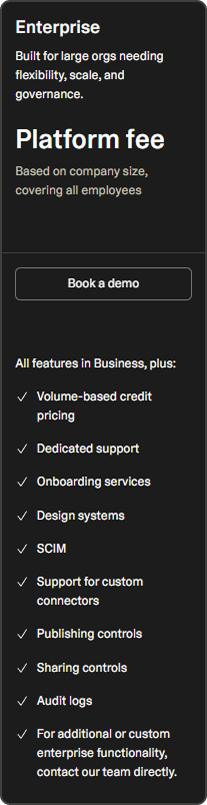
Lovable does not publish Enterprise pricing on its website. The model follows a platform fee plus usage structure, negotiated per account. Factors include seat count, expected generation volume, deployment regions, support tier, and contract length. Multi-year agreements typically include volume discounts. A proof-of-concept period — often 30 to 60 days — is standard before full commitment.
The platform fee covers dedicated infrastructure, support SLAs, and compliance artifacts. Usage beyond fair use boundaries incurs overage charges defined in the contract. Organizations should model their expected workloads carefully during the evaluation period. A team generating 500 applications per month with continuous preview deployments will have a very different cost profile than one building 20 applications per quarter.
Contractual terms deserve scrutiny. Data processing agreements, liability caps, indemnification clauses, and termination rights vary by negotiation. Legal review is essential. Some organizations negotiate source code escrow arrangements for business continuity. Others require specific uptime SLAs with financial penalties. The flexibility exists, but it requires proactive discussion during the sales cycle.
Security Architecture and Compliance
Security at the Enterprise level goes beyond feature checkboxes. The platform runs on a hardened Kubernetes control plane with network policies restricting inter-service communication. All traffic encrypts in transit using TLS 1.3. Container images scan for vulnerabilities on every build. Runtime security monitoring detects anomalous behavior in generated applications.

The security controls dashboard gives administrators visibility into authentication events, permission changes, and deployment activity across all projects. Role-based access control supports custom roles beyond the standard owner, admin, member hierarchy. Teams can enforce policies like requiring two-factor authentication, restricting external collaborators, or preventing deployments to production without approval gates.
Compliance documentation includes SOC 2 Type II reports, ISO 27001 certificates, and HIPAA business associate agreements. Penetration test summaries share under NDA. For organizations requiring FedRAMP or other government frameworks, the dedicated GovCloud deployment path provides the necessary control plane isolation. The compliance team publishes a trust center with current certifications and audit schedules.
Team Collaboration at Scale
Enterprise introduces organizational structures that mirror how large companies actually work. Workspaces group projects by business unit, product line, or environment. Each workspace carries its own billing allocation, member roster, and policy settings. A platform team can manage shared component libraries and design systems across workspaces while product teams retain autonomy over their applications.
The review workflow integrates with GitHub, GitLab, and Bitbucket. Pull requests generated by Lovable appear in the standard code review flow. Reviewers see the AI-generated diff alongside human-written changes. Approval policies can require specific reviewers for production deployments. This integration matters because it keeps security and quality gates in familiar tools rather than forcing a parallel process.
Shared prompts and templates become organizational assets. Teams can publish approved starting points for common application types — admin dashboards, customer portals, data visualization tools — reducing duplication and enforcing architectural standards. Version control for these templates means updates propagate without breaking existing projects.
Integration Ecosystem and Extensibility
Enterprise deployments often need deeper integration than the standard connector library provides. The platform supports custom connectors built against internal APIs, with a CLI and SDK for packaging them as reusable components. These private connectors appear alongside public ones in the generation interface, so developers invoke internal services as naturally as they call Stripe or Supabase.
Webhook endpoints receive real-time events for generation starts, completions, deployment status changes, and security findings. Organizations route these to SIEM platforms, incident management tools, or internal dashboards. The event schema is versioned and documented, allowing stable integration contracts.
For teams using infrastructure-as-code, the Terraform provider manages workspaces, members, policies, and connector configurations. This lets platform teams treat Lovable as another managed resource in their GitOps workflow. Changes to RBAC policies or connector allowlists go through the same review and deployment pipeline as Kubernetes manifests.
Scroll horizontally to see all columns
| Category | Standard Plan | Enterprise |
|---|---|---|
| Authentication | Email, GitHub, Google | SAML, OIDC, SCIM, Custom IdP |
| Deployment Regions | Shared US/EU | Dedicated, Multi-region, GovCloud |
| Custom Connectors | Not available | Full SDK and CLI support |
| Audit Logging | Basic 30-day | Configurable 7-year retention |
| Support Channel | Community, Email | Dedicated Slack, Phone, TAM |
| Data Export | Manual CSV | Automated, Scheduled, API |
Use Cases That Justify Enterprise
Not every organization needs Enterprise. The tier makes sense when specific conditions align. Internal tooling platforms for non-engineering teams — operations, support, sales, finance — often generate dozens of applications that become business-critical. When those tools handle customer data or financial workflows, the compliance and audit requirements escalate quickly.
Customer-facing products built on Lovable represent another driver. If the platform generates code that ships to paying users, the organization needs contractual protections, uptime guarantees, and the ability to audit every change. Enterprise provides the legal and operational framework for that scenario.
Regulated industry adoption follows a predictable pattern. A healthcare startup builds a patient intake portal on the Business plan. As they approach a BAA requirement, they evaluate Enterprise. The dedicated infrastructure and compliance artifacts unblock the deal. The same dynamic plays out in fintech, insurance, and government contracting.
Migration Path from Lower Tiers
Moving existing projects to Enterprise does not require rebuilding. Workspaces import with history intact. Git repositories maintain their connection. Environment variables, secrets, and custom domains transfer automatically. The migration typically completes in a single maintenance window scheduled with the customer success team.
The main friction point involves custom connectors and private packages. If the organization developed internal components on a lower tier, those need repackaging for the Enterprise connector registry. The process is straightforward but requires developer time. Planning for this during the evaluation period prevents delays after contract signing.
Data residency changes — moving from shared US infrastructure to dedicated EU or GovCloud — involve a full data migration. The platform handles this with zero-downtime tooling, but the organization should validate data sovereignty requirements with legal counsel before initiating. Some customers maintain parallel deployments during transition.
Support Model and Operational Partnership
Enterprise support differs fundamentally from the ticket-based system on lower tiers. Each account receives a technical account manager (TAM) who understands the organization's architecture, use cases, and escalation contacts. The TAM conducts quarterly business reviews, shares roadmap input, and coordinates incident response.
Severity 1 incidents — production downtime, data loss, security events — trigger a 15-minute response SLA with continuous updates until resolution. Severity 2 and 3 follow 1-hour and 4-hour targets. The support portal includes runbook templates for common scenarios, reducing mean-time-to-resolution for recurring issues.
Professional services engagements cover architecture reviews, custom connector development, migration assistance, and team training. These scope separately from the platform fee. Organizations often underestimate the value of dedicated onboarding; teams that invest in structured enablement see faster adoption and fewer architectural mistakes.
Governance and Policy Enforcement
Platform administrators define policies that apply across all workspaces. Generation policies can restrict certain AI models, require approval for external API calls, or enforce coding standards through linting rules. Deployment policies gate production releases behind approval workflows, automated tests, or security scans.
Cost governance tools track generation volume by workspace, project, and user. Budgets trigger alerts at configurable thresholds. Chargeback reports allocate platform costs to cost centers based on actual usage. For organizations running internal developer platforms, these controls prevent surprise bills and enable showback models.
The policy engine evaluates rules at generation time, not just deployment time. This means a developer attempting to use a prohibited library or pattern receives immediate feedback in the chat interface. The shift-left approach reduces rework and keeps compliance conversations in the development flow rather than at code review.
AI Model Selection and Data Handling
Enterprise customers gain visibility into and control over which foundation models process their prompts. The platform supports multiple model providers — Anthropic, OpenAI, and open-source options — with the ability to pin specific versions. Organizations can mandate that certain workspaces use only models hosted in their chosen region or only models meeting specific compliance criteria.
Data processing agreements extend to model providers. When using Anthropic models, the data processing terms flow through Lovable's agreement. For organizations with strict data sovereignty requirements, the option to use exclusively open-source models deployed in their own cloud account exists through a bring-your-own-model program currently in private beta.
Prompt and completion data retention policies are configurable. The default retains data for 30 days for debugging and improvement. Enterprise customers can reduce this to zero — meaning no prompt data persists after generation completes — or extend it for audit purposes. The setting applies per workspace.
Scroll horizontally to see all columns
| Control | Description |
|---|---|
| Model Allowlist | Restrict workspaces to approved models only |
| Region Pinning | Ensure inference runs in specific geography |
| Version Pinning | Lock to specific model versions for reproducibility |
| Data Retention | Configure prompt/completion storage from 0 to 365 days |
| BYOM Program | Deploy approved open-source models in customer cloud (beta) |
Real-World Deployment Patterns
A financial services firm uses Lovable Enterprise to build advisor-facing portfolio analysis tools. Their compliance team requires SOC 2 Type II, data residency in US-East, and audit logs retained for seven years. The platform team manages 12 workspaces across wealth management, retail banking, and risk divisions. Custom connectors wrap internal pricing engines and risk models. Generations average 3,000 per month across 40 active developers.
A healthcare technology company builds patient engagement applications on dedicated GovCloud infrastructure. Their BAA with Lovable covers PHI handling in generated code. The security team enforces a policy requiring security scan approval before any deployment to staging. They use the Terraform provider to manage 200+ workspace configurations as code. Monthly generations run around 1,200 with a team of 15.
A global consulting firm standardizes on Lovable for rapid client prototyping. Their Enterprise agreement covers 500 seats across 12 countries. Workspaces align to client engagements with automatic provisioning via SCIM. The firm maintains a private component library of approved UI patterns, data connectors, and compliance templates. Consultants generate client-specific prototypes in hours rather than weeks.
Comparison with Alternative Approaches
Organizations evaluating Enterprise often compare against building internal AI development platforms. The build vs. buy calculation centers on engineering opportunity cost. A dedicated platform team of 5-8 engineers can replicate core generation capabilities in 12-18 months, but ongoing model evaluation, connector maintenance, security hardening, and compliance artifacts create perpetual overhead.
Other AI coding assistants — GitHub Copilot, Cursor, Codeium — serve different workflows. They augment developers writing code in IDEs. Lovable targets a broader persona including product managers, designers, and domain experts who describe outcomes rather than implementation. The Enterprise tier supports both personas through the same platform, which matters for cross-functional teams.
Low-code platforms like Retool, Appian, or Mendix solve application delivery but constrain customization. Lovable generates standard React, TypeScript, and Tailwind code that developers can extend without platform limitations. The escape hatch — full code ownership and Git synchronization — distinguishes it from walled-garden low-code tools.
Scroll horizontally to see all columns
| Dimension | Lovable Enterprise | Internal Build | Low-Code Platform |
|---|---|---|---|
| Time to Production | Days | 12-18 months | Weeks |
| Code Ownership | Full (Git sync) | Full | Limited / Vendor-locked |
| Persona Support | Dev + Non-dev | Dev only | Citizen developers |
| Compliance Ready | SOC 2, ISO, HIPAA, FedRAMP path | Self-managed | Varies by vendor |
| Customization Depth | Full code access | Unlimited | Platform constraints |
| Ongoing Maintenance | Vendor managed | Internal team | Vendor managed |
Implementation Timeline and Milestones
A typical Enterprise deployment follows a predictable sequence. Week 1-2: contract execution, account provisioning, dedicated infrastructure spin-up. Week 2-3: SSO integration, SCIM configuration, initial policy definition. Week 3-4: pilot workspace with 5-10 power users, custom connector development, migration of priority projects. Week 5-8: phased rollout by business unit, training sessions, feedback incorporation. Week 9-12: full production cutover, governance policy enforcement, quarterly review cadence establishment.
The pilot phase deserves deliberate design. Select a project that represents real complexity — external API integrations, authentication flows, non-trivial data models — but carries manageable risk. Internal tools work well. Customer-facing products with regulatory implications do not. The pilot should validate the generation quality, deployment pipeline, and support responsiveness under realistic conditions.
Success metrics for the first quarter typically include: generation success rate above 90%, mean time to first deployment under 2 hours for new projects, zero critical security findings, and adoption across at least three distinct teams. Organizations that track these metrics explicitly tend to expand usage faster than those relying on anecdotal feedback.
Final Assessment of Lovable Enterprise
Lovable Enterprise solves a specific problem: organizations that have validated AI-assisted development at small scale and need to operationalize it without compromising security, compliance, or governance. The platform delivers on the technical requirements — dedicated infrastructure, granular controls, audit trails, integration depth. The commercial terms flex to accommodate enterprise procurement processes.
The decision ultimately depends on whether the organization has reached the inflection point where the cost of not having these capabilities exceeds the Enterprise investment. Teams building throwaway prototypes or operating without regulatory constraints will find the Business plan sufficient. Teams shipping customer-facing products, handling sensitive data, or scaling across hundreds of developers will find the gaps in lower tiers become blockers.
The platform continues evolving rapidly. Model improvements, connector expansions, and governance features ship monthly. Enterprise customers influence the roadmap directly through their TAM relationships. For organizations willing to invest in the partnership, Lovable Enterprise offers a path to institutionalize AI-assisted development rather than treating it as an experiment.
Frequently Asked Questions
What is the minimum seat count for Lovable Enterprise?
There is no public minimum, but practical engagements typically start around 25-50 seats. Smaller teams rarely justify the infrastructure and support overhead.
Can we use our own cloud account for deployments?
Bring-your-own-cloud is available for Enterprise customers on annual contracts. The platform deploys the control plane into your AWS, GCP, or Azure account with VPC peering for management.
How does Lovable handle intellectual property for generated code?
Enterprise agreements include explicit IP assignment clauses. All generated code, prompts, and completions belong to the customer. Lovable retains no rights to customer-specific outputs.
What happens if we exceed fair use generation limits?
Overage charges apply per the negotiated rate card. The contract defines fair use boundaries clearly — typically a multiple of average historical usage. Monitoring alerts fire at 80% threshold.
Can we run air-gapped deployments?
Fully air-gapped deployments are not currently supported. GovCloud deployments provide the highest isolation level with internet egress controls, but the control plane requires outbound connectivity for model inference and platform updates.
How long does the proof-of-concept period last?
Standard PoC runs 30-60 days with full Enterprise features enabled. Extensions are possible for complex migrations. The PoC environment uses production-grade infrastructure, not a sandbox.
What support do we get during migration from Business plan?
A migration engineer is assigned for the transition period. They handle workspace import, custom connector repackaging, DNS cutover for custom domains, and team onboarding sessions. The service is included in the first-year platform fee.