

AI Development Tools
Lovable Blog: Product Updates, Guides, and Community News
Your source for Lovable platform updates, tutorials, and builder insights

Senior Software Developer & Trading Technology Specialist
Ethan Parker is a software developer with over 8 years of experience in building web applications, trading tools, and financial technology solutions. He specializes in Python, JavaScript, API integrations, and trading automation, helping traders improve efficiency through innovative technology.
The Lovable blog serves as the primary communication channel between the platform team and its growing community of builders. Since its launch, the blog has evolved from simple release notes into a comprehensive resource covering product updates, technical tutorials, customer stories, and strategic direction. For anyone building with Lovable's AI-powered app generator, the blog is where new features are announced, breaking changes are explained, and best practices are shared.
Contents
- 1. Content Categories and Editorial Focus
- 2. Major Announcements That Shaped the Platform
- 3. Developer Guides and Technical Tutorials
- 4. Security Transparency and Compliance Updates
- 5. Community Programs and Builder Spotlights
- 6. Template Library and Starter Kit Evolution
- 7. Integration Ecosystem Announcements
- 8. Roadmap Communication and Feature Voting
- 9. Pricing Changes and Credit Economics
- 10. AI Model Updates and Generation Quality
- 11. Staying Current: Reading Strategies and Notifications
- 12. Content Gaps and Criticism
- 13. Comparing Information Sources
- 14. Final Assessment of the Lovable Blog
What makes this blog different from typical corporate changelogs is its practical orientation. Posts are written by the engineers and product managers who build the features, not by marketing teams translating technical details. This means you get accurate implementation guidance, honest assessments of limitations, and direct answers to the questions developers actually ask in Discord and GitHub issues.
The publishing cadence has settled into a reliable rhythm: major feature announcements arrive within days of release, deep-dive tutorials follow within a week, and monthly roundups summarize everything for those who prefer batch reading. Security advisories and breaking change notices get immediate priority regardless of schedule.
Content Categories and Editorial Focus
The blog organizes content into several distinct categories, each serving a different reader need. Product updates cover new AI models, integration additions, UI improvements, and performance optimizations. These posts include migration guides when APIs change and feature flags for gradual rollouts. Technical tutorials walk through building specific application types — SaaS dashboards, e-commerce stores, internal tools, mobile-responsive landing pages — with complete code examples and deployment instructions.
Case studies and customer stories showcase real applications built on the platform, including revenue numbers, development timelines, and lessons learned. These pieces are particularly valuable for understanding what's achievable at different skill levels. Security and compliance posts detail SOC 2 progress, data residency options, encryption implementations, and vulnerability disclosures. The team publishes these with unusual transparency, including timelines for fixes and workarounds.
- Product updates: new models, integrations, UI changes, performance fixes
- Technical tutorials: end-to-end builds with deployment steps
- Customer stories: revenue, timelines, architectural decisions
- Security advisories: vulnerabilities, compliance milestones, encryption details
- Pricing announcements: plan changes, credit adjustments, enterprise features
- Community highlights: Discord showcases, template contests, contributor spotlights
- Roadmap updates: quarterly direction, feature voting results, experimental flags
Pricing announcements deserve their own category because they directly affect project economics. When the team adjusted credit allocations or introduced the Enterprise tier, the blog posts included migration calculators and grandfathering policies. Community highlights celebrate what builders create — the monthly "Built with Lovable" roundup has become a discovery mechanism for hiring and partnership opportunities.
Major Announcements That Shaped the Platform
Several blog posts mark inflection points in Lovable's evolution. The Supabase integration announcement in early 2024 transformed the platform from a frontend generator into a full-stack solution. That post included a complete authentication tutorial, database schema examples, and real-time subscription patterns — still the most referenced guide in the documentation. The GitHub integration launch followed a similar pattern: not just an announcement, but a workflow guide covering branch management, CI/CD setup, and collaborative editing conventions.
The pricing restructuring in mid-2024 generated significant discussion. The blog post explained the reasoning behind credit-based billing, showed usage projections for typical project types, and committed to a price-lock guarantee for existing customers. That transparency set a precedent for how the team communicates business model changes. More recently, the Enterprise tier announcement detailed SSO, audit logs, dedicated support SLAs, and on-premise deployment options — features requested by teams moving from prototypes to production systems.
The AI model updates are another category of high-impact posts. When Claude 3.5 Sonnet became the default generation model, the blog published benchmarks comparing output quality, token usage, and latency against the previous GPT-4 configuration. They included prompt engineering tips specific to the new model and a migration checklist for projects with custom system prompts. This level of technical detail helps developers adapt quickly rather than discovering regressions in production.
Developer Guides and Technical Tutorials
The tutorial section has grown into the most substantial part of the blog by volume. Each guide follows a consistent structure: problem statement, prerequisites, step-by-step implementation, common pitfalls, and a complete GitHub repository. The authentication guide covers email/password, OAuth providers, magic links, and row-level security policies with Supabase. The Stripe integration tutorial walks through subscription billing, webhook handling, customer portals, and metered usage — all generated through natural language prompts.
What distinguishes these tutorials from community-written content is their maintenance commitment. When Supabase changed their auth API, the Lovable team updated the guide within 48 hours and added a version badge. The same happened when Stripe deprecated their legacy checkout flow. This reliability means developers can bookmark guides and trust they reflect current best practices.
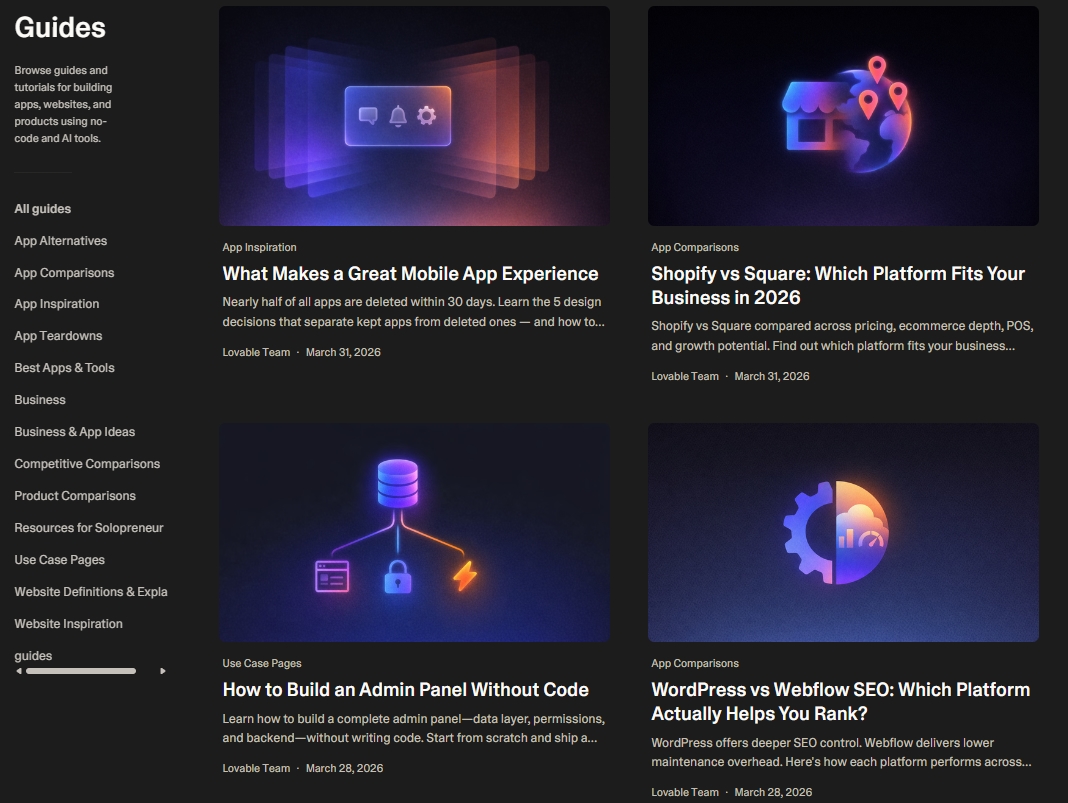
Advanced topics get dedicated series. The "Building Production-Ready Apps" series covers error boundaries, logging strategies, feature flags, A/B testing infrastructure, and database migration patterns. The "Scaling Beyond the Prototype" series addresses connection pooling, caching layers, background job queues, and multi-region deployment. These posts assume familiarity with the basics and focus on architectural decisions that prevent rewrites later.
Security Transparency and Compliance Updates
Security posts on the Lovable blog read differently than typical vendor communications. The team publishes their SOC 2 Type II audit timeline, penetration test summaries, and incident postmortems with the same detail as feature announcements. When a dependency vulnerability affected the code generation pipeline, the blog post included the CVE identifier, affected versions, exploitation requirements, and the exact patch deployment timestamp. They also published the internal detection timeline — how long the vulnerability existed before discovery — which is rare in the industry.

Data residency options received a dedicated post explaining the EU and US region selection, data transfer mechanisms, and GDPR compliance commitments. The enterprise security post detailed SSO integration with Okta and Azure AD, SCIM provisioning, audit log retention policies, and the shared responsibility model for customer data. These posts are written by the security engineering team, not compliance officers, so they address implementation questions developers actually have.
Community Programs and Builder Spotlights
The community section has evolved from occasional shoutouts into structured programs. The Lovable Experts directory — announced via blog post — lists vetted developers and agencies available for hire, with specialization tags like "Supabase architecture," "Stripe billing," and "Enterprise migration." The ambassador program provides early access to beta features in exchange for feedback and community support. Monthly template contests award credits and blog features for the best community-contributed starters.

The "Built with Lovable" monthly roundup has become a de facto portfolio review. Each edition features 8-12 applications with links, tech stack details, and founder interviews. The team explicitly includes projects at different stages — weekend prototypes, revenue-generating SaaS, internal tools saving engineering hours — so readers can calibrate expectations. Several hiring managers have reported using this roundup as a sourcing channel for technical co-founders and early employees.
Discord highlights pull the most useful discussions from the community server into searchable blog format. Topics like "handling Supabase connection limits," "optimizing generation prompts for complex forms," and "debugging hydration mismatches in production" get permanent URLs with code snippets. This solves the ephemeral nature of chat platforms while crediting the original contributors.
Template Library and Starter Kit Evolution
Template announcements follow a predictable but useful pattern. Each new starter kit gets a launch post with live demo, clone button, architecture diagram, and customization guide. The SaaS template post explained the subscription logic, team invitation flow, and admin dashboard structure. The internal tools template covered role-based access, audit logging, and approval workflows. The marketplace template detailed multi-vendor onboarding, commission calculation, and payout integration.
Version updates for existing templates are equally documented. When the team migrated all starters to the new React 19 + Vite 6 stack, the blog post included a codemod script, breaking change checklist, and performance comparison. Template deprecations get advance notice with migration paths — the legacy Next.js starters remained available for six months after the Vite transition with clear upgrade instructions.
Scroll horizontally to see all columns
| Category | Active Templates | Last Updated | Stack |
|---|---|---|---|
| SaaS Starters | 4 | January 2025 | React, Supabase, Stripe |
| Internal Tools | 3 | December 2024 | React, Supabase, TanStack Query |
| Landing Pages | 6 | January 2025 | React, Tailwind, Framer Motion |
| Marketplace | 2 | November 2024 | React, Supabase, Stripe Connect |
| AI Applications | 3 | January 2025 | React, Vercel AI SDK, OpenAI |
Integration Ecosystem Announcements
Integration posts follow a two-phase pattern: launch announcement followed by advanced usage guide. The Figma integration launch showed design-to-code workflow, component mapping, and design token synchronization. The follow-up guide covered responsive breakpoint handling, design system versioning, and collaboration patterns for designer-developer pairs. The Vercel deployment integration post included preview deployment configuration, environment variable management, and custom domain setup with SSL provisioning timing.
Third-party integration announcements are more selective. The team only blogs about integrations they maintain directly or have deep partnership agreements with. This means the Resend email integration post includes deliverability monitoring and template management, while a community-built SendGrid wrapper gets a Discord highlight but not a blog post. The distinction helps developers assess support commitments.
Roadmap Communication and Feature Voting
Quarterly roadmap posts have become a fixture. Each edition reviews the previous quarter's delivery against commitments, explains deviations, and publishes the next quarter's priorities with confidence levels. The team uses a three-tier system: "Committed" (engineering capacity allocated), "Exploring" (prototypes in progress), and "Research" (problem validation phase). This honesty about uncertainty is refreshing compared to vendor roadmaps that treat everything as guaranteed.
Feature voting results get published alongside roadmap updates. The blog shows vote counts, team assessment of technical complexity, and the decision rationale — including features that won votes but were declined due to architectural conflicts or strategic misalignment. The mobile app builder proposal received significant community support but was deferred because the team concluded responsive web + PWA covers 90% of use cases with less maintenance burden. That explanation helped align expectations.
Roadmap transparency builds trust even when the answer is 'not now.' Developers can plan around committed items and contribute to exploring ones.
Pricing Changes and Credit Economics
Pricing posts are the most scrutinized content on the blog. The credit system introduction included a calculator that estimated monthly costs for different project types: a simple landing page (~50 credits/month), a multi-tenant SaaS (~500 credits/month), an internal tool suite (~200 credits/month). The team committed to publishing quarterly credit usage benchmarks so customers can validate their projections against real data.
The Enterprise pricing announcement broke down the value calculation: dedicated infrastructure costs, support team allocation, compliance certification amortization, and the discount structure for multi-year commitments. They also published the migration path for Pro and Business customers hitting scale limits — including a credit credit (pun intended) for unused portions of annual plans. This level of financial transparency is uncommon and reduces procurement friction for engineering teams needing approval.
AI Model Updates and Generation Quality
Model update posts are technically dense but essential reading. When the default generation model shifted from GPT-4 to Claude 3.5 Sonnet, the blog published a 4,000-word analysis covering prompt adherence, code correctness, TypeScript strictness, accessibility compliance, and token efficiency. They included a regression test suite — 50 standardized prompts run against both models — with pass/fail criteria and subjective quality ratings from the design team.
Experimental model flags get documented with enablement instructions and known limitations. The GPT-4o mini flag for faster iteration cycles came with a warning about reduced complex reasoning capability. The Claude 3 Opus flag for architectural planning noted higher latency and cost. These flags let developers opt into capabilities before they become defaults, with clear rollback procedures.
Prompt engineering guides specific to each model version live in the blog's guides section. The Claude 3.5 system prompt optimization guide covers XML tagging conventions, example formatting, and constraint specification patterns that improve generation consistency. These guides are updated when model behavior shifts detectably, which the team monitors through automated evaluation pipelines.
Staying Current: Reading Strategies and Notifications
The blog offers several subscription options. The weekly digest email summarizes all posts with one-paragraph descriptions and reading time estimates. The RSS feed includes full content for feed reader users. Discord announcements post in #blog-updates with thread discussions. Twitter and LinkedIn cross-posts highlight major announcements only. The team recommends the weekly digest for most builders — it's curated by the same people who write the posts and includes context about why each piece matters.
For teams adopting Lovable organization-wide, the blog tags system enables filtered views. Tag combinations like "security + enterprise" or "tutorial + supabase" create custom feeds. The API changelog tag is particularly useful for automation — several teams have built internal dashboards that alert when breaking change posts are published. The blog's open graph metadata and structured data make this reliable.
- Weekly digest email: curated summaries with reading time
- RSS feed: full content for feed readers
- Discord #blog-updates: announcements with discussion threads
- Tag-filtered views: custom feeds for team relevance
- API changelog tag: machine-readable breaking change alerts
- Monthly roundup: batch reading for busy periods
Content Gaps and Criticism
No resource is complete. The blog has notable gaps. Mobile-specific development guidance is thin — the responsive design tutorial exists but doesn't cover native capabilities, app store deployment, or platform-specific APIs. The team acknowledges this in the roadmap but hasn't prioritized it. Internationalization (i18n) patterns for multi-language applications get mentioned in passing but lack a dedicated guide. Several enterprise customers have requested this.
Performance optimization content focuses on generation speed rather than runtime performance. Database query optimization, bundle size analysis, caching strategies, and Core Web Vitals tuning are underrepresented. The community fills some gaps with Discord discussions and template examples, but first-party guidance would carry more authority. The team has indicated a performance-focused content sprint is planned for Q2 2025.
Migration guides for major version upgrades sometimes lag behind releases by a week or two. The React 19 migration post arrived 10 days after the upgrade rolled out. For teams on tight sprint cycles, this delay matters. The team now pre-announces major upgrades with a "migration preview" tag, but the full guide still follows the release. This is a reasonable trade-off given the small documentation team, but worth knowing if you manage production deployments.
Comparing Information Sources
The blog is one of several information channels, each with different strengths. The documentation site is the authoritative reference for APIs, configuration options, and troubleshooting — but it lags on conceptual explanations and real-world patterns. Discord provides immediate answers and peer support but lacks permanence and searchability. The changelog (separate from the blog) lists every deploy with commit links but no narrative. YouTube tutorials show workflows visually but age quickly. The blog sits in the middle: more context than docs, more permanence than chat, more narrative than changelogs.
Scroll horizontally to see all columns
| Channel | Best For | Update Speed | Permanence |
|---|---|---|---|
| Blog | Conceptual guides, announcements, strategy | Days after release | High |
| Documentation | API reference, configuration, troubleshooting | Same day as release | High |
| Discord | Immediate help, peer review, workarounds | Real-time | Low |
| Changelog | Complete deploy history, commit links | Automated per deploy | High |
| YouTube | Visual workflows, beginner onboarding | Weeks after release | Medium |
Smart teams use all channels. The blog for planning and learning, docs for implementation, Discord for blockers, changelog for dependency updates. The blog's tag system and the docs' version switcher make cross-referencing practical. Several engineering leads have described their onboarding process as "read the last three months of blog posts, then live in docs and Discord."
Frequently Asked Questions
How often does the Lovable blog publish new content?
The blog publishes 2-4 posts per week on average. Major feature announcements appear within days of release. Tutorials follow within a week. Monthly roundups and quarterly roadmaps follow fixed schedules. Security advisories publish immediately regardless of calendar.
Can I get blog updates without checking the site manually?
Yes. The weekly digest email delivers curated summaries every Monday. The RSS feed provides full content for feed readers. Discord announcements post in #blog-updates with discussion threads. Tag-filtered RSS feeds let you subscribe to specific topics like security or tutorials only.
Are blog tutorials kept up to date with platform changes?
The team maintains a public update log for each tutorial. When Supabase or Stripe APIs change, affected guides are updated within 48 hours and marked with a version badge. Major platform upgrades like React 19 migration get dedicated migration guides. Community-reported issues in tutorial comments are addressed in subsequent revisions.
Does the blog cover pricing changes before they take effect?
Yes. Pricing announcements publish at least 30 days before changes take effect for existing customers. The posts include migration calculators, grandfathering policies, and credit adjustment details. Enterprise customers receive direct communication in addition to the public blog post.
How technical are the blog posts — do I need to be a developer to understand them?
Content varies. Product announcements and roadmap posts are accessible to non-technical founders. Tutorials and security posts assume coding familiarity. The tag system helps filter: "founder-friendly" tags mark accessible content, while "engineering-deep-dive" tags signal advanced material. Most posts include a prerequisites section.
Can I contribute to the blog or suggest topics?
The blog accepts guest posts from community experts through the ambassador program. Topic suggestions are collected via the quarterly roadmap voting and Discord #content-requests channel. The editorial team reviews suggestions monthly and commissions pieces that fill documented gaps. Contributors receive credit, profile links, and credit bonuses.
Where do I find the blog's archive of older posts?
The blog homepage includes a searchable archive with filters for category, tag, author, and date range. Pagination goes back to the first post. Each tag has its own feed URL. The sitemap.xml includes all posts for programmatic access. Annual "best of" roundups curate the most referenced posts by topic.
Final Assessment of the Lovable Blog
The Lovable blog functions as a genuine engineering communication channel rather than a marketing asset. Its strength lies in consistency: technical accuracy maintained over time, transparent reasoning on product decisions, and practical guidance that reduces trial-and-error for builders. The gaps — mobile, i18n, runtime performance — are acknowledged and scheduled rather than ignored. For teams adopting Lovable, the blog is the single highest-leverage reading investment. Start with the last quarter of posts, filter by your project's tags, and subscribe to the weekly digest. The signal-to-noise ratio is unusually high for a vendor blog.