

AI Development Tools
Lovable SaaS: AI App Builder for Modern Teams
From prototype to production without writing boilerplate code


Senior Software Developer & Trading Technology Specialist
Ethan Parker is a software developer with over 8 years of experience in building web applications, trading tools, and financial technology solutions. He specializes in Python, JavaScript, API integrations, and trading automation, helping traders improve efficiency through innovative technology.
Lovable SaaS represents a shift in how software gets built. Instead of spending weeks on scaffolding, authentication, database schemas, and deployment pipelines, developers and non-technical founders describe what they want in natural language and watch a working application appear. The platform handles the full stack — frontend, backend, database, auth, hosting — while keeping the generated code accessible for customization.
Contents
- 1. How Lovable SaaS Generates Applications
- 2. Core Features That Replace Traditional Scaffolding
- 3. AI-Powered App Generation Workflow
- 4. Backend and Database Capabilities
- 5. Authentication and User Management
- 6. Hosting, Custom Domains, and Deployment
- 7. Integrations Ecosystem
- 8. Pricing Plans and What They Include
- 9. Use Cases by Role and Team Type
- 10. Templates and Starting Points
- 11. Security, Compliance, and Trust
- 12. Community, Documentation, and Support
- 13. Comparison with Alternative Approaches
- 14. Getting Started and First Application
- 15. Final Assessment of Lovable SaaS
The core promise is straightforward: turn ideas into deployed applications in minutes rather than months. This matters because the traditional path from concept to production involves dozens of decisions that slow teams down. Choosing a framework, setting up CI/CD, configuring databases, implementing authentication, handling payments — each step adds friction. Lovable SaaS removes that friction by making those decisions for you based on modern best practices, then letting you override them when needed.
What distinguishes this approach from earlier no-code tools is the output. You do not get a proprietary black box. You get a React codebase with TypeScript, Vite, and Tailwind CSS that lives in your GitHub repository. The platform uses Supabase for PostgreSQL, authentication, and real-time features. Stripe handles payments. The stack is standard, which means developers can take over at any point without learning a new paradigm.
This article examines how Lovable SaaS works, what it replaces, where it fits in a modern development workflow, and whether it delivers on the promise of faster delivery without sacrificing control.
How Lovable SaaS Generates Applications
The generation process starts with a prompt. You describe the application — a marketplace, a dashboard, a CRM, an internal tool — and the AI produces a specification. That specification becomes a file structure, component hierarchy, database schema, and API routes. The platform then writes the code, creates the Supabase project, configures authentication providers, sets up Row Level Security policies, and deploys a preview URL.
Each iteration refines the application. You can ask for changes in plain English: add a field, change a layout, implement a workflow, connect a webhook. The AI modifies the codebase directly. Because the code lives in Git, every change is tracked. You can revert, branch, or pull the repository locally to work in your preferred IDE. This hybrid approach — AI generation with git-backed transparency — is the key differentiator from pure no-code platforms.
The AI models powering generation include Claude and GPT variants optimized for code tasks. They understand the Lovable component library, Supabase patterns, and Stripe integration patterns. This specialization means the generated code follows consistent conventions rather than improvising new patterns for each request. The result is a codebase that looks like it was written by a team following a style guide.
Behind the scenes, the platform manages a Supabase project for each application. This provides a PostgreSQL database with real-time subscriptions, built-in authentication with social providers and magic links, storage for file uploads, and edge functions for server-side logic. The database schema is generated from your data model descriptions. Migrations are created automatically when you modify models. You never write SQL unless you want to.
Core Features That Replace Traditional Scaffolding
Most teams spend the first sprint on infrastructure rather than features. Lovable SaaS eliminates that sprint. The platform provides authentication with email, social logins, and magic links out of the box. User profiles, roles, and permissions map to Supabase auth and Row Level Security. Protected routes, session management, and password reset flows work without configuration.
Database operations use a type-safe ORM layer generated from your schema. Queries, mutations, and real-time subscriptions are available as React hooks. The platform handles optimistic updates, cache invalidation, and offline support. Migrations run automatically on deploy. You can inspect the generated SQL and modify it if the ORM does not express a complex query.
Payments integrate with Stripe Checkout, Portal, and webhooks. Subscription plans, one-time purchases, usage-based billing, and trial periods configure through the prompt interface. The platform creates the Stripe products, prices, and webhook endpoints. Customer portal access embeds in your application with a single component. Revenue metrics appear in the dashboard alongside usage analytics.
- Authentication: email/password, OAuth providers, magic links, MFA
- Database: PostgreSQL with real-time, Row Level Security, migrations
- Payments: Stripe subscriptions, one-time, usage-based, customer portal
- Hosting: global CDN, custom domains, preview deployments, rollbacks
- Storage: file uploads, signed URLs, transformation, CDN delivery
- Edge functions: serverless TypeScript, cron jobs, webhook handlers
Hosting includes a global CDN with automatic HTTPS, custom domain configuration, and preview deployments for every branch. The platform builds the Vite production bundle, optimizes assets, and serves from edge locations. Rollbacks take one click. Environment variables manage secrets across development, preview, and production environments. The deployment pipeline requires no YAML configuration.
AI-Powered App Generation Workflow
The workflow centers on a chat interface. You describe the application concept, and the AI asks clarifying questions about data models, user roles, and key flows. This conversation produces a specification document that you can review and edit before generation begins. The specification captures entities, relationships, permissions, UI patterns, and integration requirements.
Once approved, generation runs in stages. First, the database schema and Supabase project. Second, the authentication configuration and user flows. Third, the frontend routes, components, and state management. Fourth, the API routes, edge functions, and third-party integrations. Fifth, the deployment pipeline and preview URL. Each stage produces visible output so you can verify progress.
After the initial generation, you refine through follow-up prompts. The AI maintains context about the codebase, so requests like "add a comments feature to posts" or "restrict admin dashboard to users with admin role" modify the correct files. The platform shows a diff preview before applying changes. You can accept, reject, or request modifications. This iterative loop replaces the traditional code-review-deploy cycle for many changes.
The AI also handles design decisions. You can reference design systems, provide Figma links, or describe visual preferences. The platform uses Tailwind CSS with a configurable design token system. Components follow accessibility guidelines by default. Dark mode, responsive breakpoints, and animation preferences configure through the design system rather than individual component props.
Backend and Database Capabilities
Supabase provides the backend foundation. Each Lovable application gets a dedicated PostgreSQL database with connection pooling, point-in-time recovery, and automated backups. The platform manages the Supabase project lifecycle — creation, configuration, scaling — without exposing the Supabase dashboard unless you choose to access it directly.
Row Level Security policies generate automatically from your permission model. When you define that "users can only edit their own posts" or "team members can view team resources," the platform creates the corresponding SQL policies. These policies enforce at the database level, so they work regardless of whether the request comes from the frontend, an edge function, or a direct API call.
Real-time subscriptions enable collaborative features without additional infrastructure. Presence, broadcast, and postgres changes channels work through the generated React hooks. The platform handles connection lifecycle, reconnection, and subscription cleanup. You describe the real-time behavior — "show when other users are editing this document" — and the implementation appears in the codebase.
Scroll horizontally to see all columns
| Feature | Lovable Managed | Direct Supabase |
|---|---|---|
| PostgreSQL version | Latest stable | Latest stable |
| Connection pooling | Automatic | Manual config |
| Row Level Security | Generated from prompts | Manual SQL |
| Migrations | Auto-generated | CLI or dashboard |
| Backups | Daily, point-in-time | Daily, point-in-time |
| Real-time | Hook-based API | Raw channels |
Edge functions run TypeScript on Deno at the edge. They handle webhooks, scheduled jobs, third-party API integrations, and compute-intensive tasks that should not run in the browser. The platform generates the function boilerplate, deploys on save, and provides logs. You can invoke functions from the frontend, database triggers, or HTTP endpoints. Cold starts are typically under 100ms.
Authentication and User Management
Authentication covers the common patterns without configuration. Email/password with verification, OAuth providers (Google, GitHub, GitLab, Azure, Discord, and more), magic links, and phone authentication with SMS. Multi-factor authentication supports TOTP authenticator apps. Passwordless options reduce friction for consumer applications. The auth UI components — login, signup, password reset, profile — generate with your design system.
User management includes roles, teams, and invitations. Role-based access control maps to database policies. Team-based multi-tenancy uses a shared database with row-level isolation or separate schemas per team. Invitation flows handle email delivery, token validation, and onboarding. The admin dashboard provides user search, impersonation, session revocation, and audit logs.
- Social login: Google, GitHub, GitLab, Microsoft, Discord, Slack, Apple
- Enterprise SSO: SAML, OIDC, SCIM provisioning on Enterprise plans
- Magic links: passwordless email authentication with configurable expiry
- MFA: TOTP with backup codes, WebAuthn support in beta
- Sessions: JWT with refresh rotation, device tracking, revocation
- User metadata: public and private claims, custom claims via hooks
The platform handles session management across subdomains for multi-tenant applications. Cookie configuration, CSRF protection, and secure headers apply automatically. You can customize the auth flow by modifying the generated components or adding middleware. The auth state synchronizes between tabs and persists across browser restarts.
Hosting, Custom Domains, and Deployment
Every push to GitHub triggers a preview deployment with a unique URL. The preview environment mirrors production — same database, same edge functions, same environment variables. You can share preview links with stakeholders, run automated tests, or preview on mobile devices. Merging to main promotes the preview to production with zero downtime.
Custom domains configure in the dashboard. The platform provisions SSL certificates via Let's Encrypt, configures DNS records (or provides values for manual configuration), and handles certificate renewal. Subdomain routing supports multi-tenant applications where each tenant gets a custom domain. Redirect rules, header configuration, and caching policies manage through the dashboard or code.
The build process uses Vite with optimized production settings. Code splitting, tree shaking, asset hashing, and compression happen automatically. The platform analyzes bundle size and warns about regressions. Static assets serve from the CDN with long-term caching. HTML pages use stale-while-revalidate for instant loads with background updates.
Environment variables separate by environment. Secrets encrypt at rest and inject at build time. The platform supports preview-specific variables for testing against staging APIs. Variable changes trigger redeploys. You can reference variables in prompts — "use the STRIPE_SECRET_KEY from environment" — and the platform wires them correctly.
Integrations Ecosystem
The platform integrates with the services modern applications need. Supabase provides the database and auth foundation. Stripe handles payments. GitHub stores code and triggers deployments. Figma imports designs. Additional integrations include Resend for email, Sentry for error tracking, Vercel for alternative hosting, and various AI model providers.
Each integration follows a pattern: you describe the requirement, the platform configures the service, generates the integration code, and adds the necessary environment variables. For example, adding email notifications means describing "send a welcome email on signup," which provisions a Resend domain, creates the API key, generates the edge function, and wires the auth hook. The code remains editable.
- Supabase: database, auth, real-time, storage, edge functions (native)
- Stripe: payments, subscriptions, billing portal, webhooks (native)
- GitHub: repository, actions, deployments, preview comments (native)
- Figma: design import, component mapping, design tokens (native)
- Resend: transactional email, marketing email, webhooks
- Sentry: error tracking, performance monitoring, release health
- Vercel: alternative hosting target with edge network
- AI models: Claude, GPT-4, local models via Ollama integration
The Figma integration deserves attention. You can paste a Figma file URL, and the platform extracts components, colors, spacing, and typography into a design token file. The generated components reference these tokens. When the design updates in Figma, you can re-sync and the tokens update. This keeps implementation aligned with design without manual handoff.
Pricing Plans and What They Include
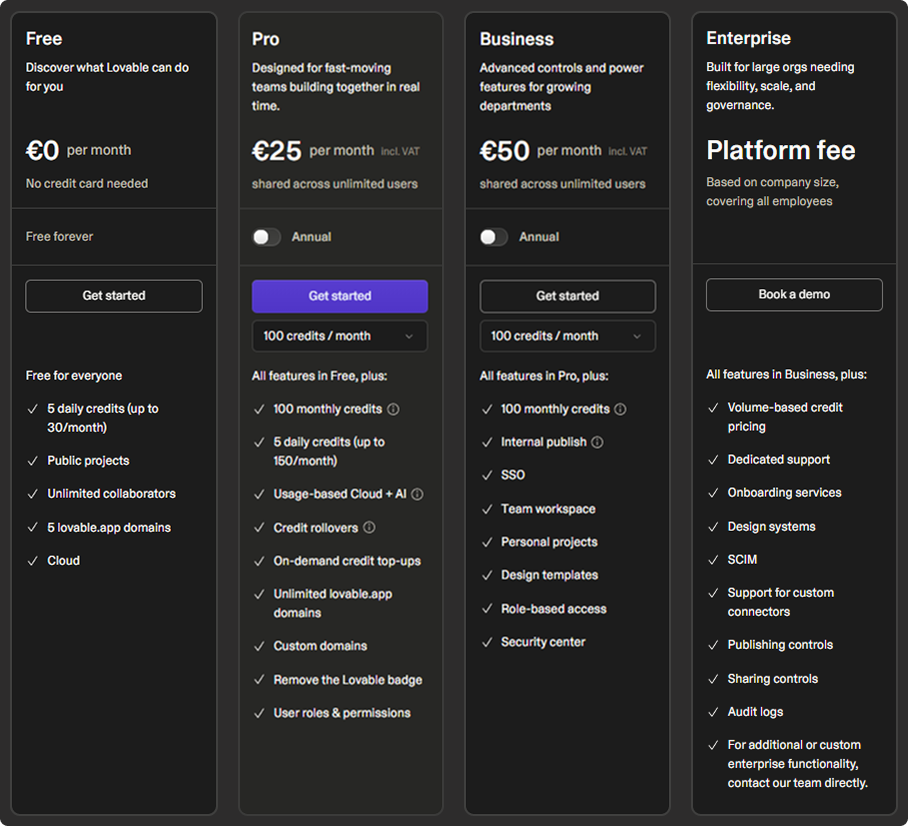
Pricing uses a credit model for AI generation plus tiered platform features. The Free tier provides 50 credits monthly, unlimited personal projects, community support, and basic features. Pro at $25/month increases credits to 500, adds custom domains, removes branding, and includes email support. Business at $100/month provides 2,500 credits, team collaboration, SSO, and priority support. Enterprise offers custom credits, dedicated infrastructure, SLA, and on-premise options.
Credits consume per generation action. A simple component might cost 1-2 credits. A full application generation costs 20-50 credits depending on complexity. Refinement prompts cost 1-5 credits. The platform shows estimated credit cost before executing. Unused credits do not roll over. You can purchase additional credit packs if you exceed your monthly allocation.
Scroll horizontally to see all columns
| Feature | Free | Pro | Business | Enterprise |
|---|---|---|---|---|
| Monthly credits | 50 | 500 | 2,500 | Custom |
| Projects | Unlimited personal | Unlimited | Unlimited team | Unlimited |
| Custom domains | No | Yes | Yes | Yes |
| Team members | Solo only | Solo only | 10 included | Unlimited |
| SSO/SAML | No | No | Yes | Yes |
| Support | Community | Priority | Dedicated | |
| SLA | No | No | 99.9% | 99.99% |
| On-premise | No | No | No | Available |
The credit model aligns cost with value generated rather than seat count. A solo founder building one application pays less than a team generating multiple applications daily. Enterprise pricing includes volume discounts, dedicated success engineering, custom model fine-tuning, and compliance certifications (SOC 2, HIPAA, GDPR). The platform also offers a student discount and an affiliate program for referrals.
Use Cases by Role and Team Type
Different roles use Lovable SaaS differently. Founders build MVPs to validate ideas before hiring engineers. Product managers prototype features for stakeholder review. Designers turn Figma files into working interfaces. Developers accelerate boilerplate and focus on business logic. Non-technical founders build entire products without writing code. Agencies deliver client projects faster with generated foundations.
For founders, the platform replaces the technical co-founder search for early validation. You can build a working SaaS with auth, payments, and admin dashboard in a weekend. The codebase is production-ready, so when you hire engineers, they inherit a clean React/TypeScript/Supabase stack rather than a prototype that needs rewriting. The GitHub repository provides full transparency for technical due diligence.
Product managers use the platform for rapid prototyping. Instead of static mockups, stakeholders interact with working features backed by real data. Feedback cycles shorten because changes deploy in minutes. The platform serves as a living specification — the code is the documentation. When engineering picks up the feature, they extend the generated codebase rather than starting from scratch.
- Founders: MVP validation, investor demos, pre-seed products
- Product managers: interactive prototypes, stakeholder alignment, living specs
- Designers: Figma to code, design system enforcement, component libraries
- Developers: boilerplate elimination, backend scaffolding, integration wiring
- Non-technical founders: full product builds, no-code with code escape hatch
- Agencies: client project acceleration, reusable templates, white-label delivery
Developers often start skeptical. The platform does not replace engineering judgment — it accelerates the 70% of work that is repetitive. Authentication, CRUD APIs, database migrations, deployment pipelines, payment integration — these patterns are solved problems. Lovable SaaS applies the solutions consistently. Engineers then spend time on the 30% that differentiates the product: complex business logic, performance optimization, novel features.
Templates and Starting Points
The platform provides templates for common application types. Each template includes a complete data model, authentication configuration, UI components, and deployment setup. Templates serve as starting points — you customize them through prompts rather than editing files directly. The template library covers SaaS dashboards, marketplaces, CRMs, internal tools, landing pages, e-commerce stores, and AI agent interfaces.

Templates are open source and community-contributed. You can fork a template, modify the specification, and save as your own template for team reuse. The platform tracks template versions and shows which templates are maintained by the core team versus community. Popular templates receive updates when platform features change — for example, when a new authentication provider adds, templates update to include it.
The template specification uses the same format as AI-generated specifications. This means you can take any generated application, extract its specification, and use it as a template for future projects. The specification captures the complete application definition: entities, relationships, permissions, UI patterns, integrations, and deployment configuration.
Security, Compliance, and Trust
Security operates at multiple layers. The platform infrastructure runs on SOC 2 Type II certified cloud providers. Data encrypts in transit (TLS 1.3) and at rest (AES-256). Database connections use pooled connections with IAM authentication. Secrets never appear in logs or build output. The platform undergoes regular penetration testing and maintains a bug bounty program.
Application-level security includes automatic Row Level Security policy generation, CSRF protection on forms, Content Security Policy headers, and secure cookie configuration. The platform prevents common vulnerabilities by construction — SQL injection is prevented by the ORM, XSS by React's escaping, CSRF by same-site cookies and tokens. Dependency scanning runs on every build with automated alerts for vulnerable packages.

Compliance certifications include SOC 2 Type II, GDPR readiness, and HIPAA eligibility on Enterprise plans. Data processing agreements available for Enterprise customers. Data residency options include US, EU, and APAC regions. The platform supports audit logging for all administrative actions, data access, and configuration changes. Export and deletion requests handle through the dashboard or API.
- Infrastructure: SOC 2 Type II, ISO 27001 cloud providers
- Encryption: TLS 1.3 in transit, AES-256 at rest
- Database: IAM auth, connection pooling, automated backups
- Application: RLS by default, CSP headers, secure cookies
- Dependencies: automated scanning, vulnerability alerts
- Compliance: GDPR, HIPAA eligible, SOC 2, data residency options
The trust center publishes security documentation, penetration test summaries, and compliance certificates. Incident response follows a defined process with customer notification timelines. The platform maintains a status page with real-time uptime metrics. Historical uptime exceeds 99.9% for the platform control plane. Application uptime depends on the underlying cloud providers and your configuration.
Community, Documentation, and Support
The community centers on Discord with channels for help, showcases, feature requests, and general discussion. Core team members participate daily. The community has built thousands of applications and shares templates, patterns, and workarounds. Weekly office hours provide live Q&A with engineers. The affiliate program rewards referrals with credit bonuses.
Documentation covers the platform concepts, CLI reference, API documentation, integration guides, and troubleshooting. The docs site includes interactive examples you can fork. Video tutorials walk through common workflows. The changelog documents every release with migration guides for breaking changes. API reference generates from the codebase so it stays current.
- Discord: 15,000+ members, core team active, template sharing
- Documentation: concepts, CLI, API, integrations, troubleshooting
- Video guides: getting started, advanced patterns, integrations
- Office hours: weekly live sessions with platform engineers
- Changelog: weekly releases, migration guides, deprecation notices
- Status page: real-time uptime, incident history, maintenance windows
Support tiers match pricing. Free users access community support and documentation. Pro users receive email support with 24-hour response target. Business users get priority email with 4-hour target and access to a shared Slack channel. Enterprise customers receive dedicated success engineer, SLA-backed response times, onboarding assistance, and architecture reviews.
Comparison with Alternative Approaches
Lovable SaaS sits between traditional development and no-code platforms. Compared to writing React + Supabase manually, it eliminates weeks of scaffolding. Compared to Bubble or Webflow, it produces portable code you own. Compared to Bolt or v0, it manages the full backend and deployment. Compared to Replit, it specializes in production SaaS patterns rather than general coding. Compared to Cursor, it generates complete applications rather than assisting line-by-line.
Scroll horizontally to see all columns
| Dimension | Lovable SaaS | Manual React/Supabase | Bubble/Webflow | Bolt/v0 | Replit |
|---|---|---|---|---|---|
| Code ownership | Full (your GitHub) | Full | Locked in platform | Full (export) | Full |
| Backend included | Yes (Supabase) | Manual setup | Proprietary | Limited | Manual setup |
| Deployment | Automatic | Manual CI/CD | Platform hosted | Manual/export | Platform hosted |
| AI generation | Full app + iterations | None | Limited | Full app | Line-by-line assist |
| Learning curve | Low | High | Medium | Low | Medium |
| Production ready | Yes | With effort | Yes | Needs work | With effort |
The trade-offs are real. Lovable SaaS makes architectural decisions for you — React, TypeScript, Tailwind, Supabase, Stripe. If your stack differs, you fight the platform. The generated code follows conventions that may not match your team's preferences. Complex customizations require reading and modifying generated code, which means you need React and TypeScript competence. The platform accelerates the common path; the uncommon path still requires engineering.
Pricing comparison favors Lovable for small teams. Manual development costs engineering hours. No-code platforms charge per user or application at scale. Lovable's credit model scales with generation volume, not user count. A team of five building one application pays the same as a solo founder building five applications, assuming similar generation volume. Enterprise pricing competes with the cost of a dedicated platform engineer.
Getting Started and First Application
Starting requires a GitHub account. Sign in, authorize the Lovable GitHub app, and you land in the dashboard. Click "New Project," describe your application in the chat, and watch the specification form. The AI asks about user roles, data entities, key features, and design preferences. Review the specification, adjust if needed, then click "Generate." The platform creates the repository, provisions Supabase, and starts building.
The first generation takes 5-15 minutes. You receive a preview URL when the build completes. Open it, test the flows, note what needs adjustment. Return to the chat and describe changes: "make the dashboard show revenue charts," "add team invitation flow," "change the color scheme to match our brand." Each refinement deploys a new preview. When satisfied, merge to main for production deployment.
- Sign in with GitHub and authorize repository access
- Create a new project and describe your application concept
- Review and refine the generated specification
- Start generation and wait for preview deployment
- Test the preview and request refinements via chat
- Merge to main for production deployment with custom domain
The Free tier provides enough credits for several complete applications. Use it to build a real project — not a toy — and evaluate whether the generated code meets your standards. Clone the repository locally, run the development server, make a manual change, push, and watch the preview deploy. This round-trip validates the escape hatch works before you commit to a paid plan.
Final Assessment of Lovable SaaS
Lovable SaaS delivers on its core promise: working applications from description to deployment in minutes. The generated code is readable, follows modern patterns, and lives in your repository. The platform handles the infrastructure that slows teams down — auth, database, payments, hosting, deployments — while preserving the ability to customize at the code level. For teams building SaaS products with standard patterns, it removes weeks of scaffolding work.
The limitations are honest. The platform opinionates on stack choices. Complex deviations require code competence. Credit costs can accumulate with heavy iteration. The AI occasionally misinterprets requirements, requiring explicit correction. But these are constraints of the approach, not failures of execution. The platform does what it claims: generates production-ready React/Supabase applications from natural language.
The best abstraction is the one you can peel back when it leaks. Lovable SaaS generates code you own, not a platform you rent.
For founders validating ideas, product managers aligning stakeholders, designers implementing systems, and developers eliminating boilerplate, Lovable SaaS is a legitimate accelerator. It does not replace engineering judgment — it applies it consistently to the solved problems so you can focus on the unsolved ones. Whether that trade-off fits your context depends on your stack alignment, team composition, and tolerance for generated code you did not write line by line.
Frequently Asked Questions
Do I own the code generated by Lovable SaaS?
Yes. The code generates directly into your GitHub repository. You have full ownership and can modify, deploy, or migrate it independently of the platform at any time.
What happens if I exceed my monthly credit limit?
Generation pauses until the next billing cycle or you purchase additional credit packs. Existing applications continue running — only new generation actions consume credits.
Can I use Lovable SaaS with an existing Supabase project?
Currently, Lovable creates and manages its own Supabase project per application. You cannot connect an existing Supabase project, but you can access the managed project directly through the Supabase dashboard.
Is the generated code suitable for production use?
Yes. The platform generates production-ready code with authentication, database migrations, payment integration, and deployment configuration. Many companies run production SaaS applications built with Lovable.
What programming languages and frameworks does the generated code use?
The frontend uses React with TypeScript, Vite, and Tailwind CSS. The backend uses Supabase (PostgreSQL) with Edge Functions in TypeScript. The stack is standard and widely supported.
Can I customize the design system and component library?
Yes. The platform uses a configurable design token system. You can define colors, spacing, typography, and component variants. Figma integration syncs design tokens from your design files.
Does Lovable SaaS support team collaboration?
Team collaboration features are available on Business and Enterprise plans. These include shared projects, role-based access, SSO/SAML, and centralized billing.
What support options are available if I encounter issues?
Free users access community Discord and documentation. Pro users receive email support. Business users get priority email and shared Slack. Enterprise customers receive dedicated success engineering and SLA-backed response times.