

AI Development Tools
Lovable vs Base44: AI App Builder Comparison
Breaking down features, pricing, workflow differences, and which tool fits your project.

Senior Software Developer & Trading Technology Specialist
Ethan Parker is a software developer with over 8 years of experience in building web applications, trading tools, and financial technology solutions. He specializes in Python, JavaScript, API integrations, and trading automation, helping traders improve efficiency through innovative technology.
Two platforms have emerged as serious contenders for developers and non-technical founders who want to ship full-stack applications without writing every line of code by hand. Lovable and Base44 both promise to turn natural language prompts into working software, but they approach the problem from different angles. This comparison cuts through the marketing to show where each tool actually delivers.
Contents
- 1. Core Philosophy and Target Users
- 2. AI Interaction Model
- 3. Backend and Database Handling
- 4. Authentication and User Management
- 5. Code Ownership and Export
- 6. Integrations and Extensibility
- 7. UI Components and Design System
- 8. Pricing Models
- 9. Development Workflow and Iteration Speed
- 10. Team Collaboration
- 11. Deployment and Hosting
- 12. Learning Curve and Documentation
- 13. When to Choose Lovable
- 14. When to Choose Base44
- 15. Migration Paths and Exit Strategy
- 16. Performance and Scalability
- 17. Security and Compliance
- 18. Final Assessment: Lovable vs Base44
I've spent time with both platforms building test projects ranging from simple landing pages to multi-user SaaS dashboards. The differences show up quickly in how they handle backend logic, database schema changes, authentication flows, and the day-to-day experience of iterating on a real product. Neither tool is a magic wand, but each has clear strengths depending on what you're building and who's building it.
Core Philosophy and Target Users
Lovable positions itself as an AI full-stack engineer that writes production-ready React, TypeScript, and Supabase code. The platform generates a complete GitHub repository you own, with proper project structure, type safety, and modern tooling like Vite and Tailwind. It's built for people who understand software concepts — components, hooks, database relationships, API routes — but want to accelerate the boilerplate and scaffolding work.
Base44 takes a more opinionated no-code approach. It abstracts away the code entirely, presenting a visual builder where you define data models, pages, and logic through a UI. The platform handles hosting, database, and deployment behind the scenes. Its sweet spot is founders and product managers who think in features and user flows rather than React components and SQL migrations.
AI Interaction Model
Both platforms use a chat interface as the primary way to build and modify your application. You describe what you want, the AI generates or updates code, and you see the result in a live preview. But the conversation flow differs in ways that affect daily productivity.
Lovable's chat feels like pair programming with a senior developer who knows the codebase. You can reference specific files, ask for refactors, request TypeScript fixes, or say "add a loading skeleton to the dashboard table" and it understands the context. The AI maintains awareness of your entire project structure — components, hooks, database types, Supabase functions — across long sessions.
Base44's chat operates at a higher abstraction level. You describe features in business terms: "add a referral system where users get 10 credits per invite" or "make the dashboard show revenue by month." The platform translates this into data model changes, page updates, and logic automatically. You don't see the code unless you explicitly export it, which most Base44 users never do.
Lovable teaches you the codebase as you build. Base44 lets you ignore the codebase entirely.
Backend and Database Handling
This is where the architectural difference becomes practical. Lovable uses Supabase (PostgreSQL) as its default backend. Every project gets a real Postgres database with row-level security, real-time subscriptions, edge functions, and auth built in. The AI writes SQL migrations, creates RLS policies, and sets up storage buckets. You can inspect every migration file, run raw SQL if needed, and connect external tools directly to the database.
Base44 runs on its own managed backend. You define data models visually — think Airtable meets Bubble — and the platform handles schema changes, indexes, and relationships automatically. It supports computed fields, rollups, and validation rules through a UI. There's no SQL access unless you use their API. For many applications this is fine, but it means you can't optimize a slow query, add a partial index, or use a Postgres extension like pgvector for embeddings.
Scroll horizontally to see all columns
| Capability | Lovable | Base44 |
|---|---|---|
| Database | PostgreSQL (Supabase) | Managed proprietary |
| Direct SQL access | Yes | No |
| Row-level security | Full control via AI | Configured via UI |
| Real-time subscriptions | Native Supabase Realtime | Built-in live updates |
| Edge functions | Deno-based Supabase Functions | Custom logic in builder |
| External database connections | Standard Postgres connection string | API only |
| Migration history | Git-tracked SQL files | Platform-managed |
For a project that might need custom search, complex analytics queries, or integration with an existing Postgres infrastructure, Lovable's transparency wins. For a straightforward CRUD app where you never want to think about indexes or connection pooling, Base44's abstraction saves time.
Authentication and User Management
Lovable leverages Supabase Auth out of the box. You get email/password, magic links, OAuth providers (Google, GitHub, Discord, etc.), MFA, and session management without configuration. The AI can implement role-based access, org-level permissions, and custom auth flows by writing the appropriate RLS policies and server-side checks. Since it's standard Supabase, you can also use their client libraries directly in any exported code.
Base44 includes a built-in auth system with similar providers. You configure sign-up flows, password requirements, and email templates through a settings panel. Role-based access is defined per-page and per-action in the visual builder. It works well for standard SaaS patterns but offers less flexibility for edge cases like impersonation, custom JWT claims, or integrating with an external identity provider like Auth0 or Clerk.
Code Ownership and Export
This distinction matters more than most comparisons acknowledge. Lovable generates a standard React + TypeScript + Vite project structure and pushes it to your GitHub repository on every change. You own the code completely. If Lovable shuts down tomorrow, your application keeps running on Vercel, Netlify, or any static host with a Supabase backend. You can clone the repo, run npm install, and continue developing locally with zero platform dependency.
Base44 hosts your application on their infrastructure. You can export the code, but it's not designed for local development. The exported codebase includes platform-specific runtime dependencies and isn't structured for independent iteration. Base44's terms allow code export, but the practical path off the platform involves rewriting. For many users this is an acceptable trade-off — they never intend to self-host — but it's a real lock-in factor.
I've seen teams start on Base44, validate their product, then spend months rewriting on a stack they control. Starting on Lovable avoids that rewrite because the code is already yours. The flip side: Base44 handles hosting, SSL, scaling, and database backups automatically. With Lovable, you're responsible for deploying the frontend and managing the Supabase project (though Supabase handles the heavy lifting).
Integrations and Extensibility
Lovable's integration story centers on Supabase and the React ecosystem. The AI can add Stripe for payments, Resend for email, OpenAI for embeddings, or any npm package you request. It writes the integration code — webhook handlers, server-side verification, client-side components — and places files correctly. Because it's standard TypeScript, you can also add integrations manually without fighting the platform.
Base44 provides a curated set of native integrations: Stripe, SendGrid, Twilio, OpenAI, Google Maps, and several others. Each integration is configured through a form in the builder. You can't add arbitrary npm packages or write custom middleware. If Base44 doesn't support a service you need, you're limited to their HTTP request action for API calls, which lacks type safety and automatic retry logic.
- Lovable: any npm package, custom webhooks, edge functions, direct API access
- Base44: ~15 native integrations, generic HTTP action for everything else
- Lovable wins for: custom payment flows, unusual APIs, ML model serving
- Base44 wins for: standard Stripe checkout, transactional email, SMS — zero config
UI Components and Design System
Lovable uses shadcn/ui (Radix UI + Tailwind) as its component foundation. The AI generates accessible, customizable components that follow modern React patterns. You get consistent styling out of the box, and the AI can create new components by composing existing ones. Since it's just Tailwind classes, design changes are straightforward — ask for "darker cards with rounded-xl" and it updates the relevant components.
Base44 has its own component library built for the visual editor. Components are configured through property panels — you set variants, sizes, colors, and data bindings without touching CSS. It's faster for non-designers to get a consistent look, but you're constrained by what the component library exposes. Custom styling requires their theme editor, which has limits compared to writing Tailwind directly.
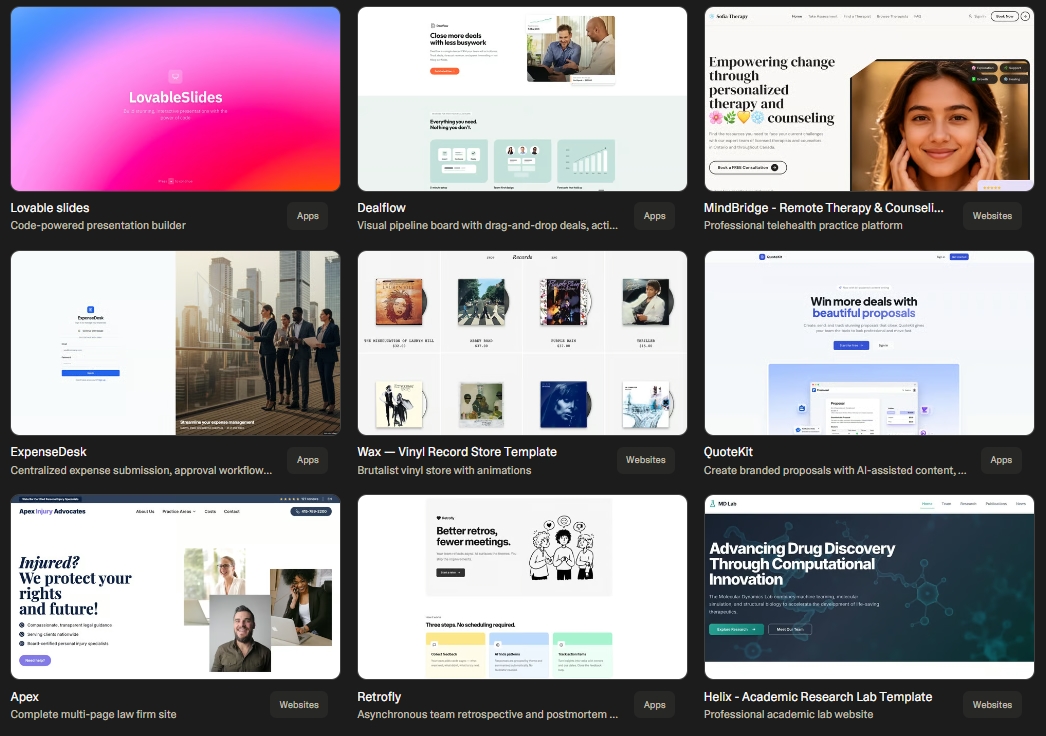
Both platforms offer template libraries. Lovable's templates are complete GitHub repos you can fork and customize. Base44's templates are pre-configured projects you duplicate within the platform. Lovable's approach means templates evolve with the ecosystem — community contributions, bug fixes, and updates flow through GitHub. Base44 templates are maintained by their team.
Pricing Models
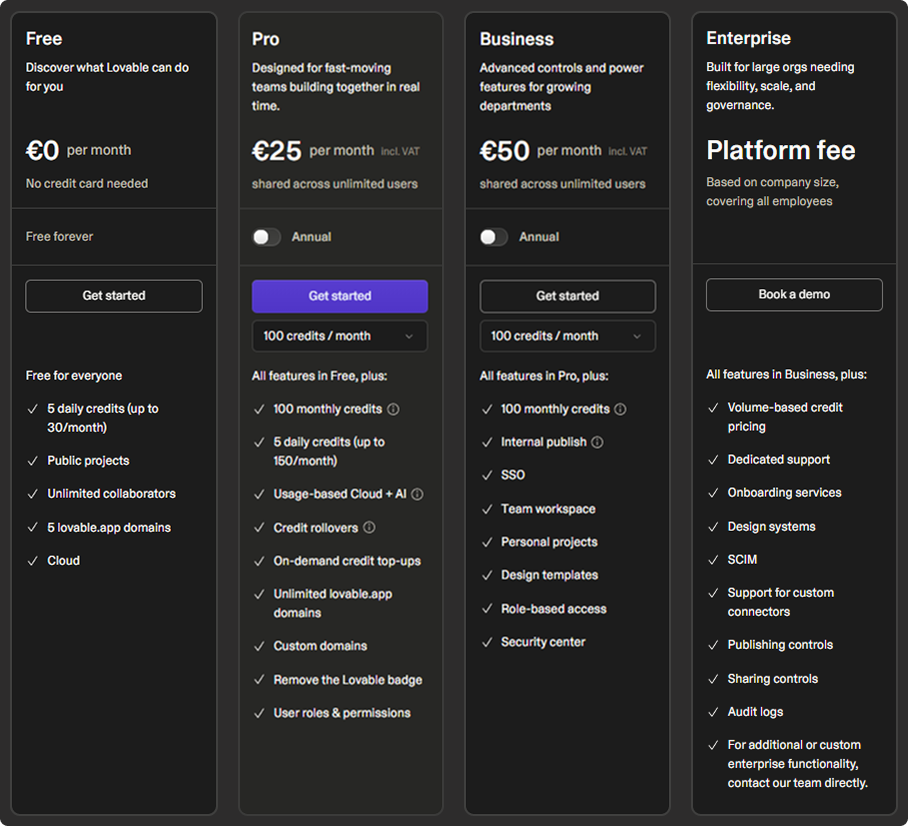
Lovable uses a credit-based system tied to AI generation usage. The free tier includes 5 credits per day (roughly 5-10 chat turns), with paid plans starting at $20/month for 100 credits and scaling to enterprise. Credits reset monthly. You also pay Supabase directly for database hosting beyond their generous free tier (500MB database, 2GB bandwidth, 50k MAU). For a typical SaaS, total monthly cost might be $20-50 for Lovable plus $25-100 for Supabase Pro as you scale.
Base44 charges per application with tiered feature limits. The starter plan is around $29/month per app with limits on records, API calls, and team members. Higher tiers increase limits and add features like custom domains, SSO, and priority support. There's no separate database bill — it's bundled. For a single app with moderate usage, Base44 can be simpler to budget. For multiple apps or high-volume applications, the per-app pricing adds up faster than Lovable's credit model.
Scroll horizontally to see all columns
| Factor | Lovable | Base44 |
|---|---|---|
| Model | Credits per month | Per app per month |
| Free tier | 5 credits/day | Limited trial |
| Entry paid | $20/mo (100 credits) | ~$29/mo per app |
| Database cost | Separate (Supabase) | Included |
| Multi-app discount | Single account, shared credits | Per-app pricing |
| Enterprise | Custom | Custom |
Development Workflow and Iteration Speed
Day-to-day iteration feels different on each platform. With Lovable, you chat, review the diff, accept or request changes, and the code updates in your GitHub repo. You can open the repo in VS Code, run the dev server locally, add console.log statements, debug in the browser, and commit manual changes alongside AI-generated ones. The workflow supports hybrid human-AI development naturally.
Base44's iteration happens entirely in the browser. You chat, see the preview update, and publish. There's no local development environment, no git history you control, no debugger. For non-technical users this simplicity is the point. For developers, it feels restrictive — you can't quickly test a hypothesis in the console, you can't bisect a regression, and you can't work offline.
Lovable fits into a developer's existing toolchain. Base44 replaces the toolchain.
Team Collaboration
Lovable collaboration happens through GitHub. Multiple developers can work on the same repository — some using Lovable's chat, others writing code directly in their IDE. Pull requests, code reviews, and CI/CD work normally. The AI-generated code is just... code. Non-technical team members can use Lovable's chat for content changes, copy updates, or simple feature requests while engineers handle complex logic.
Base44 offers multiplayer editing in the builder. Multiple team members can work on different pages simultaneously with real-time cursors. There's a comment system for feedback, version history for rollback, and role-based permissions (admin, editor, viewer). It's more like Figma than GitHub. For a cross-functional team with designers, PMs, and one technical person, this can be smoother than git workflows.
- Lovable: git-native, works with any team size, supports code review culture
- Base44: real-time multiplayer, designed for mixed-technical teams
- Lovable advantage: CI/CD, automated testing, staging environments
- Base44 advantage: no merge conflicts, instant preview sharing
Deployment and Hosting
Lovable deploys to Vercel by default (configured automatically) with custom domain support. You can also deploy to Netlify, Cloudflare Pages, AWS Amplify, or any static host. The Supabase backend runs separately on Supabase's infrastructure (AWS, GCP, or self-hosted). You control DNS, SSL, caching headers, and edge configuration. Preview deployments for every pull request are automatic with Vercel.
Base44 hosts everything on their platform. You get a base44.app subdomain free, custom domains on paid plans. SSL, CDN, and scaling are managed. You don't configure build commands, environment variables are set in their dashboard, and there's no concept of preview deployments — you publish to staging or production. It's simpler but you have zero control over the infrastructure layer.
Learning Curve and Documentation
Lovable's learning curve depends heavily on your background. Developers productive in React and TypeScript can be effective in hours. The documentation covers the AI interaction patterns, project structure, Supabase integration, and common patterns. There's a learning curve for prompt engineering — knowing how to ask for what you want so the AI produces maintainable code — but it's a skill that transfers to other AI coding tools.
Base44's learning curve is flatter for non-technical users. The visual builder uses familiar concepts: tables, forms, pages, buttons. The documentation focuses on the builder's features rather than code concepts. However, as applications grow complex, users hit the platform's abstraction ceiling — things that are simple in code (a complex filter, a custom validation rule across fields) become workarounds in the builder.
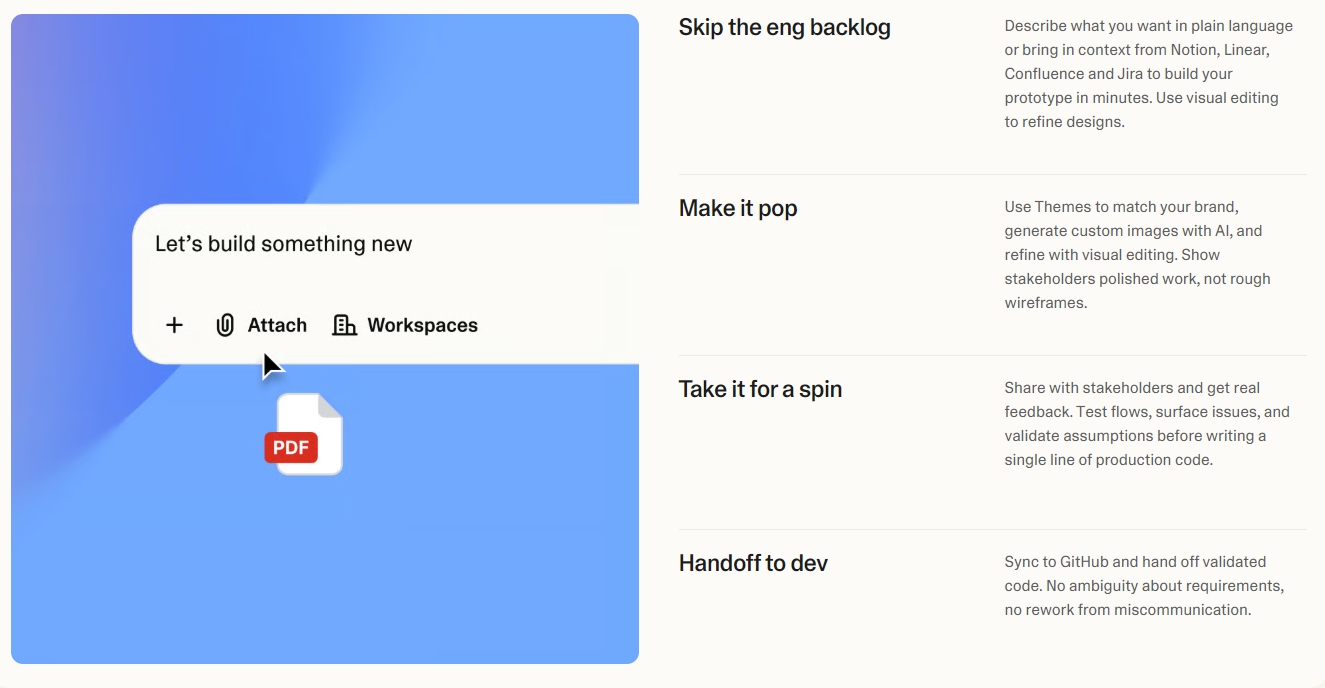
Both platforms have active communities. Lovable's Discord is developer-heavy with discussions about React patterns, Supabase optimization, and AI prompting techniques. Base44's community includes more founders and operators sharing business logic patterns and no-code workflows. The quality of community help reflects the user base — Lovable for technical depth, Base44 for product-building advice.
When to Choose Lovable
Choose Lovable when you want production code you own, need full backend control, plan to scale beyond a single application, or have (or will hire) developers who need to work on the codebase. It's the right choice for technical founders building SaaS products, agencies delivering client projects, teams that need CI/CD and automated testing, and anyone who's been burned by no-code platform lock-in before.
It's also the better choice for applications with unusual requirements: custom authentication flows, complex database relationships, real-time collaboration features, ML model integration, or anything that pushes against the boundaries of a visual builder. The AI can implement patterns that don't exist in any component library because it's writing code, not configuring components.
When to Choose Base44
Choose Base44 when you have no technical co-founder, need to validate a business idea in weeks not months, are building internal tools for operations teams, or want to avoid infrastructure decisions entirely. It's excellent for marketplaces, directories, booking systems, CRM-like tools, and dashboard applications where the data model is straightforward and the value is in the business logic.
It's also a strong choice for agencies building similar applications for multiple clients — the visual builder lets you clone and customize projects quickly, and the per-app pricing is predictable for client billing. The platform handles security updates, database maintenance, and scaling so you don't need a DevOps person.
The best tool is the one that lets you ship. If Base44 gets you to paying customers in two weeks and Lovable would take a month of learning, use Base44. You can rewrite later if you need to.
Migration Paths and Exit Strategy
This is the question nobody asks until they need the answer. Lovable projects are already on standard infrastructure. Moving from Lovable to a custom stack means... continuing to develop the same codebase. You might replace the AI chat with Cursor or Copilot, but the React components, Supabase schema, and deployment pipeline stay the same.
Base44 migration means rebuilding. The exported code isn't structured for independent development. You'd recreate the data model in Supabase or another database, rebuild the UI in React or your framework of choice, reimplement the business logic, and migrate data. It's a full rewrite. Base44 knows this — their enterprise plans include dedicated migration support — but it's a real cost to factor in.
Performance and Scalability
Lovable applications run on Vercel's edge network with Supabase on AWS/GCP. Cold starts are minimal for static pages, serverless functions scale to thousands of concurrent invocations, and the Postgres database handles significant load with proper indexing. You can upgrade Supabase compute, enable read replicas, and configure connection pooling (PgBouncer) as needed. The performance ceiling is high — companies run production workloads with millions of users on this stack.
Base44's performance is managed by their team. They handle scaling automatically, but you have no visibility into the infrastructure. For typical applications this is fine. For high-traffic or latency-sensitive applications, the lack of control becomes a constraint. You can't add a CDN layer, configure edge caching rules, or optimize database connection pooling. You're trusting their engineering team to make the right trade-offs for your use case.
Scroll horizontally to see all columns
| Aspect | Lovable | Base44 |
|---|---|---|
| Frontend scaling | Vercel edge (automatic) | Platform managed |
| Database scaling | Supabase (configurable) | Platform managed |
| Max concurrent users | Millions (with config) | Thousands (typical) |
| Performance tuning | Full control | None |
| Observability | Vercel + Supabase dashboards | Platform analytics |
Security and Compliance
Lovable inherits Supabase's security posture: SOC 2 Type II, HIPAA compliance (on dedicated clusters), GDPR-ready data processing agreements, and enterprise features like SSO/SAML, audit logs, and point-in-time recovery. Since you own the Supabase project, you control data residency (choose AWS region), encryption keys, and access policies. The AI-generated code follows security best practices — parameterized queries, proper RLS, input validation — but you should still review it.
Base44 provides platform-level security: HTTPS everywhere, automated backups, role-based access in the builder, and data encryption at rest. They handle patching and infrastructure security. However, compliance certifications are less transparent. For regulated industries (healthcare, finance, government), the inability to choose data residency or access audit logs can be a blocker. Base44's enterprise tier may offer more — you'd need to discuss with their sales team.
Frequently Asked Questions
Can I use Lovable without knowing React or TypeScript?
You can build simple applications by describing what you want, but you'll hit limits quickly. The AI generates React code, and understanding components, props, hooks, and state helps you guide it effectively. Non-technical users often pair with a developer or learn basics as they go.
Does Base44 allow custom code for features not in the builder?
Base44 has a generic HTTP action for calling external APIs, but you cannot add custom React components, server-side middleware, or database functions. If the builder doesn't support a feature, you cannot build it without leaving the platform.
What happens to my Lovable project if I cancel my subscription?
Your GitHub repository and Supabase project remain yours. You lose access to Lovable's AI chat and credit-based generation, but the code continues to run on your deployed infrastructure. You can continue developing manually or with other AI tools.
Can I migrate a Base44 app to Lovable later?
Not directly. You would rebuild the application in Lovable, using the Base44 app as a reference for data models and features. The Base44 data export (CSV/JSON) can seed your new Supabase database. Expect a full rewrite rather than a migration.
Which platform is better for building a marketplace?
Both can build marketplaces. Base44's visual builder makes user roles, listings, bookings, and payments faster to configure initially. Lovable gives you more control over search algorithms, real-time messaging, complex pricing logic, and scaling — important as the marketplace grows.
Do I need a separate Supabase account for Lovable?
Yes. Lovable creates and manages a Supabase project for you, but it's under your Supabase account. You'll need to sign up for Supabase (free tier is generous) and connect it during Lovable setup. This gives you direct access to the database, auth, and storage dashboards.
How do the AI models compare between platforms?
Both use frontier models (Claude, GPT-4 class) for code generation. Lovable's prompts are optimized for full-stack React/Supabase patterns. Base44's are optimized for no-code configuration. The model quality is similar; the difference is what the output targets — code vs. platform configuration.
Final Assessment: Lovable vs Base44
Lovable and Base44 solve the same problem — turning ideas into working software faster — but for different people with different constraints. Lovable is a force multiplier for developers and technical teams. It writes the code you would write, structures it properly, and hands you the keys. Base44 is a complete product-building environment for people who don't write code and don't want to. It makes the right decisions for you and gets out of the way.
If you're a solo technical founder building a SaaS you plan to run for years, Lovable's code ownership, Supabase foundation, and developer workflow make it the safer long-term bet. The learning curve pays off in flexibility and exit options. If you're a non-technical founder validating a B2B idea, Base44 lets you ship a working product to real users in days. The platform lock-in is a future problem — and a good problem to have, because it means you built something people want.
The honest answer: many successful products start on Base44, prove demand, then rewrite on a controlled stack. Others start on Lovable and never look back. Neither choice is wrong. The wrong choice is spending weeks comparing instead of building. Pick the one that matches your current team and constraints, start prompting, and adjust course when reality demands it.