

AI Development Security
Lovable Security: How Safe Is Your AI-Generated Code?
A practical look at what protects your projects when you build with Lovable's AI app builder.


Senior Software Developer & Trading Technology Specialist
Ethan Parker is a software developer with over 8 years of experience in building web applications, trading tools, and financial technology solutions. He specializes in Python, JavaScript, API integrations, and trading automation, helping traders improve efficiency through innovative technology.
Security questions come up fast when you hand code generation to an AI. You describe a feature, Lovable writes the React components, sets up the Supabase tables, configures Row Level Security policies, and deploys the whole thing. That convenience is real. So is the need to understand what happens to your data, who can access the generated code, and whether the platform itself introduces vulnerabilities you would not accept in a hand-written codebase.
Contents
- 1. What Lovable Security Actually Covers
- 2. Built-in Security Controls in the Dashboard
- 3. Data Handling and Privacy Boundaries
- 4. Authentication and Access Management
- 5. Code Generation Safety Patterns
- 6. Supabase Integration Security Model
- 7. Enterprise Security Features
- 8. Compliance and Standards Coverage
- 9. Common Security Concerns and Mitigations
- 10. Best Practices for Secure Development on Lovable
- 11. Final Assessment of Lovable Security
This article walks through Lovable's security model from the ground up. It covers the controls you see in the dashboard, the ones you do not see, how Supabase integration affects your risk profile, what enterprise customers get that free tiers do not, and where the gaps still exist. The goal is not to sell you on the platform or scare you away from it. The goal is to give you the information you need to decide whether Lovable fits your security requirements.
Most discussions about AI coding tools focus on output quality. Hallucinations, broken imports, and styling mismatches get the attention. Security tends to stay in the background until something goes wrong. With Lovable, the security conversation is inseparable from the architecture because the platform manages your database, your authentication, your hosting, and your secrets all at once. That centralization creates both leverage and concentration risk.
We will look at the security banner features Lovable markets, then dig into the implementation details that determine whether those features actually protect you. Along the way we will compare the free, Pro, and Enterprise tiers because the security posture changes significantly depending on what you pay for.
What Lovable Security Actually Covers
Lovable's security model sits on three layers. The platform layer handles infrastructure, encryption, access controls, and compliance. The project layer manages per-application settings like authentication providers, database policies, and environment variables. The code layer determines what the AI generates — whether it follows secure patterns, handles user input safely, and respects the principle of least privilege.
The marketing materials highlight SOC 2 Type II certification, GDPR compliance, and end-to-end encryption. Those are real. Lovable runs on AWS with data encrypted at rest using AES-256 and in transit via TLS 1.2+. The Supabase projects it provisions inherit Supabase's own security posture, which includes point-in-time recovery, automated backups, and network isolation. But certifications and infrastructure controls only tell you about the platform operator's hygiene. They do not tell you whether the code Lovable writes for your specific application is secure.
The distinction matters. A SOC 2 audit verifies that Lovable has processes for access control, incident response, and change management. It does not verify that the Row Level Security policy the AI generated for your user_profiles table actually prevents users from reading each other's data. That second verification is on you. Lovable provides tools to make it easier — policy previews, type-safe database access, and a visual policy editor — but the responsibility for correct configuration remains with the developer.
Built-in Security Controls in the Dashboard
The security controls visible in Lovable's project settings cover the basics most teams need. You can configure authentication providers — email/password, OAuth with Google, GitHub, GitLab, and others — and toggle features like email confirmation, phone verification, and MFA. The dashboard shows which providers are active and lets you adjust redirect URLs, which matters for preventing OAuth redirect attacks.
Row Level Security policies get a dedicated visual editor. You define policies per table using a builder that translates your rules into PostgreSQL policies. The editor shows a preview of the generated SQL, which helps catch logic errors before they hit production. For teams that prefer raw SQL, you can still write policies directly in the Supabase dashboard or via migration files synced through GitHub.
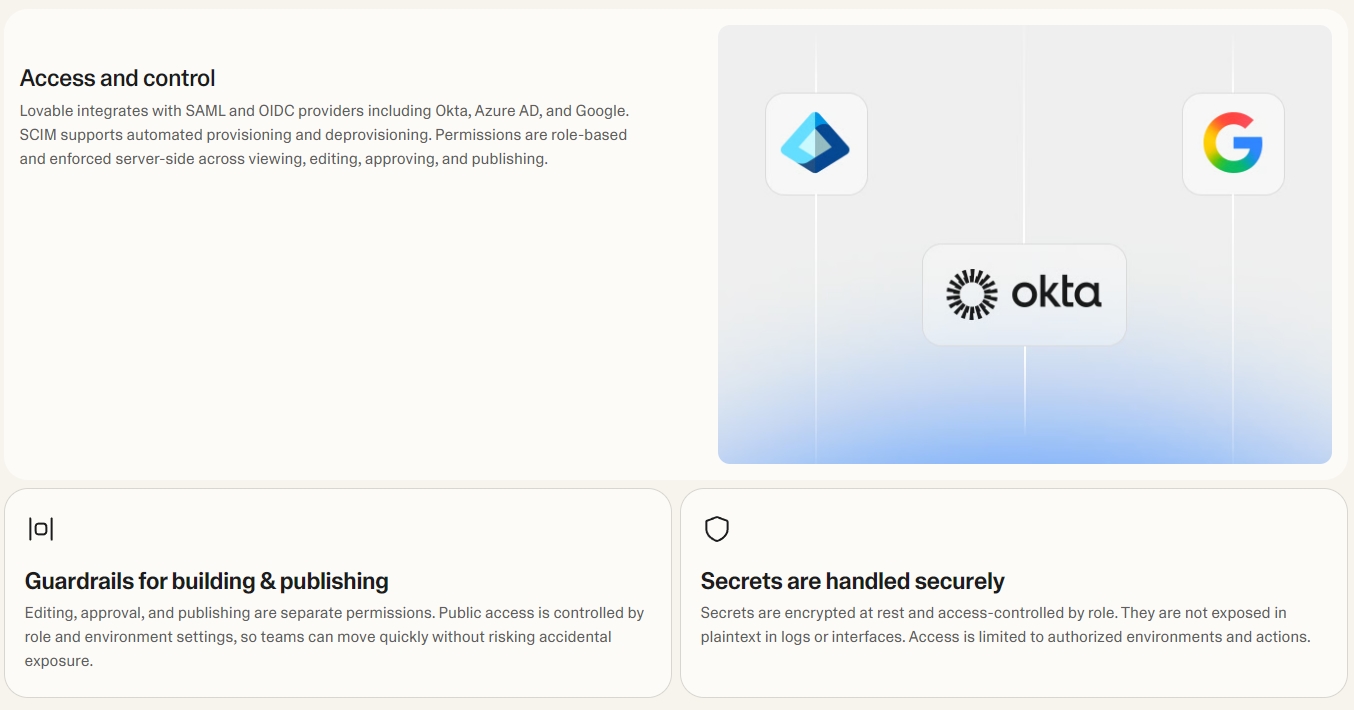
Environment variables are stored encrypted and injected at runtime. The dashboard masks values by default, with a reveal toggle for when you need to copy a key. Lovable does not log environment variable values in build outputs or deployment logs. Secrets used during the build process — like API keys for external services — are handled separately from runtime secrets, reducing the blast radius if a build log is accidentally exposed.
Custom domains come with automatic HTTPS via Let's Encrypt. Certificate provisioning and renewal happen without manual intervention. You can also bring your own certificate if your organization requires it. The platform enforces HSTS and sets secure cookie flags by default. Content Security Policy headers are not configured automatically, which means you need to add them yourself if your compliance requirements demand it.
The visual policy editor is genuinely useful for catching logic errors, but it cannot catch intent errors. If you mean to restrict access to owners only but accidentally select 'authenticated users,' the preview shows valid SQL that does the wrong thing.
Data Handling and Privacy Boundaries
Lovable processes three categories of data: your prompts and project context, the code it generates, and the runtime data your applications store in Supabase. The first two categories stay within Lovable's systems. The third lives in your Supabase project, which you control. This separation matters for data residency, deletion requests, and compliance audits.
Prompts and project context are used to generate code and improve the model. Lovable's privacy policy states they do not train their foundation models on customer data. The prompts are processed by Anthropic's Claude and OpenAI's GPT models via API. Those providers have their own data retention policies — typically 30 days for abuse monitoring, with zero-retention options for enterprise agreements. If your organization prohibits sending code context to third-party APIs, Lovable's architecture will not work for you without a self-hosted or enterprise arrangement.
Generated code is stored in Lovable's database and synced to your GitHub repository if you connect one. The GitHub sync is bidirectional — changes you push to GitHub appear in Lovable, and changes Lovable makes appear in GitHub. This means your code exists in at least two places: Lovable's systems and GitHub's. Deleting a project in Lovable removes it from their database but does not automatically delete the GitHub repository. You control that separately.
Authentication and Access Management
Authentication in Lovable projects uses Supabase Auth under the hood. That means you get battle-tested implementations of OAuth 2.0, OpenID Connect, magic links, and password-based auth with bcrypt hashing. The AI generates the frontend auth flows — login pages, signup forms, password reset, session management — using Supabase's client libraries. The generated code follows current best practices: PKCE for OAuth, secure cookie storage, automatic token refresh.
Role-based access control is not built into Lovable's project dashboard. You manage team access to Lovable projects through the organization settings — owner, admin, member roles with different permissions for deploying, managing secrets, and deleting projects. But within your application, RBAC is something you implement using Supabase's auth.users metadata, custom claims, or a separate roles table with RLS policies. The AI can scaffold this for you if you describe the requirement clearly.
Session management defaults are reasonable. Access tokens expire in one hour. Refresh tokens rotate on use and expire after 30 days of inactivity. You can adjust these in the Supabase dashboard. MFA supports TOTP and WebAuthn. The AI-generated auth UI includes MFA enrollment flows if you enable them. One gap: the generated code does not always handle session revocation across devices cleanly. If a user changes their password, existing sessions may persist until the access token expires. You need to implement a token blacklist or short-lived tokens if that matters for your threat model.
Scroll horizontally to see all columns
| Feature | Free | Pro | Enterprise |
|---|---|---|---|
| OAuth Providers | All | All | All + Custom |
| MFA (TOTP/WebAuthn) | Yes | Yes | Yes |
| Custom Auth Hooks | No | No | Yes |
| SSO/SAML | No | No | Yes |
| Session Config | Limited | Full | Full |
Code Generation Safety Patterns
The AI's training data includes a lot of insecure code. Stack Overflow answers, tutorial blogs, and example repositories often skip validation, use deprecated APIs, or ignore edge cases. Lovable addresses this through system prompts that bias the model toward secure patterns: parameterized queries, input sanitization, type-safe database access via the generated TypeScript types, and explicit error handling that does not leak stack traces to clients.
When you ask for a feature that involves user input — a search form, a file upload, a comment system — the generated code typically includes client-side validation, server-side validation via Supabase functions or RLS, and file type/size restrictions for uploads. It uses Supabase Storage with signed URLs rather than direct public access. The AI also tends to generate React components that escape output by default because React's JSX does that automatically. XSS risk is lower than in template-based frameworks, but not zero — dangerouslySetInnerHTML still exists and the AI occasionally uses it for rich text rendering.
SQL injection is largely mitigated by the architecture. You do not write raw SQL in application code. You use the Supabase client's type-safe query builder. RLS policies execute in the database with the user's context, so even if a bug lets a query reach the database, the policy enforces row-level permissions. The main injection surface shifts to Supabase Edge Functions if you write custom SQL there, or to RPC functions you define. The AI generates parameterized RPC calls by default.
The type-safe client is the single biggest security win. It eliminates an entire class of bugs where a schema change breaks a query silently. You get compile-time errors instead of runtime data leaks.
Supabase Integration Security Model
Lovable does not run your database. It provisions a Supabase project and manages it through Supabase's Management API. Your data never passes through Lovable's servers at runtime. Requests go from the browser to Supabase (for database, auth, storage, functions) and to your custom domains (for the frontend hosted on Lovable's CDN or your own infrastructure). This architecture means a compromise of Lovable's platform does not automatically expose your application data.
The integration uses service role keys for provisioning — creating tables, enabling RLS, deploying Edge Functions. These keys are stored encrypted in Lovable's vault and used only during AI-driven changes. They are not exposed to the frontend. The anon key, which is safe for client-side use, is what the generated application uses. This separation follows Supabase's recommended pattern.
One practical consequence: if you need to rotate the service role key, you must do it in the Supabase dashboard and then update it in Lovable's project settings. The AI cannot rotate it for you. Similarly, if you disable an extension in Supabase (like pg_cron or pgvector) that the AI previously enabled for a feature, the generated code may break. Lovable does not currently detect drift between the Supabase project state and the AI's understanding of it.
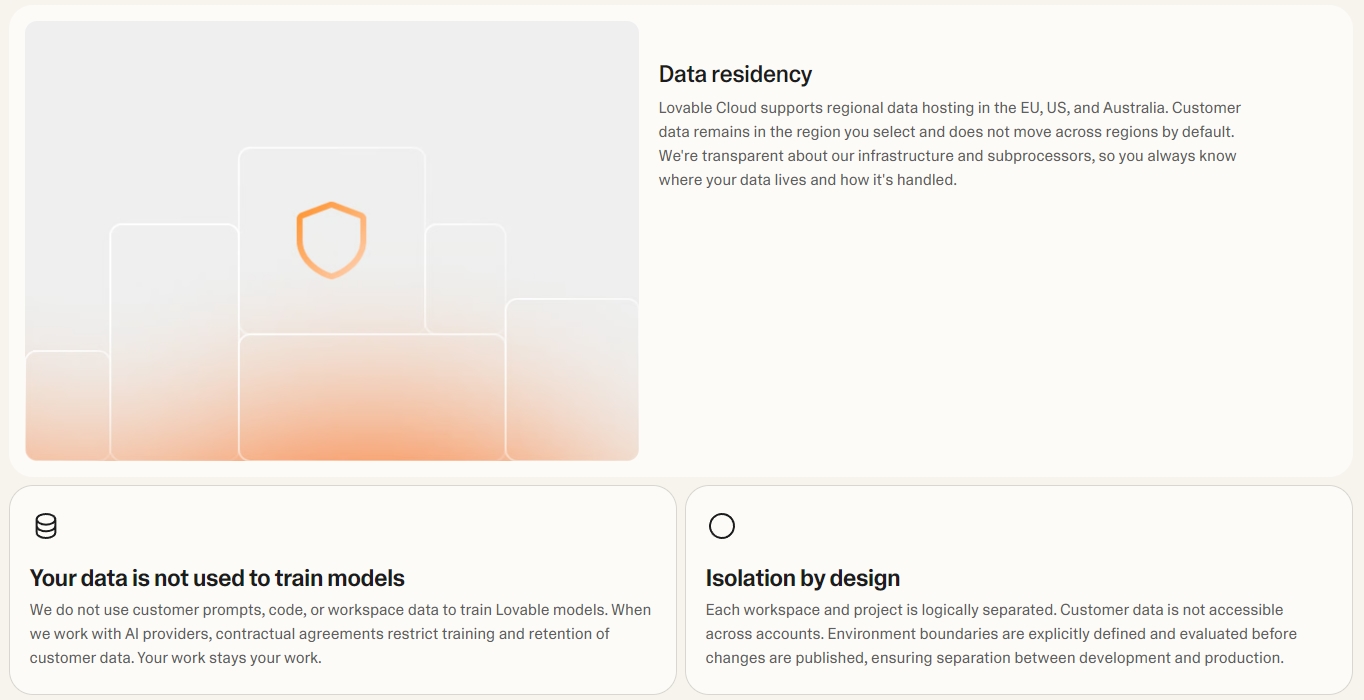
Network-level isolation is another factor. Supabase projects run in isolated VPCs. Lovable's build infrastructure runs in separate VPCs. The two communicate over authenticated API calls. There is no shared network segment where a misconfigured security group could expose your database. For enterprise customers, Supabase offers private networking options (VPC peering, AWS PrivateLink) that keep traffic off the public internet entirely. Lovable's Enterprise tier supports configuring these connections.
Enterprise Security Features
The Enterprise tier adds controls that matter for regulated industries and larger teams. SSO via SAML 2.0 and OIDC lets you enforce your identity provider's policies — password complexity, device trust, conditional access. Audit logs capture every action in the Lovable dashboard: who deployed, who changed secrets, who modified RLS policies, who added team members. These logs can be streamed to your SIEM via webhook.
Custom contract terms, data processing agreements, and dedicated support channels come with Enterprise. So does the option for EU data residency, which routes both Lovable's platform data and the provisioned Supabase projects through EU regions. The SLA includes uptime guarantees and incident response commitments. Penetration test reports are available under NDA.
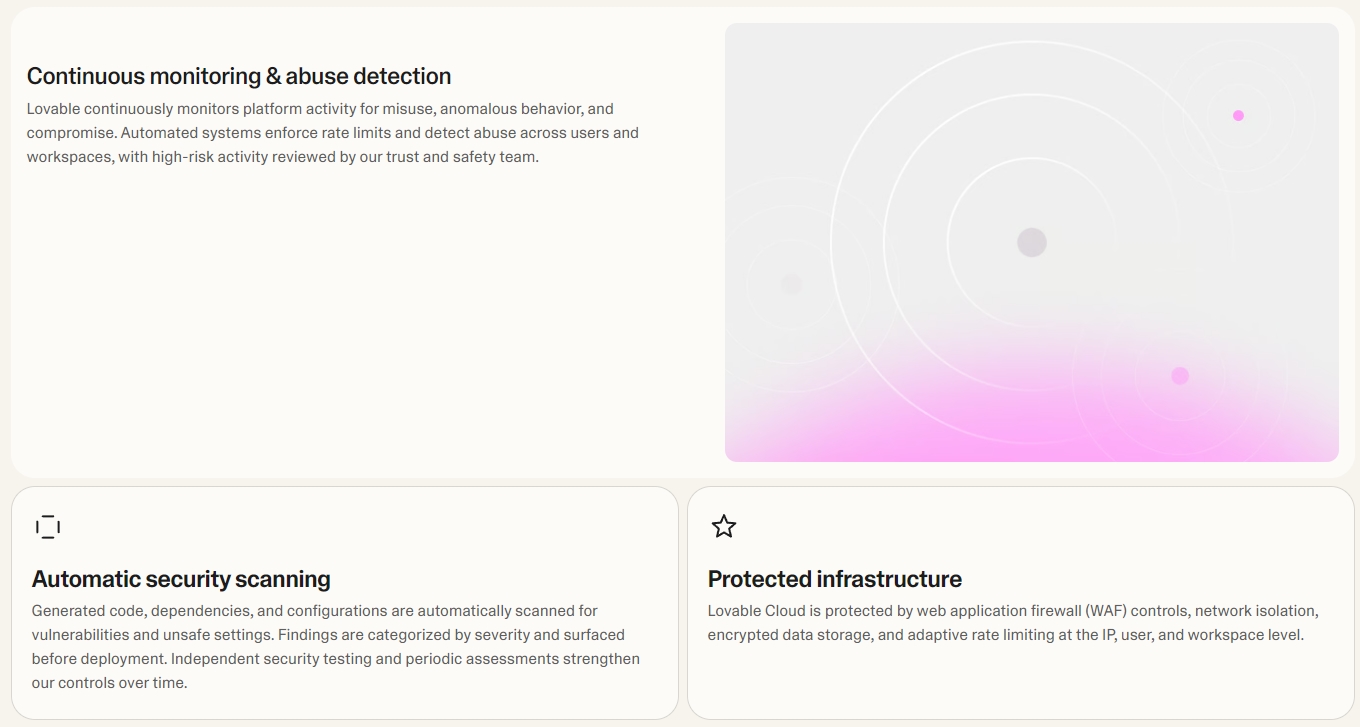
Private networking is the feature most security teams ask about. Enterprise customers can configure VPC peering between their AWS account and the Supabase project, or use PrivateLink for other clouds. This keeps database traffic off the public internet and lets you enforce network policies with your existing tooling. Lovable's build pipeline can also run in your VPC for complete isolation, though this requires a custom deployment setup.
Compliance and Standards Coverage
Lovable's platform holds SOC 2 Type II certification. The audit covers security, availability, and confidentiality trust principles. The report is available to customers under NDA. Supabase separately maintains SOC 2 Type II, ISO 27001, and HIPAA compliance. When you use Lovable, you inherit Supabase's compliance posture for the data layer, but your application's compliance depends on how you configure it.
GDPR compliance is supported through data processing agreements, the ability to delete projects and associated data, and the fact that you control the Supabase project where personal data lives. Lovable acts as a data processor; you are the controller. The platform provides tools for data subject access requests — you can export all project data, including generated code and prompt history. Deletion is permanent within 30 days.
Scroll horizontally to see all columns
| Standard | Lovable Platform | Supabase (Data Layer) | Your Responsibility |
|---|---|---|---|
| SOC 2 Type II | Yes | Yes | Application logic |
| ISO 27001 | No | Yes | Application logic |
| HIPAA | No (BAA on Enterprise) | Yes (with BAA) | PHI handling config |
| GDPR | DPA available | DPA available | Lawful basis, DSRs |
| PCI DSS | No | No | Full responsibility |
HIPAA is a common question. Lovable will sign a Business Associate Agreement for Enterprise customers. Supabase also offers BAAs. But HIPAA compliance for your application requires you to configure RLS policies that enforce minimum necessary access, enable audit logging on tables containing PHI, ensure encryption at rest (default) and in transit (default), and never log PHI in application logs. The AI does not automatically generate HIPAA-compliant configurations. You must specify the requirements.
Common Security Concerns and Mitigations
Teams evaluating Lovable raise the same concerns repeatedly. Here are the most frequent ones with practical mitigations.
- Prompt injection: The AI receives your prompts and project context. A malicious prompt could theoretically influence generated code to include backdoors. Mitigation: Review generated code before deploying. Use GitHub sync so changes go through your PR process. The AI cannot execute code or access secrets during generation.
- Supply chain risk: Generated code depends on npm packages. Lovable pins versions in package.json but does not run automated vulnerability scanning. Mitigation: Enable Dependabot or Snyk on your GitHub repo. Run npm audit in CI.
- Secret leakage: Environment variables are encrypted at rest and masked in UI. Build logs do not print them. Mitigation: Rotate secrets periodically. Use short-lived tokens where possible. Never commit secrets to GitHub — Lovable's sync respects .gitignore.
- Over-privileged service role: The service role key used for provisioning has full database access. Mitigation: Enterprise customers can bring their own Supabase project and manage the service role key themselves. Free/Pro tiers cannot.
- Vendor lock-in: Your code is standard React/TypeScript/Supabase. You can eject anytime. Mitigation: Keep GitHub sync enabled. Test local builds regularly. The only proprietary piece is the AI generation, which you lose if you leave.
The vendor lock-in concern is real but overstated. The generated code runs anywhere React runs. The database is Postgres. The auth is standard OIDC. You lose the AI assistant, not your application.
Best Practices for Secure Development on Lovable
Secure development on Lovable looks similar to secure development on any modern stack, with a few platform-specific habits.
- Enable GitHub sync from day one. Treat Lovable as a code generator, not a hosting platform. Every change goes through a pull request. This gives you code review, CI checks, and an audit trail.
- Run the generated TypeScript types in your CI pipeline. The types come from your Supabase schema. If a migration breaks the types, the build fails. This catches schema drift before deployment.
- Use the visual RLS editor for initial policies, then review the generated SQL. Copy complex policies into migration files so they are version-controlled and reviewable.
- Store all secrets in Lovable's environment variables, never in code. Use different values for development, staging, and production. Lovable supports per-environment variables.
- Enable MFA on your Lovable account and on all team members' accounts. Use a password manager. The platform does not enforce MFA for Free/Pro tiers.
- Request a penetration test report if you are evaluating for Enterprise. Review it with your security team. Ask about the scope — some reports only cover the dashboard, not the build infrastructure.
- Monitor Supabase logs for failed authentication attempts, RLS policy violations, and Edge Function errors. Set up alerts for anomaly patterns.
- Document your threat model. Know what data your application handles, who should access it, and what the impact of a breach would be. The AI cannot do this for you.
Final Assessment of Lovable Security
Lovable's security posture is solid for a platform in its category. The infrastructure is modern, the encryption defaults are correct, the Supabase integration follows security best practices, and the Enterprise tier adds the controls larger organizations require. The visual security tools — RLS editor, auth configuration, secrets management — lower the barrier to implementing proper controls, which is a genuine security benefit for teams that might otherwise skip them.
The gaps are where you would expect them. The AI generates code that follows patterns but does not understand your specific threat model. It cannot replace security review. The Free and Pro tiers lack SSO, audit logs, and private networking — hard requirements for many compliance frameworks. Data residency is fixed to us-east-1 unless you negotiate Enterprise. The platform does not scan generated dependencies for vulnerabilities. Drift detection between the AI's understanding and the actual Supabase project state is not implemented.
For a startup building an MVP, a side project, or an internal tool with low sensitivity data, Lovable's default security is likely sufficient — especially if you enable GitHub sync and review the generated code. For a healthcare application handling PHI, a fintech product moving money, or any system subject to regulatory audit, you need the Enterprise tier and you still need to do the application-level security work yourself. The platform gives you better tools than most, but it does not absolve you of responsibility.
The decision comes down to whether the productivity gains from AI generation outweigh the additional review burden. In most cases they do, because the AI handles boilerplate securely by default and the review focuses on business logic rather than framework plumbing. But that calculation changes if your team lacks the expertise to review the code the AI produces. An insecure application generated quickly is still an insecure application.
Frequently Asked Questions
Is Lovable dev safe for production applications?
Yes, with caveats. The platform infrastructure is SOC 2 certified and uses modern encryption. Your application data lives in Supabase, which has its own certifications. However, the AI-generated code requires review. Enable GitHub sync, run CI checks, and treat Lovable as a code generator rather than a black-box platform.
Does Lovable train on my code or prompts?
Lovable states they do not train foundation models on customer data. Prompts are processed by Anthropic and OpenAI APIs, which retain data for 30 days for abuse monitoring unless you have a zero-retention enterprise agreement with those providers.
Can I use Lovable for HIPAA-compliant applications?
Only on the Enterprise tier with a signed Business Associate Agreement from both Lovable and Supabase. You must also configure RLS policies, audit logging, and data handling correctly. The AI does not automatically generate HIPAA-compliant configurations.
What happens to my data if I delete a Lovable project?
The project is removed from Lovable's database within 30 days. Your GitHub repository is not deleted automatically. The Supabase project remains unless you delete it separately in the Supabase dashboard. You control the data layer independently.
Does Lovable support SSO and audit logs?
Only on the Enterprise tier. SSO supports SAML 2.0 and OIDC. Audit logs capture dashboard actions and can be streamed to a SIEM via webhook. Free and Pro tiers do not have these features.
Can I run Lovable in my own VPC or on-premises?
Enterprise customers can configure private networking (VPC peering, PrivateLink) for the Supabase data layer. The Lovable platform itself runs on Lovable's infrastructure. A fully self-hosted option is not currently available.
How does Lovable handle secrets and environment variables?
Secrets are encrypted at rest using AES-256, masked in the dashboard, and excluded from build logs. They are injected at runtime. Per-environment variables are supported. The service role key for Supabase provisioning is stored separately and never exposed to the frontend.
What compliance standards does Lovable meet?
Lovable holds SOC 2 Type II (security, availability, confidentiality). GDPR compliance is supported via DPA. ISO 27001 and HIPAA are not certified for Lovable's platform but are available through Supabase for the data layer. PCI DSS is not covered.