

AI Development Tools
Lovable Founders: Building the AI App Builder
How founder decisions shape every feature of this AI development platform


Senior Software Developer & Trading Technology Specialist
Ethan Parker is a software developer with over 8 years of experience in building web applications, trading tools, and financial technology solutions. He specializes in Python, JavaScript, API integrations, and trading automation, helping traders improve efficiency through innovative technology.
Lovable emerged from a simple observation: the gap between having an idea and shipping a working application remains stubbornly wide. Most people who understand a problem deeply lack the technical skills to build the solution. The founders recognized this friction not as an edge case but as the central challenge facing modern software creation. Their response was to build an AI system that writes production-grade code from natural language descriptions, handling everything from database schema to authentication flows to deployment configuration.
Contents
- 1. Founding Vision and Product Philosophy
- 2. How Founder Decisions Shape the User Experience
- 3. Services Designed for Founders
- 4. The Founder Community and Feedback Loops
- 5. Technical Architecture Reflecting Founder Values
- 6. Pricing Philosophy and Business Model
- 7. Security and Enterprise Readiness
- 8. AI Model Strategy and Vendor Independence
- 9. Competitive Position and Differentiation
- 10. Founder Background and Company Evolution
- 11. Roadmap Direction and Founder Commitments
- 12. Final Assessment of Lovable Founders and Their Platform
The platform targets a specific frustration. Traditional no-code tools force users into visual builders that become limiting the moment requirements grow complex. Custom code offers flexibility but demands months of learning. Lovable sits in the middle — an AI that generates real React, TypeScript, and Supabase code that developers can inspect, modify, and extend. This positioning reflects a founder philosophy that the best tool respects both the beginner's need for speed and the expert's need for control.
What distinguishes the founding approach is refusal to treat AI as a black box. The system shows its work. Every prompt produces a diff view displaying exactly which files changed and why. Users can roll back, branch, or edit the generated code directly in a browser-based IDE. This transparency wasn't an afterthought — it emerged from early decisions about what trust requires when code writes code. The founders bet that developers and non-developers alike would only adopt AI-generated software if they could verify and own the output.
Founding Vision and Product Philosophy
The product philosophy centers on a single question: what would it take for someone to describe an application in plain English and receive a deployable, maintainable codebase? Answering that question required solving problems that existing AI coding assistants ignored. Context management across thousands of lines of generated code. Consistent architectural patterns across features. Integration with real infrastructure — databases, authentication, payments, hosting — rather than toy sandboxes. The founders built Lovable to handle the full stack because partial solutions create more friction than they resolve.
Early versions focused on React with Vite, TypeScript, and Tailwind CSS — a modern stack that balances performance, developer experience, and hiring market reality. Supabase became the default backend, providing PostgreSQL, authentication, realtime subscriptions, and edge functions without requiring users to manage separate services. Stripe integration handles payments. GitHub synchronization means every project lives in a real repository from day one. These choices reflect a founder belief that the platform should produce code that feels familiar to any professional developer, not a proprietary dialect that locks users in.
- Natural language to production code in minutes, not hours
- Full-stack generation: frontend, backend, database, auth, payments
- Real GitHub repositories with complete version history
- Browser-based IDE for direct code editing and review
- One-click deployment to global edge infrastructure
- No vendor lock-in — export and run anywhere
The founding team avoided the temptation to build a walled garden. Every project can be ejected — downloaded as a standard codebase that runs independently of Lovable. This decision cost them potential recurring revenue from hosting lock-in but aligned with a longer-term thesis: the platform wins by being the best way to start, not the only way to continue. Founders who experience this freedom tend to stay, expand usage, and recommend the tool to peers. The business model reflects this — pricing tiers gate advanced AI features and collaboration, not basic code ownership.
The top banner image captures the founding moment — a small team convinced that the bottleneck in software creation isn't coding syntax but the translation layer between human intent and machine execution. Their backgrounds span competitive programming, developer tooling, and product design. This mix matters because building an AI app builder requires understanding both the capabilities of large language models and the daily frustrations of developers who maintain production systems. The founders didn't approach this as researchers experimenting with prompts; they built the tool they wished existed when they were shipping products under deadline pressure.
How Founder Decisions Shape the User Experience
Every interaction with Lovable reveals founder priorities. The onboarding flow asks what you want to build, not who you are. No credit card, no marketing questionnaire — just a text box and a generate button. Within seconds, a project structure appears with routing, state management, and component hierarchy already reasoned about. This immediacy wasn't accidental. The founding team measured time-to-first-success obsessively during beta, iterating until a complete novice could produce a working todo app with authentication in under three minutes. That metric drove decisions about default configurations, template libraries, and error recovery flows.
The chat interface serves as the primary control surface. Users describe changes — "add a dashboard with charts showing revenue by month" — and the AI produces a plan, then implements it across multiple files. The plan step is crucial. It forces the model to reason before generating, reducing hallucinated imports and architectural inconsistencies. Users can approve, modify, or reject the plan. This pattern emerged from founder insistence that AI should propose, not impose. The result feels collaborative rather than autonomous, which matches how experienced developers actually work with junior colleagues.
Scroll horizontally to see all columns
| Dimension | Lovable Approach | Traditional No-Code |
|---|---|---|
| Code ownership | Full GitHub repo from start | Platform-locked visual model |
| Extensibility | Edit generated code directly | Limited to platform primitives |
| AI transparency | Diff view for every change | Black-box generation |
| Backend reality | Real PostgreSQL + auth + functions | Simplified data stores |
| Team collaboration | Git-native workflows | Proprietary sharing links |
| Learning curve | Progressive disclosure | Cliff at platform limits |
The table above captures differences that stem directly from founding choices. Traditional no-code platforms optimize for the first hour of use. Lovable optimizes for the first year. That means accepting steeper initial complexity — users must understand that they're generating real code — in exchange for no ceiling. Founders who have hit the walls of Bubble, Webflow, or Airtable recognize this trade-off immediately. They're the core early adopters, and their feedback loops shaped the product toward professional-grade output rather than demo-friendly simplicity.
Services Designed for Founders
The founders built Lovable partly to solve their own problems as repeat entrepreneurs. They knew the pattern: validate an idea with a prototype, discover it needs user accounts, add payments, realize the database schema needs migration, scramble to deploy. Each step traditionally requires a different tool, a different specialist, or a weekend of documentation reading. Lovable compresses this by making the AI handle the glue work — the boilerplate, the configuration, the integration code that doesn't differentiate a product but consumes disproportionate time.
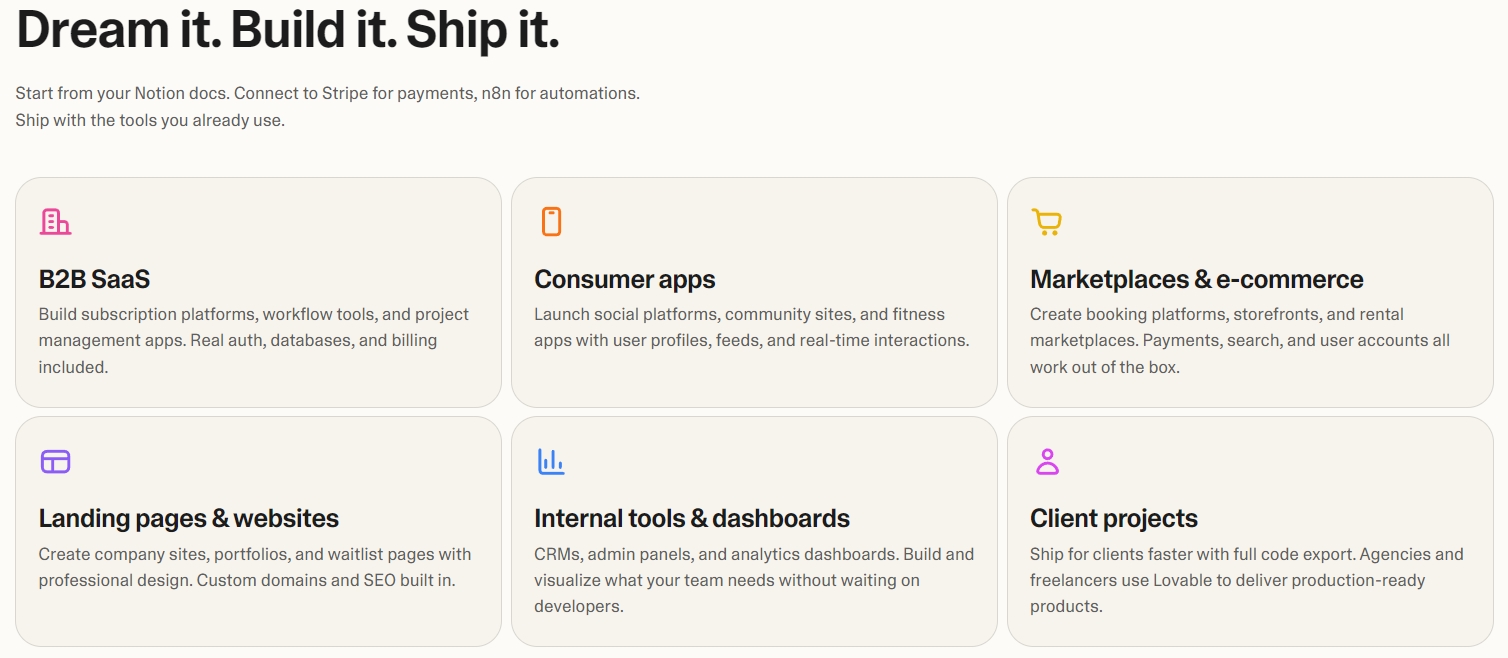
The services image illustrates how the platform maps to founder stages. MVP building focuses on speed — templates for SaaS dashboards, marketplaces, social apps, internal tools. Prototyping emphasizes iteration — branch, test, discard, refine without breaking the main codebase. Scaling addresses the graduation problem: when the prototype works and real users arrive, the same codebase handles authentication, database migrations, edge caching, and team collaboration without rewrite. This continuity is rare. Most tools excel at one stage and become obstacles at the next.
- SaaS starter kits with auth, billing, and admin panels pre-configured
- Marketplace templates handling multi-sided platforms and payments
- Internal tool generators for admin dashboards and data entry forms
- Landing page variants with A/B testing hooks built in
- AI agent scaffolds for autonomous workflows and scheduled tasks
- E-commerce foundations with inventory, cart, and checkout flows
Templates deserve specific attention. The founding team treats them as executable specifications, not starter code. Each template encodes architectural decisions — where to put business logic, how to structure database relationships, which patterns scale and which create technical debt. When a founder selects "SaaS with teams," they receive a codebase implementing role-based access control, invitation flows, subscription management, and audit logging. These aren't placeholder comments. They're working implementations that would take a senior developer weeks to build correctly. The template library grows from real founder requests, not marketing checklists.
A template should save you the decisions you'll regret later, not the decisions that make your product unique.
The Founder Community and Feedback Loops
Product development at Lovable runs on unusually tight feedback loops with founder-users. The team maintains a public Discord where founders share works-in-progress, report bugs, and request features. Several core features originated from these conversations: the GitHub integration depth, the Supabase migration tooling, the enterprise SSO support. The founders participate directly, not through community managers. This isn't performative transparency — it's the only way to understand whether a new AI capability actually solves the problem founders face when building at 11 PM on a Sunday.
The community also serves as a distribution channel. Founders who succeed on Lovable become the most credible advocates. Their case studies — real applications serving real customers — demonstrate the platform's viability better than any benchmark. The founding team amplifies these stories through a showcase program, but the authenticity comes from the founders themselves. This creates a flywheel: better product attracts more serious builders, who build better showcases, which attract more serious builders. The quality bar stays high because the community self-selects for people shipping production software.
Scroll horizontally to see all columns
| Feature | Community Signal | Time to Ship |
|---|---|---|
| GitHub Actions CI/CD templates | Repeated requests in #deployments channel | 3 weeks |
| Supabase RLS policy generator | Founders sharing manual workarounds | 2 weeks |
| Team workspaces with RBAC | Agency founders managing client projects | 6 weeks |
| Custom domain SSL automation | Launch-day failures in showcase thread | 1 week |
| AI code review mode | Senior devs asking for quality gates | 4 weeks |
The table reflects a pattern: features ship fast when the pain is visible and shared. The founding team doesn't maintain a public roadmap in the traditional sense. They maintain a ranked list of founder problems, updated weekly from Discord, support tickets, and direct conversations. This approach keeps the product honest. It's easy to build impressive demos for features nobody needs. It's harder to ignore a dozen founders describing the same deployment failure in the same week.
Technical Architecture Reflecting Founder Values
The technical stack wasn't chosen by committee. The founding CTO made opinionated bets: React over Vue or Svelte because the hiring market and component ecosystem reduce future friction. TypeScript over JavaScript because AI-generated code benefits enormously from static analysis — the model catches its own errors when types constrain the search space. Vite over Webpack because fast iteration cycles matter more than legacy compatibility. Tailwind over CSS-in-JS because utility classes produce more predictable AI output. Supabase over Firebase because PostgreSQL's maturity and SQL standard reduce lock-in risk.
These choices compound. When the AI generates a new feature, it operates within a consistent architectural vocabulary. Components follow the same patterns. Database migrations use the same conventions. Authentication flows reuse the same utilities. This consistency isn't natural for LLMs — they tend to invent new patterns for each task unless heavily constrained. The founding team invested months in prompt engineering, few-shot examples, and retrieval-augmented context to make the model behave like a senior developer who internalized the codebase conventions. The result feels coherent because the constraints are real, not performative.
- Monorepo structure separating generated code from platform code
- Deterministic prompt templates versioned alongside the codebase
- Automated evaluation suite testing generated apps against spec
- Sandbox execution environment for safe preview deployments
- Incremental context retrieval scaling to 100k+ token codebases
- Git-native state enabling branching, merging, and rollback
The evaluation suite deserves mention. Most AI coding tools rely on vibe checks. Lovable runs every model update against a test suite of 200+ founder scenarios — "build a CRM with pipeline stages," "create a multi-tenant dashboard with row-level security," "add Stripe subscriptions with trial periods." Each scenario has expected file structures, API contracts, and behavioral assertions. A model regression that breaks the CRM template blocks release. This infrastructure cost months of founder time before any customer saw it, but it prevents the silent degradation that plagues AI products chasing benchmark scores instead of user outcomes.
Benchmarks measure what models can do. Evaluations measure what your product actually does for users. The gap between them is where AI startups die.
Pricing Philosophy and Business Model
Pricing reflects the same founder-centric logic. The free tier includes unlimited public projects, full code access, and GitHub sync — enough to build and launch real applications. The Pro tier gates advanced AI models, private projects, and higher generation limits. Business adds team workspaces, SSO, and priority support. Enterprise provides dedicated infrastructure, custom contracts, and SLA guarantees. Notably, no tier restricts code ownership or deployment freedom. A founder on the free tier can build a SaaS, deploy it to Vercel, connect a custom domain, and charge customers without paying Lovable a cent. The platform captures value when teams need collaboration, privacy, or scale — not when individuals need to ship.
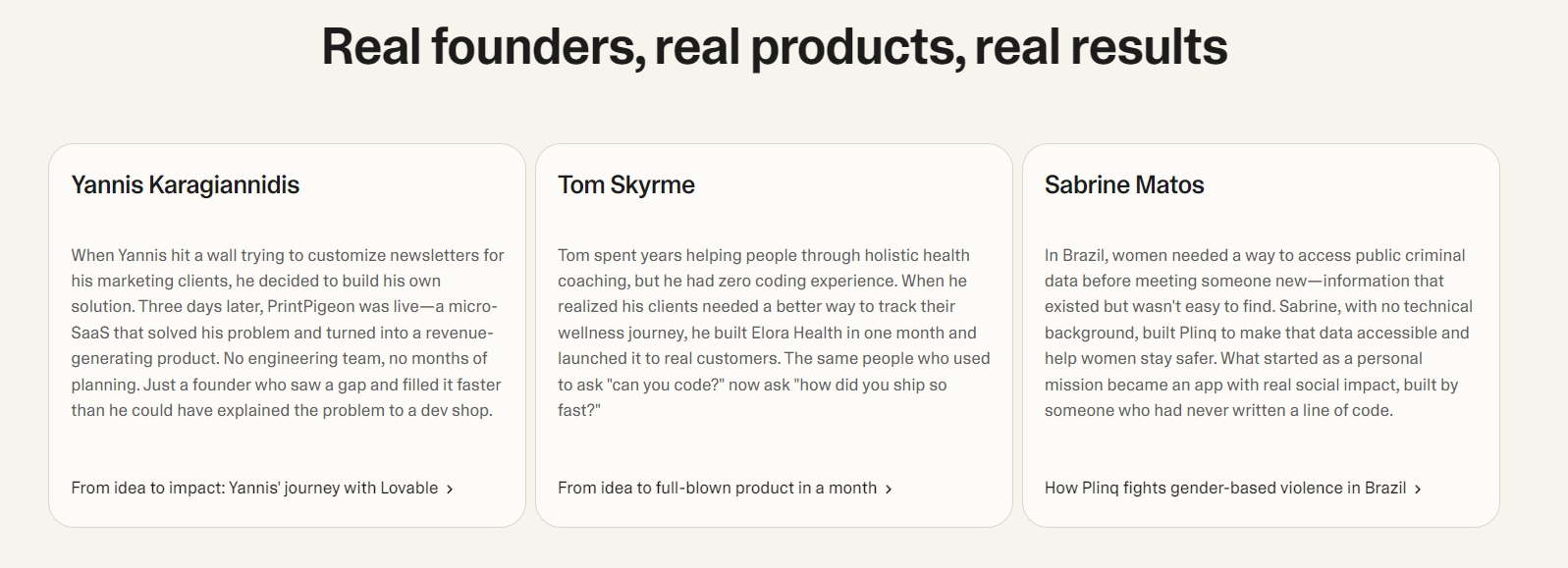
The review image captures founder sentiment: the platform earns trust by delivering working software, not promises. Testimonials cluster around three themes — speed to first deploy, quality of generated code, and absence of lock-in. Negative feedback tends to focus on AI inconsistency for highly novel requirements, mobile responsiveness edge cases, and the learning curve for non-technical users who expect pure no-code simplicity. The founding team treats this feedback as product direction, not reputation management. They've publicly acknowledged limitations and published timelines for addressing them, a rarity in the AI tool space where overpromotion is the norm.
Scroll horizontally to see all columns
| Capability | Free | Pro | Business |
|---|---|---|---|
| Public projects | Unlimited | Unlimited | Unlimited |
| Private projects | 0 | Unlimited | Unlimited |
| Advanced AI models | Limited | Full access | Full access |
| Team members | Solo only | Solo only | 10 included |
| SSO / SAML | No | No | Yes |
| Code ownership | Full | Full | Full |
The table reveals a deliberate choice: the free tier is genuinely useful for solo founders building public projects. This isn't a crippled demo — it's the full product with visibility constraints. The founding team reasoned that successful free-tier founders become the best marketing, either by upgrading when they need privacy or by advocating the platform publicly. This bet has held. Conversion rates from free to paid exceed industry averages because the upgrade trigger — needing private repos for a real business — correlates perfectly with ability and willingness to pay.
Security and Enterprise Readiness
Enterprise features didn't arrive as an afterthought. The founding team included engineers who had sold to enterprise buyers and knew the checklist: SOC 2, SSO, audit logs, data residency, penetration testing, vendor security questionnaires. Rather than bolting these on later, they architected for them from the start. The platform runs on isolated tenant infrastructure. Customer code never trains models. GitHub tokens are encrypted at rest and scoped to minimum permissions. Audit logs capture every AI generation, code edit, and deployment action. These investments preceded enterprise revenue — a founder decision to reduce friction for the first enterprise deal rather than maximize short-term margins.
Security posture affects all users, not just enterprise. The same isolation that satisfies compliance requirements protects a solo founder's proprietary algorithms. The same audit logs that enable enterprise governance help any user debug why the AI made a particular change. The founding team rejects the dichotomy between "consumer-grade" and "enterprise-grade" security. They argue that software handling production data deserves production-grade protections regardless of who pays for it. This philosophy simplifies the product — one codebase, one security model — and eliminates the feature gaps that plague tiered security approaches.
- SOC 2 Type II certification with annual audits
- SAML/OIDC SSO with SCIM provisioning
- Customer-managed encryption keys option
- EU and US data residency selections
- Automated penetration testing in CI pipeline
- Real-time security incident notification webhooks
AI Model Strategy and Vendor Independence
The founding team made an early strategic decision: never depend on a single model provider. The platform routes tasks to different models based on complexity, latency requirements, and cost. Code generation uses the strongest available model for reasoning. Simple refactoring uses faster, cheaper models. Embedding and retrieval use specialized models. This abstraction layer means the product improves automatically when new models release — the team evaluates, benchmarks, and promotes without rewriting application logic. It also provides negotiating leverage and resilience against provider outages, pricing changes, or policy shifts.
Model evaluation runs continuously. The team maintains a private leaderboard scoring models on their specific tasks: multi-file code generation, debugging from error messages, architectural reasoning, and adherence to codebase conventions. Public benchmarks like HumanEval correlate poorly with these tasks. A model that scores 90% on algorithmic puzzles might produce unusable React components because it ignores TypeScript strictness or Tailwind conventions. The founding team's evaluation framework captures these nuances, and they publish selected results to help other AI builders avoid the same trap.
Model loyalty is a liability. The best AI product is the one that switches to the best model for each task before users notice the old one fell behind.
Competitive Position and Differentiation
Lovable occupies a distinct position in the AI development landscape. Cursor and GitHub Copilot target professional developers writing code line by line. Bolt, v0, and Replit Agent target rapid prototyping with varying degrees of code access. Traditional no-code platforms target non-technical builders with visual interfaces. Lovable targets the expanding middle: technical founders who want AI to handle boilerplate but refuse to surrender code ownership, and non-technical founders willing to learn just enough code literacy to verify and extend what the AI produces. This segment is growing faster than either extreme because modern startups increasingly require both speed and technical credibility with investors, hires, and acquirers.
Scroll horizontally to see all columns
| Category | Representative Tools | Primary Gap vs Lovable |
|---|---|---|
| AI code assistants | Cursor, Copilot, Codeium | No full-stack generation, no deployment |
| AI app generators | Bolt, v0, Replit Agent | Limited code ownership, sandboxed execution |
| Visual no-code | Bubble, Webflow, FlutterFlow | Platform lock-in, ceiling at complexity |
| Backend-as-a-service | Supabase, Firebase, Appwrite | No frontend generation, manual integration |
| Full-stack frameworks | Next.js, Remix, Nuxt | No AI assistance, steep learning curve |
The table simplifies a nuanced landscape. Many founders use Lovable alongside these tools — generating the initial application with Lovable, then refining complex components in Cursor, hosting on Vercel with Supabase backend. The founding team encourages this composability. They view Lovable as the "zero to one" accelerator, not the entire development lifecycle. This positioning avoids the platform trap of trying to be everything to everyone. It also creates natural expansion opportunities: as founders' needs grow, they adopt adjacent tools rather than outgrowing Lovable entirely.
Founder Background and Company Evolution
The company began as a side project exploring whether large language models could reliably generate full-stack applications. Early experiments in 2022 produced promising but brittle results — the models hallucinated imports, forgot context, and produced code that looked correct but failed at runtime. The founding team spent six months building the infrastructure to make generation reliable: context management, evaluation frameworks, sandbox execution, and iterative refinement loops. They launched a private beta to 500 founders in early 2023, iterating weekly based on usage data and direct feedback. Public launch followed in late 2023 with a waitlist that grew to 50,000 before general availability.
Funding history reflects founder discipline. The team raised a modest seed round from developer-focused investors who understood the technical challenge and the market timing. They declined larger offers at higher valuations that came with pressure to pursue enterprise deals before the product was ready. This patience allowed them to optimize for founder love metrics — NPS, activation rate, time-to-first-deploy — rather than vanity metrics that impress investors but misalign with user value. The current team remains small by design, around 20 people, with a high ratio of engineers to non-engineers. Every hire ships code or talks to founders directly.
- Founded by engineers with competitive programming and dev-tool backgrounds
- Seed funding from investors specializing in developer tools
- Private beta: 500 founders, 6-month iteration cycle
- Public launch: 50,000 waitlist signups
- Team size: ~20, majority engineers
- Profitability-focused growth, not blitzscaling
The founding team's background in competitive programming shapes the culture. Problems are approached as optimization challenges with measurable objectives. Code quality is non-negotiable — the platform generates code that other developers read, so it must meet professional standards. This standard extends to internal tooling: the team builds their own evaluation harnesses, deployment pipelines, and observability stacks rather than buying solutions that might compromise their understanding of the system. This self-reliance slows initial velocity but compounds into a platform that the team deeply understands and can modify fearlessly.
Roadmap Direction and Founder Commitments
The public roadmap emphasizes three themes that founders consistently request: mobile-native generation, AI agent workflows, and deeper framework support. Mobile work focuses on React Native with Expo, enabling founders to generate iOS and Android apps from the same prompt that produces a web app. Agent workflows move beyond chat — founders describe a goal, and the AI plans, executes, tests, and iterates autonomously with human checkpoints. Framework expansion targets Next.js App Router, Remix, and Astro for founders who need specific rendering strategies. Each theme traces directly to founder conversations, not market analysis reports.
Commitments matter more than roadmap items. The founding team has publicly committed to: never locking generated code behind a paywall, never training models on private customer code, never removing the ability to eject and self-host, and maintaining backward compatibility for generated project structures. These commitments constrain business model options but build the trust required for founders to bet their companies on the platform. In a market where AI tools frequently pivot, deprecate APIs, or change terms of service, explicit commitments function as a competitive moat. Founders notice.
A roadmap says what you'll build. Commitments say what you'll never break. Founders bet on the second.
Final Assessment of Lovable Founders and Their Platform
The founders built Lovable to solve a problem they lived: the gap between vision and working software. Their product decisions consistently favor the founder who ships over the investor who scales, the developer who owns code over the platform that rents it, the user who needs reliability over the demo that impresses. This alignment shows in the free tier generosity, the ejection principle, the evaluation rigor, the security baseline, the model independence, and the public commitments. Whether Lovable becomes a category-defining company or a stepping stone for the next generation of AI tools, it has already shifted the conversation about what AI-assisted development should feel like — transparent, ownable, and uncompromising on code quality.
Frequently Asked Questions
Who are the founders of Lovable.dev?
Lovable was founded by a team of engineers with backgrounds in competitive programming, developer tooling, and product design. The founding team includes technical leaders who previously built and scaled developer-facing products.
What makes Lovable different from other AI app builders?
Lovable generates full-stack production code (React, TypeScript, Supabase) that you own completely — real GitHub repos, no vendor lock-in, one-click deployment anywhere. The AI shows its work through diff views and lets you edit generated code directly.
Can non-technical founders use Lovable effectively?
Yes, but with a learning curve. The platform generates real code, so non-technical founders need to develop basic code literacy to verify and extend what the AI produces. Many succeed by starting with templates and learning incrementally.
Is there a free tier for Lovable?
The free tier includes unlimited public projects, full code access, GitHub synchronization, and deployment capabilities. Private projects and advanced AI models require a paid subscription.
Does Lovable train on my private code?
No. The founding team has committed to never training models on private customer code. Customer code runs in isolated environments and is not used for model improvement.
What happens if I want to leave Lovable?
You can eject any project at any time — download the complete codebase as a standard Vite + React + TypeScript application with Supabase configuration. It runs independently on any hosting provider with no Lovable dependencies.
Which AI models does Lovable use?
Lovable routes tasks to multiple model providers based on the task type — code generation, refactoring, embedding, retrieval. The platform is model-agnostic and updates model selections continuously based on internal evaluations.
Is Lovable suitable for enterprise applications?
Yes. The platform offers SOC 2 Type II compliance, SSO/SAML with SCIM, audit logs, data residency options, and enterprise SLAs. Security architecture is unified across all tiers, not gated behind enterprise-only features.