

AI Development Tools
Lovable Community: Discord, Reddit, and Builder Networks
A practical guide to Lovable's developer communities, official channels, and builder programs

Senior Software Developer & Trading Technology Specialist
Ethan Parker is a software developer with over 8 years of experience in building web applications, trading tools, and financial technology solutions. He specializes in Python, JavaScript, API integrations, and trading automation, helping traders improve efficiency through innovative technology.
The Lovable Community has grown into one of the more active ecosystems around AI-assisted app development. What started as a small group of early adopters testing an AI app builder has expanded into multiple channels — Discord, Reddit, LinkedIn, X (formerly Twitter), YouTube, and Instagram — each serving a different purpose for builders at various stages of their journey.
Contents
- 1. Lovable Discord: The Real-Time Hub
- 2. Reddit: Longer-Form Discussion and Archives
- 3. Social Media Channels: Different Audiences, Different Content
- 3.1. X (Twitter) — Product Updates and Builder Spotlights
- 3.2. LinkedIn — Agency and Enterprise Focus
- 3.3. YouTube — Tutorials and Deep Dives
- 3.4. Instagram — Visual Showcases
- 4. Official Community Programs
- 4.1. Ambassador Program
- 4.2. Expert Directory
- 4.3. Partner Program
- 5. Finding Help: A Practical Decision Tree
- 6. Community Culture and Unwritten Rules
- 7. Templates, Guides, and Community-Created Resources
- 8. Events: Virtual and In-Person
- 9. Common Pitfalls for Newcomers
- 10. Contributing Back: Low-Effort, High-Impact Ways
- 11. Comparing Lovable Community to Other AI Builder Ecosystems
- 12. Staying Current Without Burnout
- 13. Final Assessment of Lovable Community
If you're new to Lovable, the community is often the fastest way to get unstuck. The official documentation covers the basics, but real-world edge cases — Supabase auth quirks, Stripe webhook handling, custom domain configuration — tend to surface first in community discussions. Veterans share workarounds before they make it into official guides.
This article maps out where the community lives, what each channel is good for, and how to get value without drowning in noise. I'll also cover the official programs Lovable runs for contributors, partners, and early adopters.
Lovable Discord: The Real-Time Hub
Discord is where the highest-volume, fastest-moving conversations happen. The official server passed 25,000 members in early 2024 and typically shows 2,000–3,000 online at any given moment. Channels are organized by topic: #general, #showcase, #help, #bug-reports, #feature-requests, #supabase, #stripe, #github, and several language-specific channels.
The #help channel moves quickly. During US business hours, questions often get a response within minutes. The trade-off is that answers can be fragmented — three people might reply with different approaches before you've read the first one. Pinning the solution that worked for you helps the next person, but many don't bother.
A few practical tips for Discord: use threads for follow-up questions instead of clogging the main channel. Search before asking — the search function actually works well if you use specific terms like "Supabase RLS" or "custom domain SSL." The #showcase channel is worth browsing weekly; people post production apps with revenue numbers, which is more useful than theoretical tutorials.
Reddit: Longer-Form Discussion and Archives
The r/LovableDev subreddit serves a different function than Discord. Threads stay visible for days instead of minutes. People write detailed post-mortems — what worked, what didn't, how much time they saved versus traditional coding. These posts become reference material. I've bookmarked half a dozen Reddit threads that explain complex Supabase integration patterns better than the official docs.
Reddit also catches the critical feedback that gets buried in Discord's positivity bias. When Lovable shipped a pricing change in Q2 2024, the Reddit thread had 200+ comments dissecting the impact on solo founders versus agencies. The Discord announcement channel had mostly reactions. Both perspectives matter.
Search Reddit before posting. The subreddit has accumulated enough content that most beginner questions have been answered multiple times. Use site:reddit.com/r/LovableDev with your search terms. The community is generally welcoming to newcomers who show they've done basic research.
Social Media Channels: Different Audiences, Different Content
Lovable maintains active presences across X, LinkedIn, YouTube, and Instagram. Each platform attracts a different segment of the builder spectrum, and the content strategy reflects that.
X (Twitter) — Product Updates and Builder Spotlights
The @lovable_dev account on X is the fastest source for release notes, uptime incidents, and feature teasers. The team also retweets builder projects regularly. If you want to see what's possible with the platform, the retweet feed is a curated gallery of production apps. Founders occasionally share metrics — MRR, user counts, time to launch — which helps calibrate expectations.
LinkedIn — Agency and Enterprise Focus
LinkedIn content skews toward agency case studies, enterprise features, and hiring announcements. The Lovable company page posts weekly. Comments sections often have agency owners discussing client work, which is useful if you're evaluating Lovable for client projects. The audience here is less technical, more business-oriented.
YouTube — Tutorials and Deep Dives
The official YouTube channel publishes 2–3 videos monthly: feature walkthroughs, builder interviews, and occasional live coding sessions. Video length ranges from 8-minute feature intros to 45-minute deep dives. The comment sections are surprisingly active — viewers timestamp specific techniques and ask follow-ups that the team or community members answer.
Instagram — Visual Showcases
Instagram is the least technical channel. It's mostly UI screenshots, short reels of app interactions, and team photos. Useful for getting a feel for design possibilities, less useful for implementation details. The Stories highlights archive past launches and events.
Across all social platforms, the most valuable signal comes from builders tagging Lovable in their launch posts. Those organic mentions — unprompted, unpaid — reveal what people actually ship versus what marketing claims are possible.
Official Community Programs
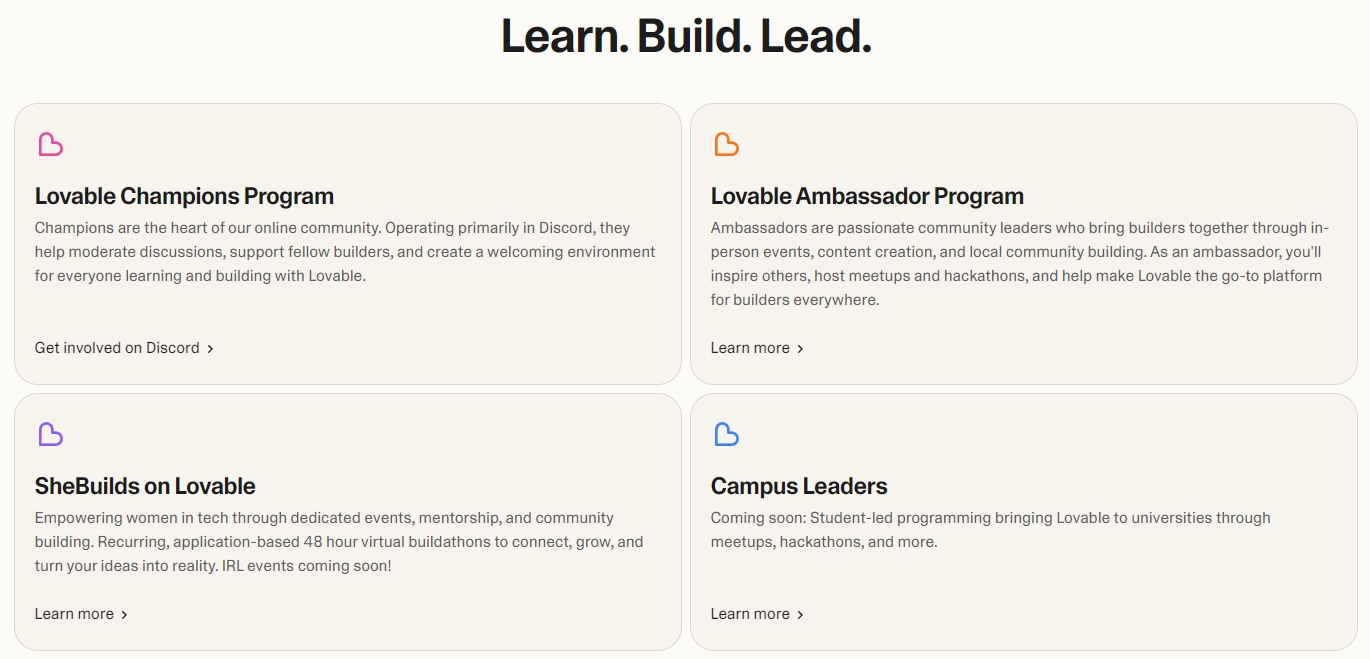
Lovable runs three structured programs for community members who contribute consistently: Ambassadors, Experts, and Partners. Each has different entry criteria, benefits, and expectations.
Ambassador Program
Ambassadors are active community members who help others, create content, and provide product feedback. The program is invite-only, typically extended to people who've been consistently helpful in Discord or Reddit for 3+ months. Benefits include early access to features, direct line to product team, credits for the platform, and a private channel with the founding team.
The commitment is informal — no quotas, no required hours. But ambassadors who go quiet for months sometimes lose access. The program works because it's self-selecting: people who genuinely enjoy helping others tend to stay active regardless of perks.
Expert Directory
The Expert Directory is a vetted list of freelancers and agencies available for hire. To qualify, you need demonstrated production apps, client references, and a technical interview with the Lovable team. Experts get listed on the official site, referral fees on projects sourced through the directory, and priority support.
For builders looking to hire, the directory saves vetting time. For experts, it's a lead source. The directory launched in late 2023 with ~30 experts and has grown steadily. Quality control matters — the team removes experts who deliver subpar work.
Partner Program
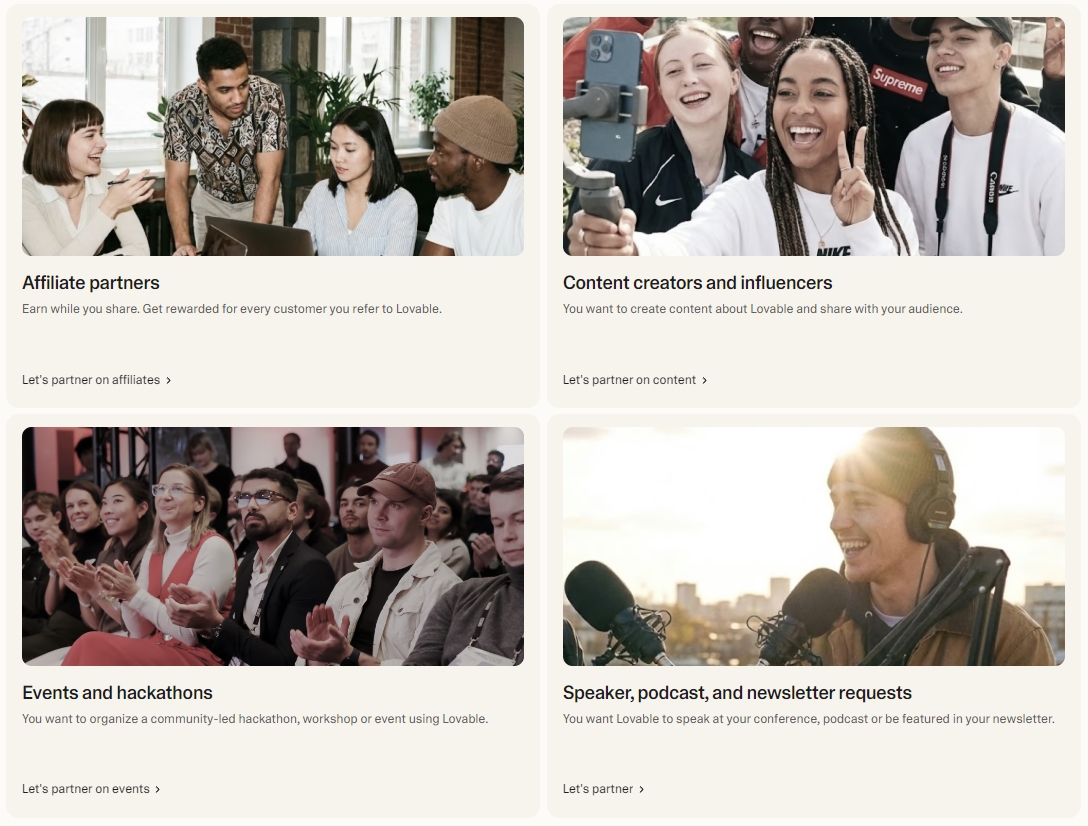
Partners are agencies, consultancies, and tooling companies that integrate Lovable into their offerings. This is a formal business relationship with revenue sharing, co-marketing, and dedicated support. The partner page lists integration types: implementation partners, technology partners (Supabase, Stripe, etc.), and education partners.
Scroll horizontally to see all columns
| Program | Entry | Primary Benefit | Commitment |
|---|---|---|---|
| Ambassador | Invite (community activity) | Early access, credits, direct feedback line | Informal, stay active |
| Expert | Application + interview | Directory listing, referral fees, priority support | Maintain quality standards |
| Partner | Business agreement | Revenue share, co-marketing, dedicated support | Formal contractual obligations |
The programs aren't mutually exclusive. Several ambassadors are also listed experts. One agency partner started as an ambassador. The pathways overlap because they're all rooted in demonstrated competence with the platform.
The best community programs don't feel like programs. They feel like recognition for work you were already doing.
Finding Help: A Practical Decision Tree
When you're stuck, the right channel depends on the problem type and urgency. Here's how I decide where to post:
- Build broken, need answer in 15 minutes → Discord #help, use a thread
- Complex architecture question, can wait hours → Reddit with detailed context
- Feature request or bug report → Discord #feature-requests or #bug-reports, then GitHub if confirmed
- Hiring or looking for work → Expert Directory or LinkedIn
- Learning a new integration (Supabase, Stripe, etc.) → YouTube tutorials first, then Discord search
- Want to see what's possible → X retweets, #showcase on Discord, Reddit showcase posts
Cross-posting the same question everywhere is frowned upon. Pick one, wait for responses, then move if needed. Mention where else you've looked — "checked Discord search, tried X approach from Reddit thread Y" — so people don't repeat suggestions.
Community Culture and Unwritten Rules
Every community develops norms. Lovable's skews collaborative rather than competitive. People share revenue numbers, client acquisition strategies, and failed experiments openly. The founder team participates regularly — not just in announcements, but in technical discussions, debugging sessions, and casual chat.
A few unwritten rules worth knowing: don't DM team members for support unless invited. Use public channels so answers help others. Don't share private beta features before public release — the team asks explicitly when something is embargoed. Credit the community when you adapt someone's solution for your project.
The community also self-polices. Low-effort "how do I build a SaaS" posts get directed to guides and templates rather than custom answers. This isn't gatekeeping — it's preserving signal-to-noise so complex questions get attention.
Conflict is rare but happens — usually around pricing changes or feature prioritization. The team's approach has been transparent: explain the reasoning, acknowledge trade-offs, commit to revisiting. That transparency builds trust even when decisions are unpopular.
Templates, Guides, and Community-Created Resources
Beyond discussion channels, the community produces tangible resources. The official template library includes community submissions — each reviewed by the team before publishing. Builders also maintain unofficial template collections on GitHub, Notion, and personal sites.
Guides are another major contribution area. The official documentation covers APIs and features. Community guides cover workflows: "How I set up multi-tenant auth with Supabase and Lovable," "Migrating from Bubble to Lovable," "Setting up CI/CD for Lovable projects." These workflow guides are often more practical than feature docs.
Scroll horizontally to see all columns
| Resource Type | Official Location | Community Locations |
|---|---|---|
| Templates | Lovable Template Library | GitHub repos, Notion databases, Discord #showcase |
| Workflow Guides | Lovable Guides page | Reddit wiki, YouTube, personal blogs, Discord pins |
| Code Snippets | Documentation examples | Discord threads, GitHub gists, Reddit comments |
| Video Tutorials | Official YouTube | Community YouTube channels, Twitch archives |
If you create a resource that gets traction, consider submitting it to the official library or asking a moderator to pin it in Discord. The team actively curates community content — they want good resources discoverable.
Events: Virtual and In-Person
Lovable runs a monthly virtual event series — sometimes a feature deep-dive, sometimes a builder AMA, sometimes a live coding session. Announcements go out on Discord #announcements, X, and email. Recordings land on YouTube within a week.
In-person meetups happen irregularly, usually organized by ambassadors or local experts in major tech hubs (SF, NYC, London, Berlin, Bangalore). The company sponsors venue and swag but doesn't centrally plan them. Check the #events channel on Discord or the events page on the website.
Hackathons run quarterly with specific themes — "Best AI Agent," "Best Internal Tool," "Best Mobile-First App." Prizes include credits, swag, and sometimes cash. The submission requirement is a working Lovable app deployed to a custom domain. Judging criteria emphasize creativity and technical execution over polish.
Common Pitfalls for Newcomers
New community members tend to make the same mistakes. Recognizing them early saves frustration.
- Asking "how do I build X" without attempting it first — try the AI chat, hit an error, then ask about the error
- Expecting the AI to handle complex backend logic without Supabase knowledge — you need to understand RLS, functions, and webhooks
- Ignoring plan limits — Free tier has message limits, no custom domains, no team features
- Treating Discord like a support ticket system — it's peer-to-peer, not guaranteed response
- Not reading the changelog — features ship fast, workflows change monthly
The last one is underrated. Lovable ships weekly updates. A workflow that worked in January might be obsolete by March. The #releases channel and changelog page are essential reading if you build seriously on the platform.
Contributing Back: Low-Effort, High-Impact Ways
You don't need to be an expert to contribute. The highest-leverage contributions are often simple:
- When you solve a problem, post the solution in the thread where you asked — future searchers will find it
- Upvote useful Reddit posts and Discord messages — visibility helps good answers rise
- Report bugs with reproduction steps — vague reports waste everyone's time
- Share your launched app with metrics — real data helps others plan
- Translate guides or docs if you're bilingual — the community is global
These take minutes but compound. A single posted solution might save dozens of people hours each. The community runs on this reciprocity.
The best documentation is a solved thread with a clear explanation of why the fix worked.
Comparing Lovable Community to Other AI Builder Ecosystems
Context helps. I've spent time in Bolt, v0, Replit, and Cursor communities. Lovable's stands out in a few ways.
Scroll horizontally to see all columns
| Platform | Primary Channel | Response Speed | Technical Depth | Commercial Focus |
|---|---|---|---|---|
| Lovable | Discord + Reddit | Minutes (Discord) | High — full-stack focus | Balanced |
| Bolt | Discord | Fast | Medium — frontend heavy | Builder-first |
| v0 | X + Discord | Variable | High — React/Next.js focus | Design-system oriented |
| Replit | Discord + Forum | Medium | High — full IDE | Education + pro |
| Cursor | Discord + Forum | Fast | Very high — IDE internals | Developer tooling |
Lovable's community feels more "product builder" than "developer tool user." Conversations center on shipping SaaS, marketplaces, internal tools — business outcomes. The technical depth is there, but it's applied. That orientation attracts founders and product managers alongside engineers.
The trade-off: if you're pushing the platform's boundaries — custom Vite configs, unusual Supabase patterns, edge runtime experiments — you'll find fewer peers than in Cursor's community. Lovable abstracts more, which means less control but also less need for deep infrastructure knowledge.
Staying Current Without Burnout
The volume across channels can overwhelm. A sustainable approach:
- Pick one primary channel (Discord or Reddit) and check it 2–3 times weekly
- Follow @lovable_dev on X for release announcements only — turn off other notifications
- Subscribe to the email newsletter — it summarizes the month in 5 minutes
- Bookmark 3–5 trusted community members whose projects align with yours — watch their showcases
- Ignore the rest until you have a specific problem
FOMO is real in fast-moving communities. But the fundamentals — Supabase, React, TypeScript, Stripe — change slowly. Master those, and platform updates become incremental rather than disruptive.
Final Assessment of Lovable Community
The Lovable Community is a genuine asset for anyone building on the platform. It's large enough to answer obscure questions quickly, structured enough to find resources without digging, and active enough that the knowledge base compounds weekly. The multi-channel approach — real-time Discord, archived Reddit, visual social, structured programs — covers different learning styles and urgency levels.
The main gap is advanced technical depth. If you're doing custom infrastructure work, you'll often need to step outside to Supabase, Vercel, or React communities. But for the 90% of builders shipping standard full-stack apps, the community provides answers, templates, hiring paths, and occasional motivation. That's more than most tool ecosystems offer.
Frequently Asked Questions
How do I join the Lovable Discord server?
Visit the Lovable website and click the Discord link in the footer or community page. No invitation code required — just accept the server rules on entry.
Is the Reddit community official or fan-run?
r/LovableDev is community-run but monitored by Lovable team members. They participate in discussions and occasionally post official updates.
What's the difference between Ambassador and Expert programs?
Ambassadors are recognized for community contribution (helping, content, feedback). Experts are vetted professionals listed for hire. Some people are both, but the criteria and benefits differ.
Can I get help on the Free plan?
Yes. Community support is available to all tiers. Priority support from the Lovable team is a Pro/Business/Enterprise benefit, but peer help in Discord and Reddit doesn't check your plan.
How often does Lovable host hackathons?
Quarterly, typically aligned with major feature releases. Announcements go out 3–4 weeks before via Discord, email, and social channels.
Are there local in-person meetups?
They happen organically in major tech hubs, usually organized by ambassadors. Check the #events Discord channel or the events page for upcoming gatherings.
What's the best way to report a bug?
Post in Discord #bug-reports with reproduction steps, expected vs actual behavior, and your browser/OS. The team triages there and moves confirmed bugs to their internal tracker.