

Software Development
Lovable Developers: Building with AI-Powered App Development
A practical guide to Lovable's developer tools, career opportunities, and AI-driven development approach.

Senior Software Developer & Trading Technology Specialist
Ethan Parker is a software developer with over 8 years of experience in building web applications, trading tools, and financial technology solutions. He specializes in Python, JavaScript, API integrations, and trading automation, helping traders improve efficiency through innovative technology.
Lovable Developers represents a shift in how software gets built. The platform combines AI-assisted code generation with full-stack deployment, letting developers describe features in natural language and watch working applications emerge. Unlike traditional no-code tools that lock users into proprietary ecosystems, Lovable produces standard React, TypeScript, and Vite code that runs anywhere. This approach has attracted attention from individual builders, startup teams, and enterprise organizations looking to accelerate their development cycles without sacrificing code ownership.
Contents
- 1. What Is Lovable Developers
- 2. How Lovable Changes Development Workflows
- 3. Core Features for Development Teams
- 4. Lovable Dev Careers and Job Opportunities
- 5. Salary Expectations and Glassdoor Insights
- 6. Integration Ecosystem: GitHub, Supabase, Stripe
- 7. Prototyping to Production with Lovable
- 8. Security and Enterprise Considerations
- 9. Pricing Tiers for Development Teams
- 10. Community and Learning Resources
- 11. Comparing Lovable to Traditional Development
- 12. Limitations and Honest Assessment
- 13. Final Assessment of Lovable Developers
The platform emerged from a simple observation: developers spend significant time on boilerplate, configuration, and repetitive patterns that follow predictable rules. By automating those layers, Lovable lets engineers focus on business logic, user experience, and architectural decisions that actually differentiate their products. The result is a development experience that feels more like pair programming with a knowledgeable colleague than working with a code generator.
For teams evaluating whether to adopt AI-assisted development tools, understanding the practical implications matters more than marketing claims. This article examines what Lovable Developers offers, how it fits into existing workflows, what career opportunities exist within the ecosystem, and where the platform fits in the broader landscape of modern software development.
What Is Lovable Developers
Lovable Developers is both a platform and a community. The core product is an AI-powered application builder that translates natural language descriptions into production-ready code. Users describe what they want — a dashboard with real-time charts, an e-commerce checkout flow, a multi-tenant SaaS authentication system — and the system generates the complete implementation including frontend components, backend logic, database schemas, and deployment configuration.
The generated code uses technologies that most web developers already know: React for UI, TypeScript for type safety, Vite for build tooling, Tailwind CSS for styling, and Supabase for backend services including PostgreSQL database, authentication, and real-time subscriptions. This stack choice is deliberate. It means developers can read, modify, and extend generated code without learning a proprietary framework. If Lovable disappeared tomorrow, the applications would continue running on standard infrastructure.
Beyond the builder itself, Lovable Developers encompasses documentation, guides, templates, and a community of builders sharing patterns and solutions. The platform integrates with GitHub for version control, allowing teams to sync generated code to their repositories and continue development in their preferred IDE. This hybrid approach — AI for scaffolding and boilerplate, human developers for customization and complex logic — reflects how most teams actually want to work with AI tools.
How Lovable Changes Development Workflows
Traditional development workflows involve several phases that consume disproportionate time: project initialization, dependency configuration, authentication setup, database schema design, API route creation, and basic CRUD operations. These steps are necessary but rarely where competitive advantage lives. Lovable compresses this initial phase from days to minutes by handling the mechanical work automatically.
A typical workflow with Lovable starts with a prompt describing the application concept. The system generates a complete project structure with routing, state management, and component hierarchy. Developers then iterate by requesting specific changes — add a filter to the user table, implement role-based access control, connect Stripe for subscriptions — and the AI applies those changes across the codebase. The developer reviews diffs, runs tests, and merges when satisfied.
- Project scaffolding reduces from hours to minutes
- Authentication flows generate with proper token handling and refresh logic
- Database schemas create with relationships, indexes, and migration files
- API endpoints follow REST conventions with proper error handling
- Component libraries maintain consistency without manual style guide enforcement
The workflow shift is subtle but significant. Developers spend less time typing boilerplate and more time evaluating architectural decisions. The AI handles the how; the human decides the what and why. This doesn't eliminate the need for engineering judgment — it amplifies it by removing the friction between idea and implementation.
The best developers aren't the ones who type fastest. They're the ones who make the right architectural decisions. Lovable removes the typing tax so that judgment becomes the primary bottleneck.
Core Features for Development Teams
Lovable's feature set targets the practical needs of development teams rather than demo-friendly capabilities. The platform supports real-time collaboration, allowing multiple developers to work on the same project simultaneously with changes syncing instantly. Version history tracks every generation and manual edit, making it possible to revert to any previous state or compare approaches side by side.
GitHub integration goes beyond simple export. The platform can create pull requests directly from the interface, preserving commit history and enabling code review workflows that teams already use. Branch management works naturally — developers can create feature branches, generate changes, and merge through standard GitHub processes. This means Lovable fits into existing CI/CD pipelines without requiring new infrastructure.
Scroll horizontally to see all columns
| Feature | Description | Team Benefit |
|---|---|---|
| Real-time Collaboration | Multiple developers edit simultaneously | Parallel work without conflicts |
| GitHub Sync | Two-way repository synchronization | Standard code review and CI/CD |
| Version History | Complete audit trail of all changes | Safe experimentation and rollback |
| Environment Variables | Secure configuration management | Production secrets stay protected |
| Custom Domains | Deploy to branded URLs | Professional presentation for clients |
The platform also handles deployment automatically. Each project gets a preview URL that updates with every change, and production deployments happen with a single click. Custom domains, SSL certificates, and CDN distribution are managed automatically. For teams that need more control, the generated code can be deployed to any platform that supports Node.js — Vercel, Netlify, AWS, Google Cloud, or self-hosted infrastructure.
Lovable Dev Careers and Job Opportunities
The growth of AI-assisted development platforms has created new career paths. Lovable Dev careers span several categories: platform engineers building the core AI systems, developer advocates helping users succeed, product engineers shaping the builder experience, and solutions engineers working with enterprise customers. The company also hires for traditional roles — backend, frontend, DevOps, security — but with the expectation that employees use and improve the platform they're building.
Job postings for Lovable developer roles typically emphasize experience with the core technology stack: React, TypeScript, Node.js, PostgreSQL, and modern AI/ML tooling. Familiarity with developer tools, compiler design, or code generation systems is valued but not required. The interview process often includes a practical exercise using the platform itself, reflecting the product-first culture.

Beyond direct employment at Lovable, a growing ecosystem of agencies and consultancies specialize in building with the platform. These firms hire developers who can combine traditional engineering skills with AI-assisted workflows. Freelancers and contractors also find opportunities helping startups and enterprises prototype and launch products faster using Lovable. The skill set transfers — developers who learn the platform's patterns become more productive in any React/TypeScript environment.
- Platform Engineer — Core AI and code generation systems
- Developer Advocate — Community, content, and education
- Product Engineer — Builder UX and feature development
- Solutions Engineer — Enterprise customer success
- Full-Stack Engineer — Internal tools and infrastructure
- Security Engineer — Platform hardening and compliance
Salary Expectations and Glassdoor Insights
Compensation for Lovable developer roles aligns with senior engineering positions at well-funded AI startups. Base salaries typically range from $150,000 to $250,000 for individual contributors, with equity packages that reflect the company's growth stage. Total compensation for senior roles can exceed $300,000 when including equity appreciation. These figures are consistent with what Glassdoor and similar platforms report for comparable positions at companies building developer tools and AI infrastructure.
The compensation structure reflects the hybrid skill set required. Engineers who understand both traditional full-stack development and modern AI systems command a premium. Remote work options are standard, with the company distributed across multiple time zones. Benefits include the usual startup package — health insurance, equipment budget, learning stipend — plus early access to platform features and direct influence on the product roadmap.
Scroll horizontally to see all columns
| Role Level | Base Salary Range | Equity Range |
|---|---|---|
| Junior Engineer | $120,000 - $160,000 | 0.01% - 0.05% |
| Mid-Level Engineer | $150,000 - $200,000 | 0.03% - 0.1% |
| Senior Engineer | $180,000 - $250,000 | 0.05% - 0.2% |
| Staff Engineer | $220,000 - $300,000 | 0.1% - 0.4% |
| Engineering Lead | $250,000 - $350,000 | 0.2% - 0.6% |
Glassdoor reviews for the company highlight the technical challenge of building an AI code generator, the autonomy engineers receive, and the satisfaction of building a tool they use daily. Common themes in reviews include fast iteration cycles, minimal bureaucracy, and a culture that values shipping over process. As with any early-stage company, workload can be intense during product milestones.
Integration Ecosystem: GitHub, Supabase, Stripe
Lovable's integration strategy centers on the tools developers already use. GitHub integration is bidirectional — the platform reads repository structure to understand existing code and writes changes back as commits or pull requests. This means teams can adopt Lovable incrementally, starting with new features in existing projects rather than requiring a full rewrite.
Supabase provides the backend foundation. Every Lovable project gets a dedicated Supabase instance with PostgreSQL, authentication, real-time subscriptions, storage, and edge functions. The AI understands Supabase patterns deeply — it generates proper Row Level Security policies, creates efficient indexes, and structures database relationships following Postgres best practices. Developers can also connect existing Supabase projects if they prefer to manage infrastructure separately.
Stripe integration handles payments, subscriptions, and billing portals with minimal configuration. The AI generates complete checkout flows, webhook handlers for subscription events, and customer portal integration. For teams building SaaS products, this eliminates weeks of payment infrastructure work. Other integrations include SendGrid for email, Sentry for error tracking, Vercel for deployment, and various AI model providers for applications that need LLM capabilities.
- GitHub — Two-way sync, PR creation, branch management
- Supabase — Database, auth, real-time, edge functions
- Stripe — Payments, subscriptions, billing portal
- Vercel/Netlify — Preview and production deployment
- Sentry — Error monitoring and performance tracking
- SendGrid/Resend — Transactional and marketing email
- OpenAI/Anthropic — LLM integration for AI features
Prototyping to Production with Lovable
The platform excels at the prototype-to-production journey that kills many projects. Traditional prototyping tools create throwaway code. Lovable generates production-quality code from the start, meaning the prototype becomes the foundation for the real product. This changes how teams validate ideas — they can ship a working version to real users in days, gather feedback, and iterate on the same codebase.
For founders and product managers, this means technical validation happens earlier. Instead of waiting for engineering capacity to build a prototype, they can use Lovable directly to create functional demos. The learning curve is shallow enough that non-engineers can build meaningful prototypes, though production applications still benefit from developer oversight for architecture, security, and scaling decisions.
The prototype is the product. There's no handoff, no rewrite, no 'now let's build it for real.' You validate with real code from day one.
Enterprise teams use this capability for internal tools — admin dashboards, reporting interfaces, data entry forms, approval workflows. These applications often have clear requirements but consume disproportionate engineering resources. Lovable lets platform teams generate the initial version quickly, then hand off to product engineers for refinement. The generated code follows the same patterns the team would write manually, so maintenance burden stays low.
Security and Enterprise Considerations
Security architecture matters for any platform generating production code. Lovable implements several layers of protection. Generated code follows OWASP guidelines — parameterized queries prevent SQL injection, Content Security Policy headers mitigate XSS, authentication tokens use secure storage patterns, and API routes implement rate limiting by default. The platform also scans generated dependencies for known vulnerabilities.
For enterprise customers, additional controls include SSO integration (SAML, OIDC), audit logging for all platform actions, data residency options, and dedicated support channels. The platform can run in isolated environments for organizations with strict compliance requirements. SOC 2 Type II certification is in progress, with current controls covering access management, encryption at rest and in transit, and incident response procedures.

Data privacy follows a clear model: user code and project data belong to the user. Lovable doesn't train models on private project data. Prompts and generated code stay within the user's project scope. For teams with regulatory requirements, the option to self-host the entire stack — including the AI inference layer — provides maximum control. This flexibility distinguishes Lovable from platforms that require sending proprietary code to external APIs.
Scroll horizontally to see all columns
| Feature | Free/Pro | Business | Enterprise |
|---|---|---|---|
| SSO/SAML | No | Yes | Yes |
| Audit Logs | Basic | Extended | Full |
| Data Residency | No | Regional | Custom |
| Vulnerability Scanning | Automated | Automated + Manual | Continuous |
| Dedicated Support | Community | Priority | 24/7 SLA |
Pricing Tiers for Development Teams
Lovable's pricing model aligns with team size and usage intensity. The free tier provides generous limits for individual developers and small projects — enough to build and deploy multiple applications. Paid tiers add team collaboration features, higher generation limits, priority support, and enterprise controls. The pricing page clearly separates what each tier includes, avoiding the hidden limits that frustrate developers on other platforms.
Credit-based generation limits apply to AI operations. Each prompt, iteration, and code generation consumes credits based on complexity. The free tier includes a monthly credit allowance that resets. Pro and Business tiers increase the allowance significantly. Enterprise customers negotiate custom limits based on projected usage. Unused credits don't roll over, which encourages consistent usage but can feel restrictive during variable workloads.
For teams evaluating cost against alternatives, the comparison isn't straightforward. Traditional development costs include engineer time, infrastructure, and tooling subscriptions. Lovable replaces some engineer time with AI credits. A rough heuristic: if a feature would take a developer two days to build manually, and Lovable generates it in 30 minutes with 10 minutes of review, the time savings often justify the credit cost. But this calculation varies wildly by project type, team experience, and feature complexity.
Community and Learning Resources
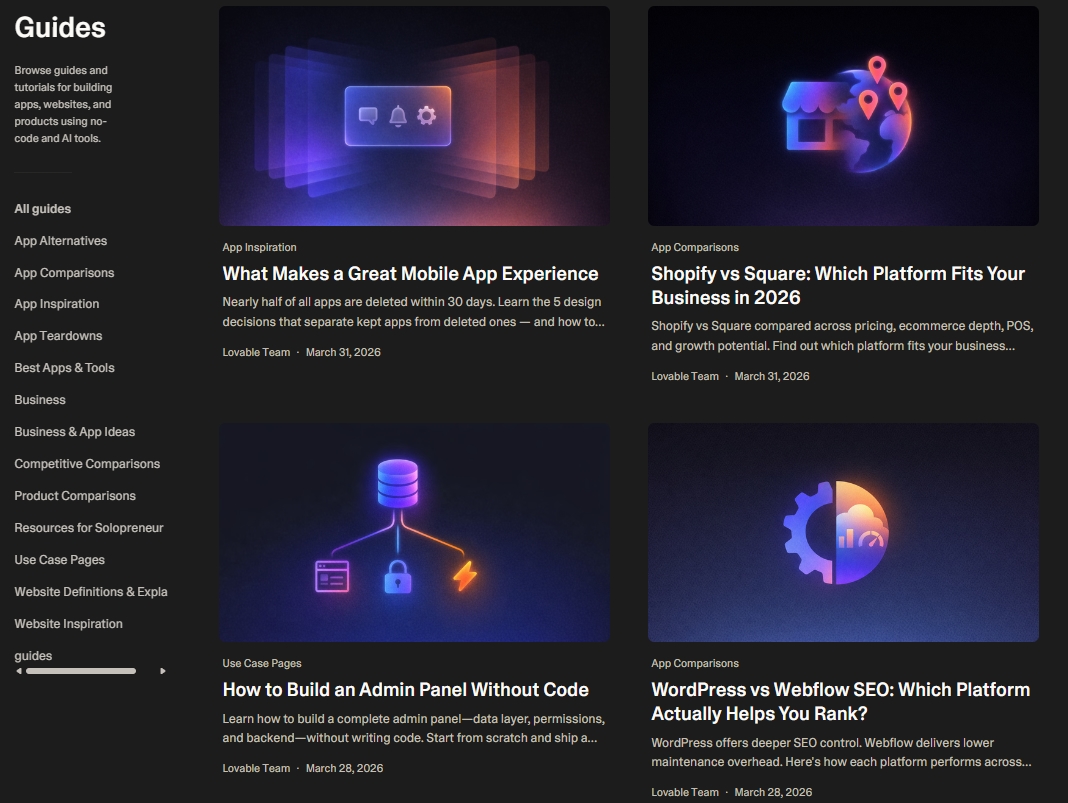
The Lovable community has grown into a practical knowledge base. The official guides cover everything from getting started to advanced patterns like multi-tenancy, real-time collaboration features, and custom authentication flows. Community-contributed templates provide starting points for common application types — marketplaces, dashboards, landing pages, internal tools. These templates aren't just demos; they're production-ready foundations that teams customize for their specific needs.
Discord serves as the primary community hub. Developers share patterns, debug generation issues, and showcase projects. The Lovable team participates actively, often shipping fixes based on community feedback within days. Weekly office hours provide direct access to platform engineers. This feedback loop means the platform evolves based on actual usage patterns rather than assumed needs.
The best documentation comes from developers solving real problems. Community templates often reveal platform capabilities the official docs haven't caught up to yet.
For structured learning, the platform offers interactive tutorials that guide users through building complete applications. Each tutorial teaches a specific pattern — authentication, payments, real-time data, file uploads — while producing working code. The learning path accommodates different backgrounds: experienced developers can skip basics, while newcomers get step-by-step guidance. Video content supplements written guides for visual learners.
Comparing Lovable to Traditional Development
The comparison to traditional development isn't binary. Most teams adopt Lovable for specific project types while continuing traditional workflows elsewhere. The platform shines for applications with standard patterns: CRUD interfaces, dashboards, authentication flows, payment integration, and content management. It struggles with highly custom algorithms, specialized domain logic, performance-critical paths, and novel architectural patterns that lack training examples.
Compared to other AI coding assistants like GitHub Copilot or Cursor, Lovable operates at a higher abstraction level. Copilot suggests code completions within files. Cursor enables chat-based editing across a codebase. Lovable generates entire application structures from descriptions. These tools complement each other — developers might use Lovable for initial scaffolding and major feature additions, then switch to Cursor or Copilot for fine-grained editing and complex logic.
Scroll horizontally to see all columns
| Task Type | Lovable | Cursor/Copilot | Traditional |
|---|---|---|---|
| Project Scaffolding | Excellent | Good | Manual |
| Feature Implementation | Good | Excellent | Manual |
| Complex Algorithms | Limited | Good | Best |
| Refactoring | Fair | Excellent | Manual |
| Code Review | Diff Generation | Inline Suggestions | Manual |
Compared to no-code platforms like Bubble or Webflow, Lovable's code export capability is the fundamental difference. No-code platforms host applications on their infrastructure with limited export options. Lovable generates standard code that runs anywhere. This means no vendor lock-in, but it also means developers need sufficient technical knowledge to deploy, monitor, and maintain the generated applications. The trade-off favors teams that want speed without sacrificing long-term flexibility.
Limitations and Honest Assessment
No platform solves every problem. Lovable's limitations are worth understanding before committing significant projects. The AI occasionally generates code that compiles but contains subtle bugs — incorrect TypeScript types that pass compilation but fail at runtime, missing error handling edge cases, inefficient database queries that work in development but degrade under load. These issues require developer review, which is expected but sometimes underestimated.
The platform's knowledge cutoff affects its ability to use the latest library versions. When React 19 or Next.js 15 introduce breaking changes, there's a lag before Lovable generates compatible code. Teams on the bleeding edge may need to manually update generated code more frequently. The platform also struggles with highly opinionated codebases that deviate from standard patterns — custom state management, unusual folder structures, or domain-specific frameworks.
- Generated code requires review for production readiness
- Latest framework versions may have delayed support
- Highly custom architectures need manual adaptation
- Complex business logic often needs human implementation
- Credit limits can constrain heavy usage periods
- Debugging AI-generated code requires understanding the patterns
Credit-based pricing introduces unpredictability. Complex generation requests consume more credits, and iteration cycles can accumulate costs quickly during exploration phases. Teams need to budget for this variability. The platform provides usage estimates before generation, but actual consumption depends on prompt complexity and the number of iterations needed to reach acceptable results.
Frequently Asked Questions
Can I use Lovable for an existing project or only new ones?
Lovable works with existing GitHub repositories. Connect your repo and the platform analyzes the structure to generate compatible code. You can add features to existing applications without starting from scratch.
What happens to my code if I cancel my subscription?
All generated code remains yours. The code lives in your GitHub repository and runs on your infrastructure. Canceling only removes access to the AI generation interface and platform hosting.
Does Lovable train on my private project data?
No. Prompts, generated code, and project data are not used for model training. Enterprise customers can self-host for complete data isolation.
How does Lovable handle database migrations?
The platform generates Supabase migration files for schema changes. You review and apply migrations through the Supabase dashboard or CLI. The AI suggests migrations based on your requested changes.
Can non-developers build production applications with Lovable?
Non-developers can build functional prototypes and simple applications. Production deployments benefit from developer review for security, performance, and architectural decisions.
What programming languages does Lovable support?
Currently TypeScript with React, Vite, and Tailwind CSS. The backend uses Supabase (PostgreSQL). Other stacks are on the roadmap but not yet available.
How does Lovable compare to hiring a development agency?
Lovable accelerates development but doesn't replace engineering judgment. Agencies provide strategy, architecture, and ongoing maintenance. Many agencies now use Lovable internally to deliver faster.
Final Assessment of Lovable Developers
Lovable Developers occupies a practical middle ground in the AI-assisted development landscape. It doesn't promise to replace developers — it promises to remove the mechanical overhead that consumes disproportionate time. For teams building standard web applications, the platform delivers measurable acceleration. The generated code is readable, maintainable, and portable. The integration ecosystem covers the services most applications need. The pricing, while usage-dependent, is transparent.
The platform works best when developers treat it as a force multiplier rather than an automation replacement. Teams that invest in learning its patterns, understanding its limitations, and integrating it thoughtfully into their workflow see the strongest returns. Teams expecting magic — perfect code from vague prompts, zero review needed, all problems solved — will be disappointed. The technology is impressive but not miraculous.
For developers considering Lovable Dev careers, the company represents an interesting intersection of AI research and practical developer tooling. The technical challenges — code generation quality, multi-file coherence, framework compatibility — are genuinely hard problems. The compensation is competitive. The culture appears to value shipping and technical excellence. As with any early-stage company, the risk profile is higher than established employers, but the learning opportunity is substantial.
The broader implication is that AI-assisted development is moving from novelty to utility. Lovable is one of several platforms demonstrating that the technology has matured enough for production use. The question for development teams isn't whether to adopt these tools, but how to adopt them without losing the engineering rigor that makes software reliable. Lovable's approach — generate standard code, keep humans in the loop, preserve exit options — offers a reasonable answer.