

AI Development Tools
Lovable Canada: AI App Builder for Canadian Teams
Pricing, features, and real workflows for Canadian builders using Lovable's AI platform.


Senior Software Developer & Trading Technology Specialist
Ethan Parker is a software developer with over 8 years of experience in building web applications, trading tools, and financial technology solutions. He specializes in Python, JavaScript, API integrations, and trading automation, helping traders improve efficiency through innovative technology.
Canadian founders have watched the AI coding space evolve rapidly over the past two years. Tools that once generated disposable prototypes now ship production-ready applications with authentication, databases, and payment processing built in. Lovable sits in this category — an AI app builder that turns natural language descriptions into working React applications backed by Supabase, deployed on infrastructure that handles Canadian data residency requirements.
Contents
- 1. How Lovable Works for Canadian Builders
- 2. Pricing Breakdown in Canadian Dollars
- 3. Templates and Starting Points for Canadian Markets
- 4. Integrations That Matter for Canadian Teams
- 5. Real Workflows: From Idea to Canadian Customers
- 6. Limitations Canadian Teams Should Know
- 7. Security and Compliance Posture
- 8. Team Collaboration and Agency Workflows
- 9. Comparing Alternatives in the Canadian Context
- 10. Getting Started: First Week Checklist
- 11. Community and Support Channels
- 12. Final Assessment: Lovable for Canadian Builders
The platform launched broadly in 2024 and quickly gained traction among Canadian startup teams who need to move from idea to paying customers without hiring a full engineering team. What distinguishes it from earlier no-code tools is the underlying code ownership: everything Lovable generates lives in your GitHub repository, written in standard React, TypeScript, and Tailwind. You can eject at any point and continue building with your own developers.
For Canadian teams specifically, the pricing structure in USD creates both opportunity and friction. The Free tier provides 50 credits monthly — enough for small experiments — while the Pro tier at $25 monthly unlocks 500 credits and removes the Lovable branding. Business and Enterprise tiers add team collaboration, SSO, and dedicated support. At current exchange rates, a Canadian solo founder on Pro pays roughly $34 CAD monthly, which compares favourably to hiring even a junior developer for a few hours.
How Lovable Works for Canadian Builders
The core workflow starts with a chat interface. You describe what you want — "a SaaS dashboard for Canadian freelancers to track GST/HST remittances with Stripe Connect payouts" — and Lovable generates the initial project structure, database schema, authentication flows, and UI components. Each iteration consumes credits based on complexity. The generated code pushes to a GitHub repository you control, triggering automatic deployments to Lovable's hosting or your own Vercel, Netlify, or AWS account.
Supabase integration handles the backend automatically. When you ask for user accounts, Lovable configures Supabase Auth with email/password, OAuth providers, and row-level security policies. Database tables appear as you request features — subscriptions, invoices, team invitations — with proper indexes and foreign keys. The AI understands Canadian context if you specify it: provincial tax rates, bilingual UI requirements, PIPEDA compliance notes in privacy policies.
Stripe integration works similarly. Request "subscription billing with Canadian tax handling" and Lovable sets up Stripe products, prices, webhooks, and the customer portal. It generates the checkout session creation endpoints and handles the redirect flow. For Canadian businesses, this means GST/HST can be configured per province automatically through Stripe Tax, though you still need to verify the configuration matches your registration obligations.
Pricing Breakdown in Canadian Dollars
Understanding the real cost in CAD helps with budget planning. The following table uses an approximate exchange rate of 1.36 USD/CAD, but rates fluctuate. All tiers bill annually for the listed monthly price, or monthly at a slight premium.
Scroll horizontally to see all columns
| Tier | Monthly USD | Monthly CAD | Credits/Month | Key Features |
|---|---|---|---|---|
| Free | $0 | $0 | 50 | Public projects, community support, Lovable branding |
| Pro | $25 | $34 | 500 | Private projects, custom domains, no branding, priority support |
| Business | $50 | $68 | 1,500 | Team collaboration (5 seats), SSO, audit logs, advanced permissions |
| Enterprise | Custom | Custom | Custom | Unlimited seats, dedicated support, SLA, on-premise option, custom contracts |
Credits consume based on the complexity of each generation. A simple landing page might cost 5-10 credits. A multi-page dashboard with authentication, database operations, and Stripe integration could cost 50-100 credits. The Pro tier's 500 credits typically covers 5-10 substantial feature iterations monthly. Unused credits do not roll over, so teams often batch their prompting sessions.
The credit model rewards clear, specific prompts. Vague requests burn credits on revisions that a precise specification would avoid.
Templates and Starting Points for Canadian Markets
Lovable's template library includes starting points that accelerate common Canadian business types. The SaaS starter includes subscription billing, team workspaces, and admin dashboards. The marketplace template handles multi-vendor onboarding, commission splits, and payout schedules — useful for platforms targeting Canadian artisans or service providers. E-commerce templates integrate with Shopify's Storefront API or direct Stripe checkout for digital goods.
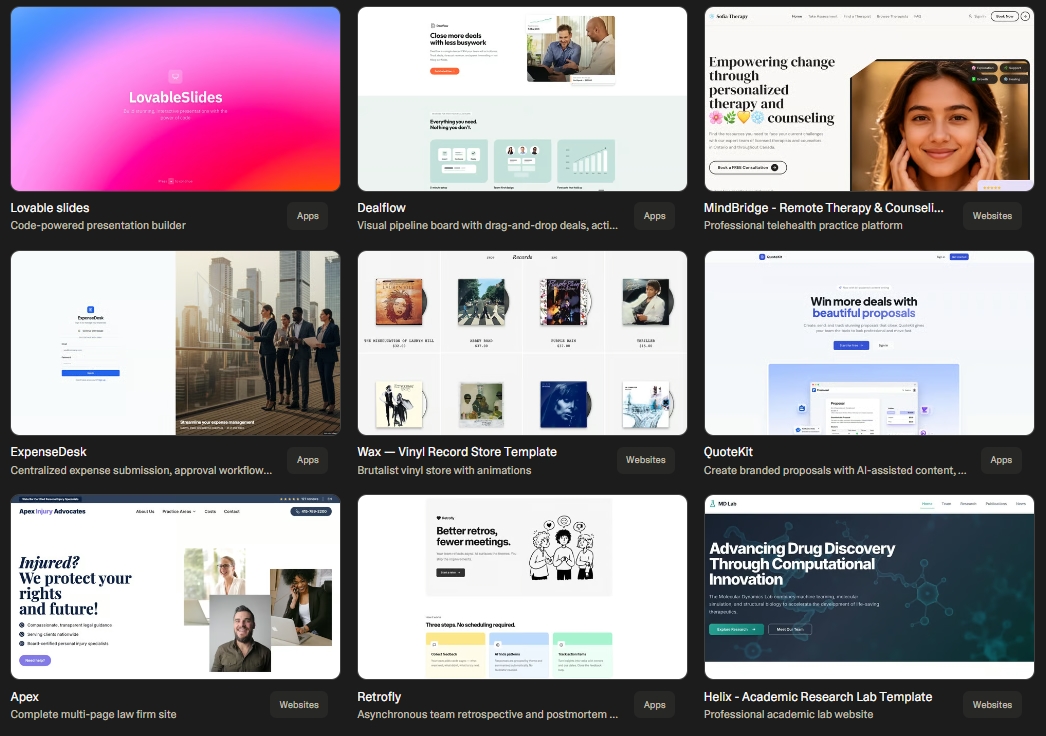
For regulated industries, templates provide a foundation but not compliance. A fintech template includes Plaid integration for Canadian bank connections and transaction categorization, but you must implement the specific KYC/AML flows required by FINTRAC. Health tech templates include FHIR-compatible data models and audit logging, but PIPEDA and provincial health privacy laws require legal review. The templates save weeks of boilerplate; they do not replace regulatory work.
- SaaS Starter: Auth, billing, teams, admin — 2-3 weeks saved
- Marketplace: Vendor onboarding, commissions, payouts — 3-4 weeks saved
- E-commerce: Product catalog, cart, checkout, webhooks — 2 weeks saved
- Internal Tool: CRUD admin, roles, audit logs — 1-2 weeks saved
- Landing Page: SEO-ready, analytics, forms — 2-3 days saved
Integrations That Matter for Canadian Teams
The integration ecosystem determines whether Lovable fits your stack. Supabase is the default backend — PostgreSQL, Auth, Realtime, Storage, and Edge Functions all configured automatically. GitHub integration is mandatory; every project lives in a repository you own. Vercel and Netlify deployments work out of the box. For Canadian teams, the following integrations see heavy use:
Scroll horizontally to see all columns
| Service | Purpose | Canadian Relevance |
|---|---|---|
| Supabase | Database, auth, realtime, storage | Canadian regions on Pro+ plans; PIPEDA-friendly |
| Stripe | Payments, subscriptions, Connect, Tax | Full Canadian support including Interac, GST/HST automation |
| GitHub | Version control, CI/CD, collaboration | Standard for Canadian dev teams; data stays in your repo |
| Vercel/Netlify | Hosting, edge functions, analytics | Canadian edge nodes available; custom domain SSL included |
| Figma | Design handoff, component sync | Popular with Canadian design agencies; speeds UI implementation |
| Resend/SendGrid | Transactional email | Canadian anti-spam law (CASL) compliance features available |
The Figma integration deserves specific mention. Canadian design agencies often work in Figma and hand off to developers. Lovable can import Figma frames and generate the corresponding React components with Tailwind classes. This doesn't replace developers — the generated components still need logic, state management, and API integration — but it eliminates the pixel-pushing back-and-forth that consumes sprint capacity.
Real Workflows: From Idea to Canadian Customers
Toronto-based founder Sarah Chen built a B2B marketplace for Canadian industrial suppliers using Lovable over six weeks. She started with the marketplace template, customized the vendor onboarding flow to include GST/HST number validation via the CRA API, and integrated Stripe Connect for split payments. Her team of two — herself and a part-time developer — launched with 12 paying vendors. The developer spent most of their time on the CRA integration and custom reporting; Lovable handled the auth, database, dashboard UI, and payment flows.
A Vancouver agency uses Lovable for client MVP delivery. They charge clients $15-25K for a 4-week build that previously took 8-12 weeks. The agency's designers work in Figma, import to Lovable, then their single developer extends the generated code with custom business logic. They estimate 60% time savings on standard SaaS features, allowing them to take on more clients without hiring. Their constraint: complex B2B workflows with legacy system integrations still require traditional development.
Lovable doesn't replace developers. It changes what developers spend time on — less boilerplate, more business logic.
Limitations Canadian Teams Should Know
The platform has genuine constraints. Complex state management — think real-time collaborative editing, offline-first sync, or intricate drag-and-drop builders — often produces code that needs significant refactoring. The AI tends to generate prop-drilling instead of context or state libraries, and its TypeScript types can be loose. Teams with strong React architects will rewrite these sections; teams without them may accumulate technical debt.
Mobile responsiveness works for standard layouts but breaks down with complex dashboards. The AI generates Tailwind classes that look correct on desktop but stack awkwardly on mobile. You'll need to review and adjust responsive breakpoints manually. For consumer-facing Canadian apps where mobile traffic exceeds 60%, budget time for this polish.
- Complex real-time features need manual implementation
- Mobile responsive polish required for consumer apps
- TypeScript types often need tightening
- No built-in i18n — bilingual apps need custom setup
- Credit limits constrain heavy iteration months
- No native support for Interac debit (Stripe handles credit only)
Security and Compliance Posture
Lovable generates code that follows React and Supabase security best practices by default: row-level security policies on all tables, parameterized queries, CSRF protection on forms, and secure authentication flows. However, the platform itself is a SaaS tool with access to your codebase during generation. Their security page documents SOC 2 Type II certification, encryption at rest and in transit, and regular penetration testing. For Canadian enterprises, the key question is whether your data processing agreements cover the brief periods when your prompts and generated code pass through Lovable's systems.
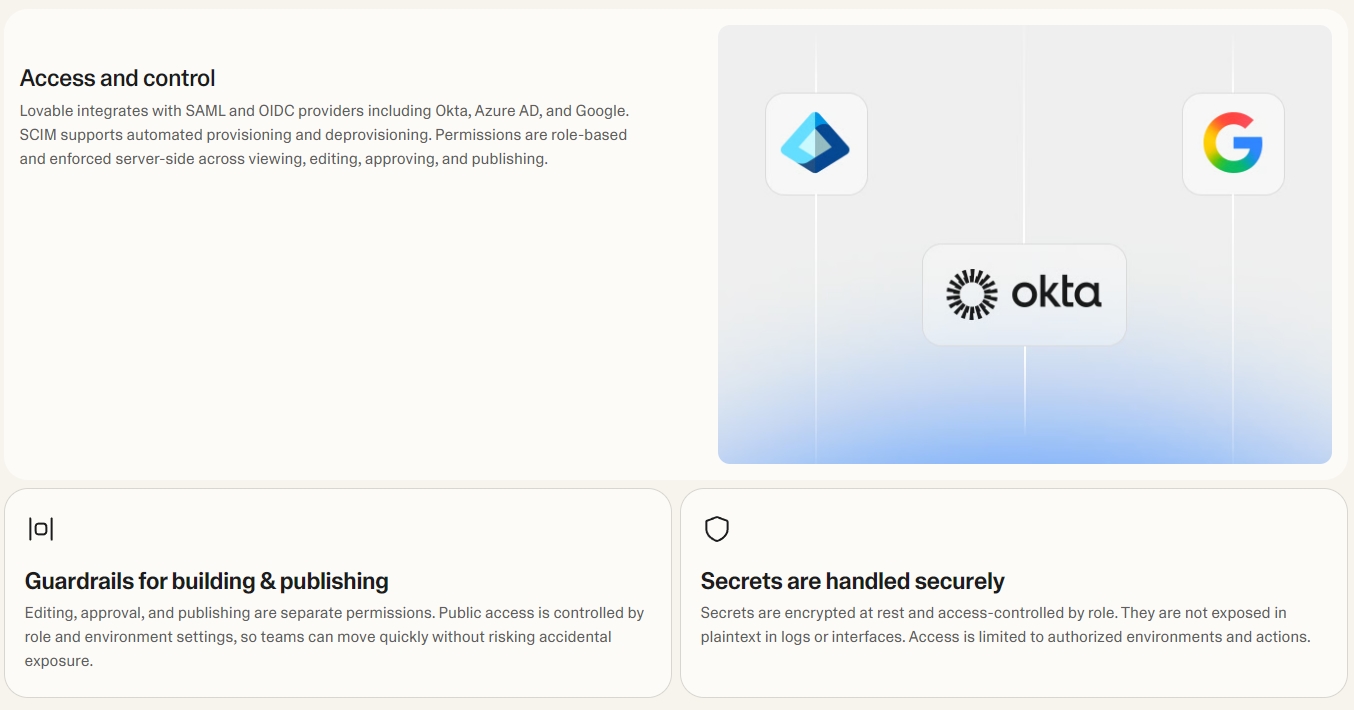
Supabase's Canadian region (ca-central-1) keeps database and auth data in Canada on paid plans. Lovable's default hosting on Vercel uses global edge caching; static assets may cache outside Canada. For strict data residency, deploy to your own AWS Canada or Azure Canada account. The generated code includes no telemetry or tracking unless you add it. This matters for PIPEDA compliance — you control what data your application collects.
Team Collaboration and Agency Workflows
The Business tier enables team workspaces with role-based access. Owners manage billing and membership; admins can invite members and configure integrations; developers have full project access; viewers can inspect but not modify. This maps well to Canadian agency models where a technical lead owns the Lovable account, designers contribute via Figma imports, and junior developers extend the generated code in GitHub.
A Montreal agency described their workflow: the technical lead creates the project in Lovable, prompts the initial architecture, then pushes to GitHub. Designers import Figma components that auto-generate PRs. Developers review, merge, and extend locally. The Lovable chat becomes a specification tool — "add invoice PDF generation with Canadian tax breakdown" — generating a PR the team reviews. This keeps the AI-assisted work visible and auditable.
The best teams treat Lovable as a senior developer who writes fast but needs code review.
Comparing Alternatives in the Canadian Context
Canadian teams evaluating Lovable typically compare it against Bolt.new, v0.dev, Replit Agent, and Cursor. Each has different strengths. Bolt.new excels at rapid prototyping but lacks the Supabase depth and GitHub ownership model. v0.dev produces exceptional UI components but doesn't handle backend or deployment. Replit Agent provides a full development environment but targets individual developers rather than team workflows. Cursor is an AI-enhanced IDE for developers who want to write code themselves.
Scroll horizontally to see all columns
| Tool | Best For | Code Ownership | Backend | Team Features | Approx. Monthly CAD |
|---|---|---|---|---|---|
| Lovable | Full-stack SaaS, marketplaces, internal tools | Full (your GitHub) | Supabase (PostgreSQL) | Business tier+ | $34-68 |
| Bolt.new | Rapid prototypes, learning, simple apps | Full (exportable) | Supabase optional | Limited | $27-54 |
| v0.dev | UI components, design systems, marketing sites | Full (your repo) | None (BYODB) | Team plans | $27-41 |
| Replit Agent | Solo developers, full-stack experiments | Full (your repl) | PostgreSQL, Redis, more | Teams (beta) | $27-41 |
| Cursor | Developers wanting AI pair programming | Full (local/remote) | Any (you build) | Business tier | $27-54 |
For Canadian founders building B2B SaaS with subscription billing, team workspaces, and admin dashboards, Lovable's Supabase integration and code ownership model provide the clearest path to a maintainable codebase. The trade-off is the credit system, which can feel restrictive during heavy development phases. Teams that prefer unlimited usage at a fixed price may prefer Cursor with their own Supabase setup, accepting that they'll write more code themselves.
Getting Started: First Week Checklist
New Canadian users can follow this sequence to evaluate Lovable effectively before committing to a paid tier:
- Sign up for Free tier — 50 credits, no card required
- Build a simple CRUD app: "task manager for Canadian freelancers with project tags and due dates"
- Connect your GitHub and inspect the generated repository structure
- Deploy to Vercel free tier and test the live application
- Add Supabase Auth and verify email/password flow works
- Prompt for Stripe checkout integration with a test Canadian price
- Review the generated code quality: TypeScript strictness, component organization, RLS policies
- Estimate your monthly credit needs based on iteration complexity
- Decide: Pro for solo work, Business if collaborating with designer/developer
The Free tier's 50 credits typically cover 3-5 substantial prompts. Use them on representative features — not landing pages. Test the hardest part of your application: the complex form with conditional validation, the multi-step wizard with database transactions, the dashboard with real-time updates. If Lovable handles those well, the simpler pages will be trivial.
Community and Support Channels
Lovable's community centers on Discord, where Canadian builders share prompts, debug generated code, and showcase launches. The team monitors channels and responds to bugs within hours during business days. Documentation covers the core workflows but lags on advanced patterns — expect to search Discord or GitHub discussions for solutions to specific integration challenges.

For Canadian teams, the time zone overlap with the core team (US East Coast) means daytime support availability. Enterprise tiers include dedicated Slack channels and scheduled architecture reviews. The affiliate program offers 30% recurring commission for referrals — relevant for Canadian agencies recommending Lovable to clients. Educational partnerships with Canadian institutions provide classroom credits; several university entrepreneurship programs have integrated Lovable into their curriculum.
Frequently Asked Questions
Does Lovable support Canadian data residency requirements?
Yes, by deploying to your own AWS Canada or Azure Canada account and using Supabase's Canadian region (ca-central-1) on paid plans. Default hosting uses Vercel's global edge network which may cache data outside Canada.
Can Lovable generate bilingual English/French applications?
Not automatically. You need to integrate an i18n library like next-intl or react-i18next manually. The AI can generate the initial setup and translation files if prompted specifically, but ongoing maintenance is your responsibility.
How does pricing work for Canadian customers paying in CAD?
Lovable bills in USD. Your credit card or bank handles the conversion. At roughly 1.36 USD/CAD, Pro tier costs about $34 CAD monthly, Business about $68 CAD. Rates fluctuate with exchange rates.
Does Stripe integration through Lovable handle GST/HST automatically?
Lovable configures Stripe Tax which can calculate GST/HST per province. You must enable Stripe Tax in your Stripe dashboard and verify the configuration matches your tax registration obligations. Lovable generates the integration code; compliance is your responsibility.
Can I use Lovable if I'm not a developer?
Yes, for standard SaaS patterns. Non-technical founders successfully build MVPs using templates and prompting. However, you will hit limits on custom logic, complex integrations, and debugging. Most non-technical founders eventually hire a developer to extend the generated code.
What happens to my code if I cancel my Lovable subscription?
Your code remains in your GitHub repository forever. You lose access to the Lovable chat interface and automatic deployments, but the generated React/TypeScript/Tailwind code is yours to continue developing with any tools.
Are there Canadian-specific templates for regulated industries?
Templates exist for fintech (Plaid Canada), health (FHIR models), and marketplaces, but they provide structural foundations only. Regulatory compliance — FINTRAC, PIPEDA, provincial health privacy laws — requires legal review and custom implementation beyond the template.
Final Assessment: Lovable for Canadian Builders
Lovable fills a specific gap for Canadian teams: the space between no-code tools that trap you in proprietary platforms and traditional development that moves too slowly for early validation. Its code ownership model — your GitHub repo, your Supabase project, your Stripe account — means you never face vendor lock-in. The credit system aligns costs with value delivered, though heavy iteration months can feel constrained.
For solo Canadian founders building B2B SaaS, the Pro tier at roughly $34 CAD monthly delivers exceptional leverage. For agencies delivering client MVPs, the Business tier pays for itself on the first project. For enterprise teams with strict compliance needs, the Enterprise tier's dedicated support and deployment flexibility justify the custom pricing. The platform's limitations — mobile polish, complex state, bilingual support — are real but manageable with a developer on the team.
The Canadian startup ecosystem has historically struggled with the build-versus-buy decision for early products. Lovable shifts that calculus: you can build a proper, maintainable codebase in weeks rather than months, validate with real Canadian customers, and either continue extending it yourself or hand it to a growing engineering team. That flexibility — not the AI novelty — is what makes it worth evaluating.