

AI Development Tools
Building E-Commerce Stores with Lovable AI
From prototype to production-ready online stores using natural language prompts

Senior Software Developer & Trading Technology Specialist
Ethan Parker is a software developer with over 8 years of experience in building web applications, trading tools, and financial technology solutions. He specializes in Python, JavaScript, API integrations, and trading automation, helping traders improve efficiency through innovative technology.
Lovable has changed how developers and non-technical founders approach e-commerce development. Instead of wrestling with Shopify Liquid templates, configuring complex app stacks, or hiring agencies for custom builds, you describe what you want in plain English and watch a working React application materialize. The platform handles the full stack — frontend, backend, database, authentication, payments, and deployment — through an AI agent that understands modern web architecture.
Contents
- 1. How Lovable Builds E-Commerce Applications
- 1.1. Natural Language to Working Storefront
- 1.2. Shopify Integration and Headless Commerce
- 2. Payment Processing and Checkout Flows
- 2.1. Stripe Integration Built In
- 2.2. Custom Checkout Experiences
- 3. Product Management and Inventory
- 3.1. Dynamic Product Catalogs
- 3.2. Inventory Sync Across Channels
- 4. Customer Accounts and Authentication
- 4.1. Supabase Auth for User Management
- 5. Order Management and Fulfillment
- 5.1. Admin Dashboards for Store Owners
- 5.2. Automated Email Notifications
- 6. Performance and SEO for E-Commerce
- 6.1. Vite and React Optimizations
- 6.2. SEO-Friendly Architecture
- 7. Scaling from MVP to Production
- 7.1. Database Considerations at Scale
- 7.2. Enterprise Features and Team Collaboration
- 8. Pricing Tiers for E-Commerce Projects
- 9. Common Challenges and Solutions
- 10. Final Assessment of Lovable E-Commerce
This shift matters because e-commerce projects traditionally sit at an uncomfortable intersection. They need polished customer-facing interfaces, secure payment processing, inventory logic, order management, and often integration with existing systems like ERPs or POS platforms. Building all of that from scratch takes months. Buying a SaaS platform limits customization. Lovable occupies a middle ground: you get production-grade code you own, generated in hours rather than months, with the flexibility to extend it however you need.
The platform's e-commerce capabilities have expanded rapidly since its early days as a prototyping tool. Today it ships with pre-built patterns for product catalogs, shopping carts, checkout flows, user accounts, admin dashboards, and webhook handlers for third-party services. You can connect to Shopify as a headless backend, use Supabase for a fully custom store, or integrate Stripe directly for payment processing. Each approach has trade-offs that matter depending on your scale, team, and long-term strategy.
How Lovable Builds E-Commerce Applications
The core interaction model is conversational. You open the chat interface, describe your store — "I need a fashion marketplace with vendor onboarding, commission splits, and Stripe Connect payouts" — and the AI generates a project structure with routes, components, database schemas, and API endpoints. It uses React with TypeScript, Vite for bundling, Tailwind CSS for styling, and Supabase for PostgreSQL, auth, and realtime subscriptions. The generated code follows modern patterns: server components where appropriate, client-side state management with React Query, and a component library built on Radix UI primitives.
Natural Language to Working Storefront
The first prompt usually produces a functional but generic starting point. You then iterate by asking for specific changes: "Add variant selectors with inventory tracking per size and color," "Make the cart a slide-over drawer instead of a page," "Show estimated delivery dates based on shipping zones." Each request modifies the codebase directly. You can also switch to the code view, make manual edits, and the AI will understand those changes in subsequent prompts. This hybrid workflow — AI for scaffolding and broad changes, manual for precision — is where experienced developers get the most leverage.
- Product grids with filtering, sorting, and infinite scroll
- Variant selection with real-time price and stock updates
- Cart persistence across sessions using localStorage and database sync
- Guest checkout with email capture for order tracking
- Order confirmation pages with printable receipts
- Responsive layouts that work on mobile without extra effort
Shopify Integration and Headless Commerce
Many teams choose Shopify as the commerce engine and Lovable as the frontend. This headless approach lets you keep Shopify's battle-tested checkout, payment gateway ecosystem, and app marketplace while building a custom storefront that loads faster and offers design freedom. Lovable generates the Storefront API integration automatically — GraphQL queries for products, collections, cart operations, and customer accounts. It handles the authentication flow for customer logins through Shopify's Multipass or the newer Customer Account API.
Scroll horizontally to see all columns
| Factor | Shopify Headless | Custom Supabase Backend |
|---|---|---|
| Setup time | Hours | Days |
| Monthly cost | Shopify plan + hosting | Supabase usage only |
| Checkout control | Limited to Shopify Checkout | Full customization |
| Payment gateways | 100+ via Shopify | Stripe, PayPal, custom |
| Inventory management | Built-in, mature | Build yourself |
| B2B features | Shopify Plus required | Flexible from start |
| Code ownership | Frontend only | Full stack |
| Scaling complexity | Managed by Shopify | Your responsibility |
The trade-off comes down to where you want to spend engineering time. Shopify headless removes the need to build order management, tax calculation, shipping rules, and PCI compliance from scratch. But you're locked into Shopify's checkout flow — customizing it requires Shopify Plus and even then has limits. A custom Supabase backend gives you complete control over the checkout experience, subscription logic, and data model, but you own the compliance burden and must build features that Shopify provides out of the box.
Payment Processing and Checkout Flows
Payments are where most e-commerce projects stall. Lovable's Stripe integration handles the heavy lifting: it generates the server-side PaymentIntent creation, client-side Elements integration, webhook handlers for payment confirmation, and the database schema for storing orders with idempotency keys. You describe the flow — "Support Apple Pay, save cards for returning customers, handle 3D Secure automatically" — and the AI wires it up using Stripe's latest APIs.
Stripe Integration Built In
The generated Stripe implementation follows current best practices. It uses the Payment Element for a unified interface supporting cards, wallets, and local payment methods like iDEAL or Blik. The backend creates PaymentIntents with automatic payment methods, handles the confirm callback, and updates order status through webhooks with proper signature verification. Refunds, partial captures, and dispute handling are scaffolded but need business logic tailored to your return policy.
- Payment Element with automatic method detection
- SetupIntents for saving payment methods to customer profiles
- Webhook endpoints for payment_intent.succeeded, payment_intent.payment_failed, charge.refunded
- Idempotency keys on all mutation endpoints
- Test mode toggle with separate API keys per environment
- Apple Pay and Google Pay enabled through Stripe's domain verification
Custom Checkout Experiences
Because you own the frontend code, the checkout flow can match any design requirement. Multi-step checkouts with progress indicators, express checkout buttons above the fold, upsell modals between steps, custom fields for gift messages or delivery instructions — all are straightforward modifications. The AI understands Stripe's client-side validation hooks, so you can add custom rules like "require phone number for international orders" or "block PO boxes for express shipping" without fighting a rigid template system.
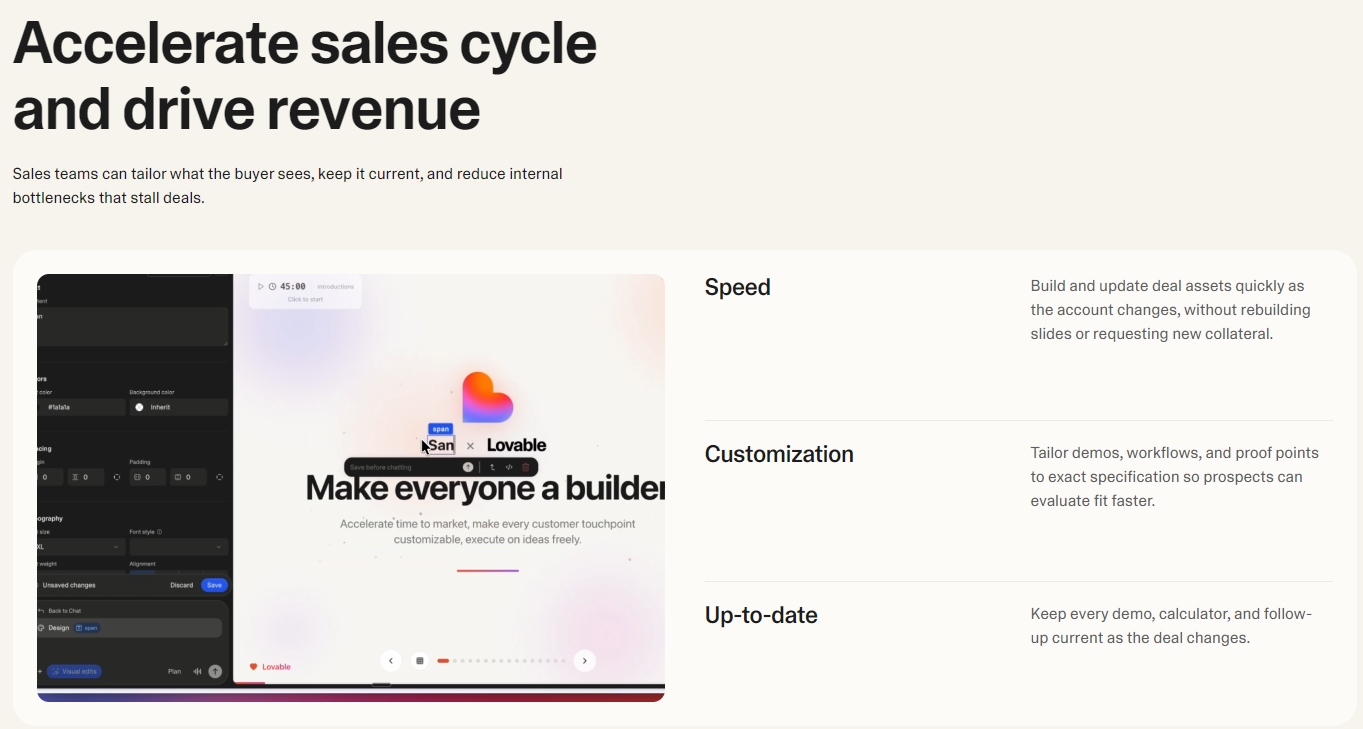
One pattern that works well: generate a headless checkout as a separate route that can be embedded in any page or loaded in a modal. This lets you test checkout variations — single page vs multi-step, guest-first vs account-first — without restructuring the entire application. The cart state stays in React Query's cache, synchronized with the database, so users can move between product pages and checkout without losing their selections.
Product Management and Inventory
Product data modeling is where e-commerce complexity hides. A simple t-shirt has sizes, colors, each with its own SKU, barcode, weight, and stock level. Add bundles, digital downloads, subscription products, or made-to-order items and the schema grows quickly. Lovable generates a flexible product-variant schema from a natural language description, but you'll likely need to refine it for edge cases your specific catalog presents.
Dynamic Product Catalogs
The default schema supports hierarchical categories, product attributes with typed values (text, number, boolean, enum), variant combinations with individual pricing and inventory, media galleries with alt text for SEO, and SEO fields per product (meta title, description, Open Graph tags). The admin interface for managing this data is generated alongside the storefront — a CRUD dashboard with search, filters, bulk actions, and CSV import/export. You can extend it with custom fields like "care instructions" or "sustainability certifications" by describing the requirement.
Scroll horizontally to see all columns
| Feature | Included | Notes |
|---|---|---|
| Categories and collections | Yes | Nested hierarchies supported |
| Variant matrix (size × color) | Yes | Auto-generates combinations |
| Per-variant inventory | Yes | Tracks stock at SKU level |
| Digital products | Partial | Needs delivery logic added |
| Subscription products | Partial | Requires Stripe Billing setup |
| Bundles and kits | Manual | Custom logic required |
| CSV import/export | Yes | Admin dashboard included |
| Product reviews | Scaffolded | Needs moderation workflow |
Inventory Sync Across Channels
If you sell on multiple channels — your Lovable storefront, Shopify, Amazon, a POS system — inventory synchronization becomes critical. Lovable can generate webhook endpoints that receive stock updates from external systems and update the Supabase database, or push changes out via API calls. The pattern uses a message queue (Supabase pg_notify or a dedicated queue table) to handle bursts reliably. You'll need to define a source-of-truth strategy: is Lovable the master, or does it subscribe to an ERP? The AI can scaffold either architecture once you clarify the requirement.
Customer Accounts and Authentication
E-commerce authentication has specific requirements beyond standard login: guest checkout with optional account creation after purchase, order history tied to email regardless of account status, wishlist persistence, saved addresses, and subscription management. Lovable uses Supabase Auth which handles email/password, magic links, OAuth providers (Google, GitHub, Apple), and MFA. The generated schema links orders to users through a flexible profile table that works for both registered and guest customers.
Supabase Auth for User Management
The auth flow includes email verification, password reset with secure tokens, session management with JWTs stored in HttpOnly cookies, and row-level security policies that ensure users only see their own orders and addresses. Admin users get elevated permissions through a role column on the profile table. The AI generates the RLS policies automatically when you describe access rules: "Customers see only their orders, admins see all orders, support agents see orders but not payment details."
- Email/password with optional magic link login
- Social providers configured through Supabase dashboard
- Multi-factor authentication with TOTP apps
- Session persistence across devices
- Account deletion with data anonymization option
- Impersonation for support teams (admin only)
A practical detail: Supabase Auth stores minimal user data by default. For e-commerce you'll want a profile table with shipping addresses, billing addresses, phone number, marketing consent, and loyalty tier. The AI generates this table and the trigger that creates a profile row on user signup. You can then extend it with fields like "preferred currency" or "tax exemption certificate" for B2B customers.
Order Management and Fulfillment
After payment succeeds, the order lifecycle begins: confirmation, processing, fulfillment, shipping, delivery, returns. Lovable generates an order state machine with configurable statuses and transitions. Each transition can trigger side effects — email notifications, webhook calls to fulfillment centers, inventory decrement, loyalty point accrual. The admin dashboard shows orders in a filterable table with detail views for customer communication, refund processing, and shipping label generation.
Admin Dashboards for Store Owners
The generated admin interface is a separate route group protected by role-based access. It includes an orders table with status badges, date range filters, search by order number or customer email, and bulk actions like "mark shipped" or "export to CSV." Clicking an order opens a detail drawer showing the full timeline: payment events, inventory allocations, shipping updates, customer notes, and internal comments. You can add custom fields to the order model — "gift wrap," "installation requested," "wholesale tier" — and they appear automatically in the admin UI.
Scroll horizontally to see all columns
| Capability | Status | Extension Points |
|---|---|---|
| Order state machine | Included | Custom statuses and transitions |
| Payment timeline | Included | Stripe event log integration |
| Shipping label generation | Scaffolded | Carrier API integration needed |
| Return/RMA workflow | Partial | Needs policy configuration |
| Customer communication log | Included | Email and SMS templates |
| Commission calculations | Manual | Marketplace-specific logic |
| Analytics dashboard | Basic | Connect to PostHog or Mixpanel |
Automated Email Notifications
Transactional emails are generated using Resend or SendGrid templates. The AI creates the trigger functions: order confirmation on payment success, shipping notification when status changes to fulfilled, delivery confirmation from carrier webhook, review request after a configurable delay. Each email uses a React component rendered to HTML, so you can preview and test them in the browser before sending. The template system supports localization if you pass a locale parameter.
The difference between a prototype and a production store is almost entirely in the operational tooling — order management, returns, customer communication, inventory reconciliation. Lovable gives you the scaffolding for all of it, but you still have to define the business rules.
Performance and SEO for E-Commerce
Conversion rates drop measurably with each second of load time. Lovable's default stack — Vite, React 18, Tailwind — produces fast builds, but e-commerce has specific performance requirements: product images at multiple sizes, critical CSS for above-the-fold content, preloading key resources, and caching strategies for dynamic data. The AI understands these patterns and implements them when prompted.
Vite and React Optimizations
The generated Vite config includes code splitting by route, automatic chunking for vendor libraries, and image optimization through a plugin that generates WebP/AVIF variants at build time. Product pages use React Server Components (when deployed to a supporting platform) or static generation with ISR for the product shell, while price and stock fetch client-side for freshness. The cart and checkout remain fully client-side for interactivity.
- Route-based code splitting with lazy-loaded pages
- Image optimization with responsive srcset generation
- Critical CSS inlining for first paint
- Resource hints (preconnect, dns-prefetch) for third-party domains
- Service worker for offline cart persistence
- Bundle analysis script in package.json
SEO-Friendly Architecture
SEO for e-commerce means structured data, clean URLs, canonical tags, paginated collections with rel=next/prev, and XML sitemaps. Lovable generates JSON-LD Product, Offer, BreadcrumbList, and Organization schemas on product and category pages. The routing uses descriptive slugs (/products/organic-cotton-tee rather than /product/123) with automatic redirect handling for changed slugs. Meta tags are populated from the product's SEO fields with sensible fallbacks.
Scaling from MVP to Production
The first version of your store will work. The question is whether it survives Black Friday traffic, handles international expansion, or supports a team of five developers working in parallel. Lovable projects are standard React/TypeScript codebases — you can eject to local development, set up CI/CD, add testing, and scale the infrastructure independently. The platform doesn't lock you into its hosting.
Database Considerations at Scale
Supabase (PostgreSQL) handles significant load with proper indexing, connection pooling, and read replicas. For high-volume stores, you'll want to add indexes on frequently queried columns (customer_id on orders, status+created_at for admin views), enable pg_stat_statements to identify slow queries, and consider partitioning the orders table by month. The AI can generate migration files for these optimizations when you describe the performance issue.
Enterprise Features and Team Collaboration
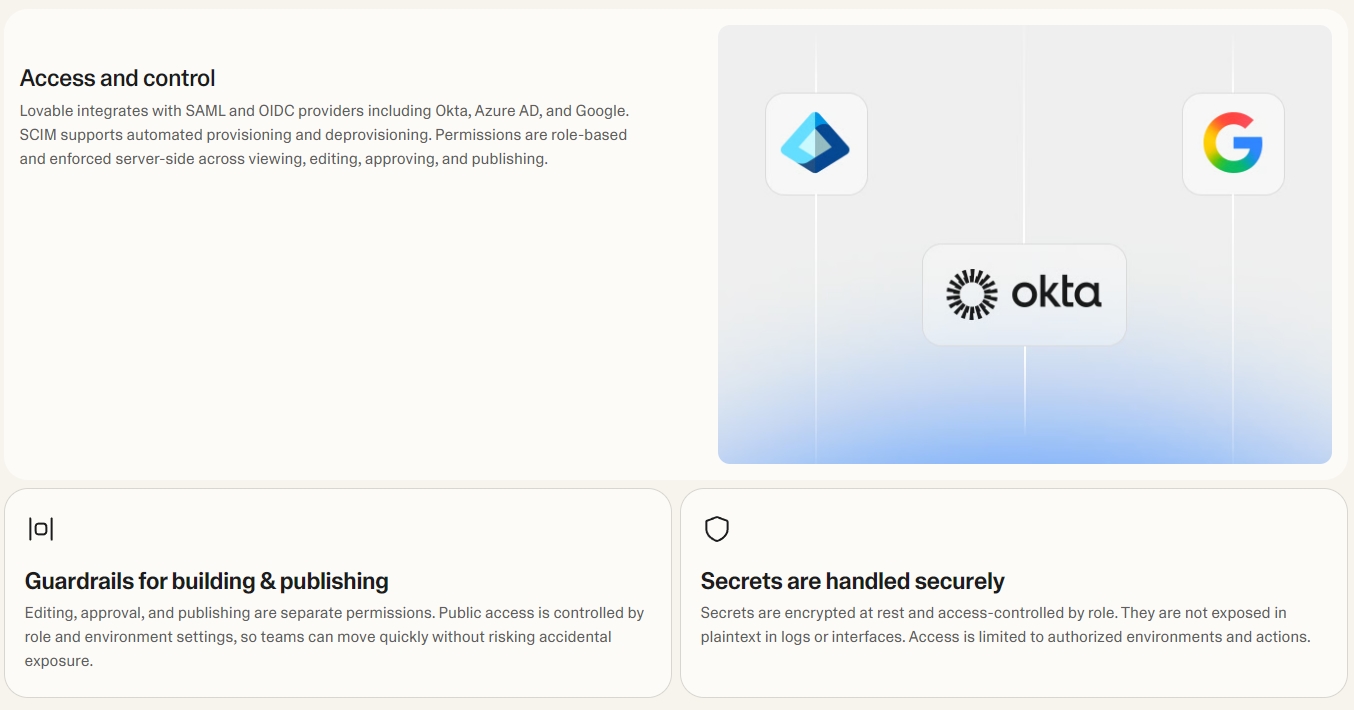
Lovable's enterprise tier adds features relevant to larger teams: SSO authentication for the platform itself, audit logs for all project changes, role-based access control for team members, and dedicated support. The generated codebase supports monorepo structures if you need to share components across a marketing site, admin dashboard, and mobile app. GitHub integration lets you push to your own repository and run your own CI pipeline — the AI commits with conventional messages and opens PRs for review.

A practical workflow: use Lovable for rapid feature development — new landing pages, promotional components, A/B test variants — then have engineers review, test, and merge. The AI writes tests when asked (Vitest for unit, Playwright for e2e) but they need human validation. Many teams treat Lovable as a senior frontend engineer who works at 10x speed but still needs code review.
Pricing Tiers for E-Commerce Projects
Lovable's pricing affects e-commerce projects differently than simple apps. The free tier includes 5 credits daily — enough for experimentation but not sustained development. The Pro tier at $20/month gives 100 credits monthly, which covers a typical e-commerce build with iterations. Teams doing daily development on a store will want the Business tier ($50/user/month) for higher limits and collaboration features. Enterprise pricing is custom and includes dedicated infrastructure options.
Scroll horizontally to see all columns
| Tier | Monthly Credits | Best For |
|---|---|---|
| Free | 150 (5/day) | Learning, prototypes, small MVPs |
| Pro | 100 | Solo founders, single store build |
| Business | 400 per user | Active development teams, multiple projects |
| Enterprise | Custom | Large orgs, compliance needs, dedicated support |
Credits consume based on model usage — complex multi-file changes use more than simple tweaks. A typical e-commerce project from blank to launch might use 200-500 credits depending on complexity and iteration count. Budget for ongoing maintenance: seasonal updates, payment method additions, performance optimizations, and platform updates all consume credits. The Business tier's per-user model makes sense once you have two or more people prompting daily.
Common Challenges and Solutions
Every e-commerce project hits similar walls. Understanding them upfront saves weeks of rework. The AI can scaffold solutions, but you need to recognize the pattern and ask for it.
- Cart abandonment: Add exit-intent email capture, persistent cart across devices, and one-click checkout for returning customers
- Mobile conversion: Test checkout on real devices, not just browser dev tools. Thumb zones, keyboard types, and autofill behavior vary
- International pricing: Implement currency detection, local payment methods, tax calculation per jurisdiction, and translated checkout
- Subscription complexity: Stripe Billing handles recurring payments but you need dunning management, proration logic, and customer portal
- Fraud prevention: Stripe Radar is configurable. Add velocity checks, block known bad actors, and review high-risk orders manually
- Data migration: Moving from Shopify/WooCommerce requires mapping product IDs, customer records, and order history with preserved timestamps
Final Assessment of Lovable E-Commerce
Lovable makes sense for e-commerce when you need a custom storefront faster than traditional development allows, but you're not willing to accept the constraints of a pure SaaS platform. It excels at headless Shopify frontends, marketplace MVPs, B2B portals with complex pricing, and direct-to-consumer brands that want design differentiation. The generated code is readable, maintainable, and portable — you're not locked into the platform. The main limitation is that complex business logic (tax engines, advanced promotions, multi-warehouse fulfillment) still requires engineering time. The AI scaffolds the structure; you supply the domain expertise. For teams that understand both the commerce requirements and the technical stack, Lovable compresses months of frontend and backend work into weeks. For non-technical founders, it's a powerful prototyping tool but production deployment still benefits from developer review.
Frequently Asked Questions
Can Lovable build a complete e-commerce store without any coding?
Yes, you can generate a functional store with products, cart, checkout, and admin dashboard using only prompts. However, production deployment, custom domain setup, payment provider configuration, and thorough testing benefit from technical knowledge.
Does Lovable integrate with Shopify for headless commerce?
Yes. Lovable generates Storefront API integrations including GraphQL queries for products, collections, cart operations, and customer authentication. You keep Shopify's checkout and backend while building a custom React frontend.
What payment processors does Lovable support?
Stripe is the primary integration with full Payment Element support, webhooks, and saved payment methods. You can also integrate PayPal, Square, or other processors by adding their SDKs and API calls manually.
How does inventory management work in a Lovable store?
The generated schema tracks inventory at the variant level with real-time updates via Supabase Realtime. You can sync with external systems through webhooks or API calls. Advanced features like reservations, backorders, and multi-location stock require custom logic.
Can I migrate an existing Shopify or WooCommerce store to Lovable?
Yes, but it's a data migration project. You'll export products, customers, and orders from the old platform, transform the data to match Lovable's schema, and import via CSV or scripts. URL redirects for SEO preservation need separate configuration.
What are the hosting costs for a Lovable e-commerce store?
Lovable includes hosting on its platform. For custom domains and higher traffic, you can deploy to Vercel, Netlify, or AWS. Supabase database hosting starts free and scales with usage. Expect $20-100/month for a production store depending on traffic and database size.
Does Lovable support B2B e-commerce features like tiered pricing and net terms?
The platform can generate the data models and UI for B2B features — customer groups, price lists, quote requests, purchase orders — but the business logic for credit limits, net payment terms, and approval workflows needs custom implementation.