

AI Development Tools
Lovable Launch: When the AI App Builder Went Public
Tracking the release of an AI app builder that turns natural language into production-ready code.

Senior Software Developer & Trading Technology Specialist
Ethan Parker is a software developer with over 8 years of experience in building web applications, trading tools, and financial technology solutions. He specializes in Python, JavaScript, API integrations, and trading automation, helping traders improve efficiency through innovative technology.
Lovable.dev entered the public conversation in early 2024, but the groundwork started months earlier. The platform positions itself as an AI-powered full-stack engineer that can take a natural language prompt and produce a working React application with backend integration, authentication, and deployment — all without the user writing code. Understanding when Lovable launched, what it offered on day one, and how it evolved in the first months tells you a lot about where AI-assisted development is heading.
Contents
- 1. Pre-Launch Development and Closed Beta
- 2. Official Public Launch Timeline
- 3. Market Reception and Early Adoption Patterns
- 4. Technical Architecture Decisions at Launch
- 5. Pricing Evolution in the First Quarter
- 6. Community Growth and Feedback Loops
- 7. Competitive Positioning at Launch
- 8. Post-Launch Iterations: The First 90 Days
- 9. User Behavior Patterns That Emerged
- 10. Limitations That Persisted Past Launch
- 11. Enterprise Adoption Signals
- 12. Final Assessment of the Lovable Launch
The company behind Lovable, founded by Anton Osika and Fabian Hedin, operated in stealth through late 2023. They built on top of large language models, Supabase for backend services, and a custom code generation pipeline that targets React, TypeScript, Tailwind CSS, and Vite. The goal was not just code snippets but complete, deployable applications. That ambition shaped every decision about timing, feature scope, and who got early access.
Public awareness began with a waitlist announcement in January 2024. The team shared demo videos showing the system building a SaaS dashboard, a marketplace, and a CRM from prompts like "build a project management tool with teams, tasks, and due dates." Those demos circulated on X and in developer Discords, creating demand before anyone outside the beta could try it. The waitlist grew to tens of thousands within weeks.
Pre-Launch Development and Closed Beta
The closed beta ran from roughly November 2023 through February 2024. Access was granted in waves to founders, product managers, and developers who signed up early. Beta testers reported that the system excelled at scaffolding — creating project structure, routing, component hierarchy, and Supabase schema — but struggled with complex business logic, custom API integrations, and edge cases in authentication flows. The team used this feedback to prioritize fixes before the public launch.
During beta, Lovable introduced its credit-based pricing model. Each generation or modification consumed credits, with more complex requests costing more. This mechanism served dual purposes: it managed GPU costs during the expensive inference phase, and it created a natural rate limit that prevented abuse. Beta users received a monthly credit allowance that reset, establishing the pattern that would carry into the public tiers.
- Beta access began November 2023 via waitlist
- Initial testers: founders, PMs, developers
- Core stack: React, TypeScript, Tailwind, Vite, Supabase
- Credit system introduced to manage inference costs
- Primary feedback: strong scaffolding, weak complex logic
The beta also revealed a usage pattern the team hadn't fully anticipated. Non-technical founders used Lovable to build MVPs they could show investors. Product managers used it to prototype features before handing off to engineering. Designers used it to turn Figma mockups into interactive prototypes. Developers used it to accelerate boilerplate. Each group pushed the product in different directions, forcing the team to balance simplicity for non-coders with escape hatches for developers who wanted to edit the generated code directly.
By late January 2024, the waitlist had become a marketing asset. The team published case studies from beta users who had launched products built entirely with Lovable. One founder built a B2B marketplace in two weeks. Another shipped an internal tool for their operations team in an afternoon. These stories did more than any feature list to communicate what the platform could actually do.
Official Public Launch Timeline
Lovable opened to the public on February 12, 2024. The announcement came via a blog post, a launch video, and coordinated posts from the founders and early users. There was no Product Hunt launch, no big conference keynote, no press embargo. The team chose a quiet Monday release, letting the product speak through the community that had already formed. Within 48 hours, the platform had processed over 100,000 generation requests.
The launch version included the core chat interface, project management dashboard, GitHub integration for code export, Supabase connection for database and auth, one-click deployment to Vercel, and a template gallery with 20 starter projects. Missing at launch: team collaboration features, custom domain support on the free tier, advanced debugging tools, and any mobile-specific templates. The team was explicit about these gaps in the launch post, framing them as deliberate scope cuts to ship a reliable core.
Scroll horizontally to see all columns
| Feature | At Launch (Feb 2024) | Added Within 90 Days |
|---|---|---|
| Chat-based generation | Yes | Enhanced with multi-file edits |
| GitHub integration | Yes (export only) | Two-way sync added |
| Supabase backend | Yes | Schema visualization added |
| Vercel deployment | One-click | Preview deployments added |
| Template gallery | 20 templates | 50+ templates, community submissions |
| Team collaboration | No | Workspaces launched April 2024 |
| Custom domains | Paid tiers only | Free tier support added May 2024 |
| Code editing in browser | Read-only | Full Monaco editor integrated |
The launch pricing had four tiers: Free (50 credits/month), Starter ($20/month for 500 credits), Pro ($50/month for 1,500 credits), and Enterprise (custom). Credits roughly mapped to generation complexity — a simple landing page might cost 5-10 credits, while a multi-page dashboard with auth and database could cost 50-100. The Free tier was generous enough for exploration but tight enough that serious builders upgraded quickly.
Market Reception and Early Adoption Patterns
The reception split along predictable lines. Developers who understood the underlying stack — React, Supabase, Vercel — evaluated Lovable as a productivity tool. They appreciated the speed for scaffolding but wanted more control over the generated code, better TypeScript inference, and the ability to inject custom logic without fighting the AI. Non-technical users evaluated it as a product builder. They cared less about code quality and more about whether the result worked, looked professional, and could handle real users.
A notable early adopter segment was agencies. Several boutique development shops began using Lovable to accelerate client projects, particularly for discovery phases and rapid prototypes. They could show a working demo in a first meeting instead of wireframes. This created a secondary distribution channel: clients who saw Lovable in agency demos then signed up themselves. The team noticed this pattern and later built agency-specific features like white-label workspaces.
The launch proved that developers will adopt AI tools that respect their existing stack. Lovable didn't ask you to learn a new framework — it generated code in the stack you already use.
Competitor comparisons emerged immediately. Bolt.new had launched months earlier with a similar promise but a different UX — more browser-based IDE, less chat-centric. v0 from Vercel focused on UI components rather than full apps. Replit Agent targeted a broader coding assistant role. Lovable differentiated by going deep on the React + Supabase + Vercel triangle, making opinionated choices that reduced decision fatigue but also limited flexibility. Users who wanted Next.js app router, or PlanetScale instead of Supabase, or AWS instead of Vercel, found themselves fighting the platform.
- Developers: valued speed, wanted more code control
- Non-technical founders: valued working output, ignored code
- Agencies: adopted for rapid client prototyping
- Designers: used for Figma-to-code workflow
- Students: heavy Free tier usage for learning
Technical Architecture Decisions at Launch
The launch architecture reflected a series of deliberate constraints. The team chose to generate a single-page application structure with client-side routing via React Router, rather than Next.js. This simplified the mental model for non-technical users — one build output, one deployment target — but frustrated developers who wanted server-side rendering, static generation, or API routes. The decision was revisited within 60 days when Next.js support was added as an option.
Supabase integration was baked in at the schema level. When the AI generated a data model, it simultaneously created the PostgreSQL tables, Row Level Security policies, and TypeScript types. This tight coupling was a major differentiator. Competing tools often generated frontend code and left backend as an exercise. The trade-off: you were locked into Supabase's Postgres flavor and auth system. Migration paths to other backends required manual work.
Scroll horizontally to see all columns
| Layer | Choice | Rationale |
|---|---|---|
| Frontend framework | React 18 + Vite | Fast HMR, wide talent pool, simple mental model |
| Language | TypeScript strict mode | Catch errors early, better AI completion context |
| Styling | Tailwind CSS | Utility-first matches AI generation patterns |
| Routing | React Router v6 | SPA simplicity, no server runtime needed |
| Backend | Supabase (Postgres + Auth + Realtime) | Integrated BaaS, generous free tier, SQL standard |
| Deployment | Vercel | Zero-config for SPA, preview deployments, global CDN |
| Code hosting | GitHub | Universal developer workflow, PR-based collaboration |
The generation pipeline used a multi-step approach: prompt understanding, architecture planning, file-by-file generation, type checking, and validation. Each step had its own prompt template and model call. The team found that asking a single model to produce an entire codebase led to hallucinated imports, inconsistent patterns, and broken builds. Breaking it down improved reliability but increased latency — typical generation took 30-90 seconds at launch. They accepted this latency as the cost of correctness.
Error handling was a launch weak point. When generated code failed to compile, the system surfaced raw TypeScript errors to the user. Non-technical users found these opaque. The team prioritized a "self-healing" loop where the AI would read the error, propose a fix, and re-generate — but this often consumed 3-5 additional credits per failure. By April, they had introduced a more user-friendly error overlay with plain-language explanations and one-click fix attempts.
Pricing Evolution in the First Quarter
The launch pricing held for six weeks. Then the team introduced a Pro tier adjustment: $50/month now included 2,000 credits (up from 1,500) and added priority generation queue access. They also launched a "Launch" tier at $100/month with 5,000 credits, team seats, and custom domain support — targeting the agency and power-user segment that had emerged organically. The Free tier remained unchanged, a deliberate decision to keep the top of funnel wide.
Credit consumption proved controversial. Users discovered that iterative refinement — "change the button color," "add a filter," "fix the mobile layout" — each consumed fresh credits as if starting from scratch. The team responded by introducing "edit mode" in March, where follow-up modifications to an existing project cost 50% fewer credits. This acknowledged the real workflow: building is iterative, not one-shot.
The credit model also created an unexpected behavior: users hoarded credits. Some Free tier users would wait until month-end to use their remaining credits, creating usage spikes. The team considered rollover credits but decided against it, citing predictability of GPU capacity planning. Instead, they added a "credit preview" estimator before each generation so users could make informed decisions.
Community Growth and Feedback Loops
Lovable's Discord server became the de facto community hub within days of launch. The founders were active daily, answering questions, triaging bugs, and taking feature requests. This visibility built trust. Users could see the roadmap taking shape in real time. The team ran weekly "office hours" voice chats where they demoed upcoming features and gathered live feedback. This rhythm — ship, listen, iterate — became a competitive advantage against larger, slower-moving incumbents.
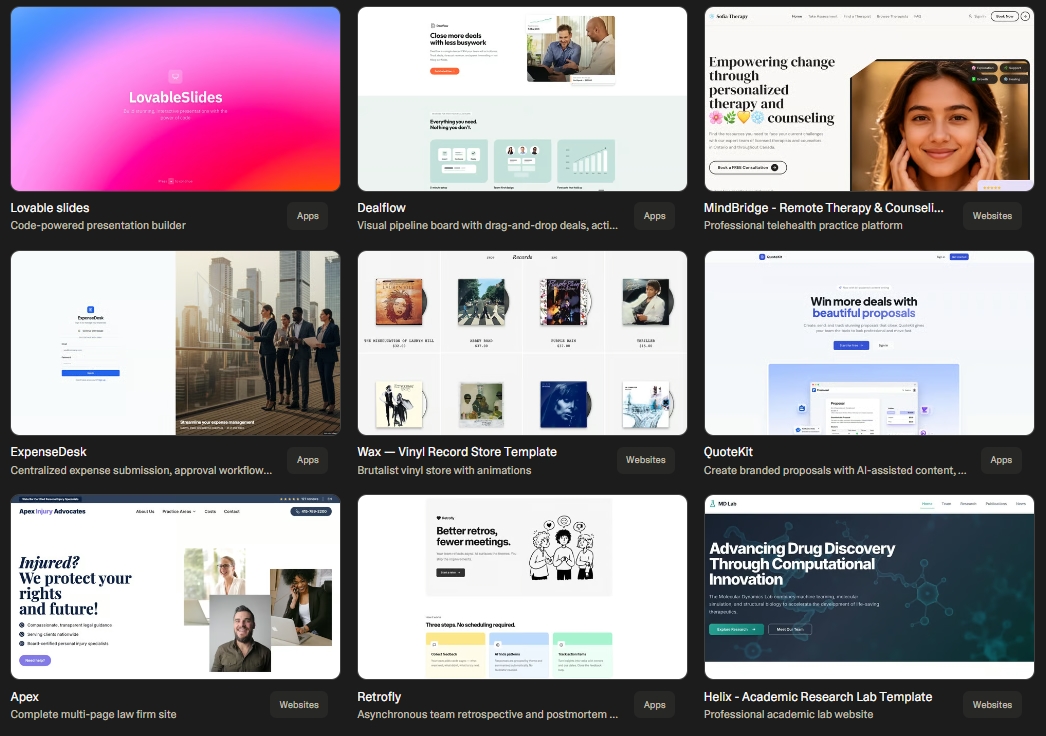
The template gallery evolved from a static launch asset into a community-driven marketplace. By March, users could submit their own projects as templates after a review process. This served multiple purposes: it expanded the template library without internal engineering effort, it showcased what was possible, and it created a social proof loop. Popular templates included a Notion-style workspace, a Stripe-powered subscription SaaS, a real-time chat app, and a multi-tenant CRM.
- Discord: 8,000+ members by end of March
- Weekly office hours with founders
- Community template submissions opened March 2024
- Public roadmap on GitHub Projects
- Bug bounty program for critical issues
The fastest way to improve an AI product is to watch real users struggle with it in public. Lovable's founders did exactly that.
A friction point emerged around code ownership. Lovable's terms stated that generated code belonged to the user, but the platform retained a license to use generations for model improvement. Some enterprise prospects flagged this as a blocker. The team clarified the policy in April, adding an Enterprise tier opt-out for training data usage. This kind of legal nuance — boring but critical — often determines whether a tool gets adopted in regulated industries.
Competitive Positioning at Launch
When Lovable launched, the AI app builder category was crowded but immature. Bolt.new had the mindshare lead among developers. v0 dominated the design-to-code niche. Replit Agent appealed to the learn-to-code crowd. Cursor was the AI-enhanced IDE for professionals. Lovable's wedge was "full-stack app from prompt" — not components, not snippets, not a coding assistant. An entire deployable application with database, auth, and hosting.
This positioning attracted a specific user: someone who had an app idea but lacked the full-stack skills to build it. Not a developer looking for autocomplete. Not a designer wanting React components. A founder, PM, or operator who needed a working product yesterday. The marketing leaned into this: "From idea to deployed app in minutes." The launch video showed exactly that — a prompt, a generation, a deployment, a working URL.
Scroll horizontally to see all columns
| Tool | Primary Focus | Target User | Key Limitation at Launch |
|---|---|---|---|
| Lovable | Full-stack app generation | Founders, PMs, non-technical builders | Opinionated stack, limited customization |
| Bolt.new | Browser-based AI IDE | Developers, hobbyists | No integrated backend, manual deploy |
| v0 | UI component generation | Designers, frontend devs | Components only, no backend/logic |
| Replit Agent | General coding assistant | Learners, polyglot developers | Less opinionated, more setup required |
| Cursor | AI-enhanced code editor | Professional developers | Requires coding knowledge |
The competitive pressure accelerated Lovable's roadmap. Bolt added Supabase integration within weeks. v0 added full-page generation. Replit improved its deployment story. The category moved fast enough that any feature advantage lasted 4-6 weeks at most. Lovable's moat, if any, would come from the quality of its generation pipeline, the tightness of its Supabase integration, and the community it built — not from any single feature.
Post-Launch Iterations: The First 90 Days
The first 90 days after launch saw weekly releases. The team operated on a Monday deploy cadence: features merged by Friday, tested over weekend, shipped Monday. This rhythm let them respond to feedback fast. Major additions in this window: Next.js App Router support (March 15), two-way GitHub sync (March 28), team workspaces (April 10), custom domains on Free tier (May 1), browser-based code editor (May 15), and a plugin system for custom integrations (May 28).
Next.js support was the most technically significant. It required rewriting the generation pipeline to output app router structure, server components, and API routes. The team maintained backward compatibility — users could choose SPA or Next.js per project. This doubled the test surface but unlocked enterprise adoption, where Next.js is often a hard requirement. The migration tool for existing SPA projects to Next.js arrived in June.
Two-way GitHub sync changed the workflow fundamentally. At launch, GitHub was export-only: you generated, then pushed. With sync, you could clone a Lovable project locally, edit in your IDE, push, and see changes reflected in the Lovable chat. This bridged the AI-assisted and manual development modes. Developers who had dismissed Lovable as "no-code only" reconsidered. The feature also enabled CI/CD pipelines — teams could run tests on every push before the Lovable deployment triggered.
The plugin system, released in late May, was a strategic bet. It allowed developers to wrap existing npm packages or internal APIs as "tools" the AI could call during generation. A company with a proprietary payment gateway could make it available to Lovable without waiting for native support. This extensibility addressed the long-tail integration problem that every platform faces. Early plugins included Stripe Connect, SendGrid, Twilio, and several internal tool wrappers from agency users.
User Behavior Patterns That Emerged
Analytics from the first quarter revealed usage patterns the team hadn't designed for. The most common first project was a landing page with email capture — essentially a waitlist builder. The second most common was a dashboard with charts and tables. The third was an authentication flow demo. Users treated Lovable as a learning tool as much as a building tool. They generated, inspected the code, learned patterns, then sometimes rebuilt manually.
A surprising cohort: computer science students. They used Lovable to generate reference implementations for assignments — not to cheat, but to see how a full-stack feature should be structured. The team debated whether to embrace this (student discounts, educational templates) or discourage it. They chose to embrace: a student discount program launched in April, and educational templates for common CS patterns (auth, CRUD, real-time) were added to the gallery.
- Top first project: landing page with waitlist capture
- Second: admin dashboard with charts/tables
- Third: authentication flow reference
- Students: 15% of Free tier, heavy template usage
- Agencies: 8% of users, 35% of Pro/Launch revenue
- Iteration depth: avg 7 edits per project before deploy
Users don't just want the output. They want to understand the output. The code is the documentation.
Iteration depth was higher than expected. The average project saw 7 chat interactions before the user deployed. This wasn't "one prompt, done" — it was a dialogue. Users refined layout, adjusted color schemes, added fields, fixed mobile responsiveness, tweaked authentication rules. Each iteration consumed credits. The team realized that the real product wasn't the initial generation but the iteration loop. They invested heavily in making follow-up edits faster, cheaper, and more precise.
Limitations That Persisted Past Launch
Three months in, several launch-era limitations remained. Complex state management — think drag-and-drop kanban boards, real-time collaborative editing, or multi-step wizards with conditional logic — still produced buggy code. The AI tended to reach for useState and useEffect where a state machine or library like XState would be appropriate. Users who needed these patterns ended up ejecting to manual code.
Mobile responsiveness was another weak spot. Generated apps looked fine on desktop but often broke on mobile: overflowing tables, stacked modals, touch targets too small. The AI didn't consistently apply responsive Tailwind utilities. The team added a "mobile-first" prompt hint and a device preview toggle, but the root cause — training data bias toward desktop layouts — required model-level fixes that were out of their direct control.
Scroll horizontally to see all columns
| Area | Limitation | Workaround |
|---|---|---|
| Complex state | Poor handling of multi-step flows, drag-drop | Eject to manual code, use XState/Zustand |
| Mobile responsive | Inconsistent Tailwind responsive utilities | Manual CSS fixes, device preview testing |
| Custom APIs | No native OpenAPI/Swagger ingestion | Plugin system, manual integration code |
| Testing | No generated test files | Write tests manually after generation |
| Accessibility | Basic ARIA only, no audit | Manual audit, axe-core in CI |
| Monorepo | Single project per workspace | Multiple workspaces, manual linking |
Testing and accessibility were notably absent. Generated projects had no unit tests, no integration tests, no E2E tests, and minimal ARIA attributes. For hobby projects this didn't matter. For production apps in regulated industries, it was a blocker. The team acknowledged this but prioritized generation quality over test generation, arguing that tests for AI-generated code would need AI-generated assertions — a circular problem. They hinted at a future "test generation" mode but gave no timeline.
Enterprise Adoption Signals
By June 2024, enterprise inquiries had become a significant pipeline. The signals: companies asking for SSO/SAML, audit logs, data residency guarantees, dedicated support SLAs, and the ability to run in their own cloud (VPC deployment). Lovable's architecture — generating standard React/TypeScript that runs anywhere — made VPC deployment technically feasible. The team started a private beta for self-hosted enterprise in July, with a planned GA in Q4.
The enterprise use case differed from the founder/PM use case. Enterprises weren't building new products from scratch. They were accelerating internal tool development: admin panels, data entry forms, reporting dashboards, workflow automation. These projects had well-defined requirements, existing design systems, and strict security reviews. Lovable's value was reducing a 2-week sprint to 2 days. The ROI calculation was straightforward for engineering managers.
- Primary enterprise use case: internal tools acceleration
- Typical project: admin panel, dashboard, form workflow
- Key requirements: SSO, audit logs, VPC, design system sync
- ROI frame: 2-week sprint → 2 days
- Private VPC beta: July 2024
- Target GA: Q4 2024
Enterprises don't buy AI magic. They buy time. If you can prove you save engineering weeks, the budget appears.
A friction point for enterprise adoption was the credit model. Predictable per-seat pricing is standard; consumption-based pricing creates budget uncertainty. The team introduced annual contracts with credit pools — buy 100,000 credits upfront, use across the organization, roll over unused. This mapped to how procurement actually works. It also locked in revenue and reduced churn risk.
Final Assessment of the Lovable Launch
The Lovable launch succeeded because it solved a real problem for a specific audience at the right abstraction level. It didn't try to be everything for everyone. It picked a stack, opinionated the architecture, and delivered working full-stack apps to people who couldn't build them otherwise. The February 12, 2024 launch date marks when this capability became publicly accessible, but the product had been viable for months in beta. The launch was the moment the waitlist converted to users, not the moment the technology worked.
What happens next depends on whether the category consolidates or fragments. If every major platform (Vercel, Replit, GitHub, AWS) builds equivalent generation into their native tooling, standalone AI app builders face pressure. If the complexity of integrating generation, backend, deployment, and iteration remains high, specialized tools like Lovable retain value. The team's bet on plugins, enterprise self-hosting, and community templates suggests they're building for the specialization path.
For users evaluating Lovable today, the launch history matters less than the current capability. The platform has added Next.js, two-way GitHub sync, team workspaces, browser editing, and plugins since February. The credit model has softened with edit-mode discounts. The template gallery has grown from 20 to 100+. The limitations — complex state, mobile responsiveness, testing, accessibility — are documented and have workarounds. Whether it fits your project depends on where you sit on the spectrum from "need a working app fast" to "need full control over every layer."
Frequently Asked Questions
When exactly did Lovable.dev launch to the public?
Lovable.dev opened to the public on February 12, 2024. A closed beta ran from November 2023 through January 2024 for waitlisted users.
What features were included at launch versus added later?
Launch included chat generation, GitHub export, Supabase integration, Vercel deployment, and 20 templates. Team workspaces, Next.js support, two-way GitHub sync, browser code editor, custom domains on Free tier, and plugin system arrived within 90 days.
How did the pricing work at launch?
Four tiers: Free (50 credits/month), Starter ($20 for 500 credits), Pro ($50 for 1,500 credits), Enterprise (custom). Credits consumed per generation. Edit mode (50% discount on iterations) added in March.
What stack does Lovable generate?
React 18, TypeScript, Tailwind CSS, Vite, React Router (SPA) or Next.js App Router, Supabase for Postgres/auth/realtime, deployed to Vercel. Code hosted on GitHub.
Can I use Lovable for production applications?
Yes, many users deploy production apps. Limitations exist around complex state, mobile responsiveness, testing, and accessibility. Enterprise tier adds SSO, audit logs, and VPC deployment options.
How does Lovable differ from Bolt.new or v0?
Lovable generates full-stack apps with integrated backend (Supabase) and deployment (Vercel). Bolt is a browser IDE without integrated backend. v0 focuses on UI components only. Lovable targets non-technical builders; Bolt and v0 target developers/designers.
Is there a student discount for Lovable?
Yes, a student discount program launched in April 2024. Verified students receive reduced pricing on paid tiers. Educational templates for common CS patterns are also available in the gallery.