

Software Development
Lovable Dev Languages: The Tech Stack Behind the AI App Builder
A detailed breakdown of React, TypeScript, Supabase, and the AI models driving Lovable's development platform.

Senior Software Developer & Trading Technology Specialist
Ethan Parker is a software developer with over 8 years of experience in building web applications, trading tools, and financial technology solutions. He specializes in Python, JavaScript, API integrations, and trading automation, helping traders improve efficiency through innovative technology.
Lovable.dev has positioned itself as an AI-powered application builder that lets developers and non-technical founders ship production-ready software through natural language prompts. Under the hood, the platform relies on a deliberate set of technologies that balance developer experience, type safety, and deployment simplicity. Understanding what languages and frameworks Lovable uses helps you evaluate whether the generated code fits your existing stack, your team's expertise, and your long-term maintenance plans.
Contents
- 1. Frontend Foundation: React, TypeScript, and Vite
- 2. Styling with Tailwind CSS
- 3. Backend and Database: Supabase as the Default
- 4. Authentication Flow and User Management
- 5. AI Models Powering Code Generation
- 6. Routing, State, and Data Fetching Patterns
- 7. Component Architecture and Code Organization
- 8. Integrations: GitHub, Stripe, Figma, and More
- 9. Deployment and Hosting Options
- 10. Developer Experience: Local Development and CI
- 11. Extending the Generated Codebase
- 12. Limitations and Trade-offs
- 13. When to Use Lovable vs. Traditional Development
- 14. Pricing Tiers and What They Unlock
- 15. Community, Documentation, and Support
- 16. Migration Path: From Lovable to Independent Codebase
- 17. Final Assessment of Lovable Dev Languages
The platform does not hide its choices. When you prompt Lovable to create a feature, the output is standard React code written in TypeScript, styled with Tailwind CSS, and bundled with Vite. Data lives in Supabase, which provides PostgreSQL, authentication, realtime subscriptions, and edge functions. AI models from Anthropic and OpenAI handle the code generation. This transparency means you can eject at any point and continue working in a familiar environment without vendor lock-in.
This article walks through each layer of the stack, explains why those choices matter for day-to-day development, and highlights where the platform's opinions align with or diverge from common industry practices. Whether you are evaluating Lovable for a new MVP, migrating an existing project, or just curious about how AI app builders structure their output, the following sections give you a practical reference.
Frontend Foundation: React, TypeScript, and Vite
Every Lovable project starts as a React 18 application written in TypeScript. The build tool is Vite, which provides near-instant hot module replacement during development and optimized production bundles. This combination has become the de facto standard for modern React projects because it eliminates the configuration fatigue of older toolchains while delivering fast feedback loops.
TypeScript is not optional in Lovable output. Every component, hook, and utility function ships with type annotations. The platform generates strict tsconfig settings that catch common errors at compile time rather than runtime. For teams already using TypeScript, this means the generated code slots into existing codebases without friction. For teams new to TypeScript, the output serves as a practical learning reference because it follows current best practices — discriminated unions for state, proper generic constraints, and exhaustive switch matching.
- React 18 with concurrent features enabled
- TypeScript 5.x in strict mode
- Vite 5 for development and production builds
- ESLint and Prettier configured out of the box
- Path aliases (@/components, @/lib, @/hooks) for clean imports
Vite's plugin ecosystem handles the rest. The @vitejs/plugin-react provides Fast Refresh. The TypeScript compiler runs in watch mode during development but type-checking is deferred to a separate CI step so the dev server stays responsive. Production builds use esbuild for minification and Rollup for chunk splitting, resulting in small initial payloads and cache-friendly hashed filenames.
Styling with Tailwind CSS
Lovable standardizes on Tailwind CSS for all styling. The utility-first approach maps well to AI-generated code because the model can compose classes directly in JSX without switching between template and stylesheet files. The generated markup uses Tailwind's design tokens — spacing scale, color palette, typography scale — which keeps visual consistency across pages without custom CSS files.
The platform includes a tailored tailwind.config.js that extends the default theme with a few brand-specific colors and a custom font stack. Dark mode is configured via the class strategy, so toggling a single class on the html element switches the entire application. Components generated by Lovable respect this automatically because they reference semantic color names (bg-background, text-foreground) rather than hardcoded hex values.
One trade-off: the generated JSX can become verbose when components have many conditional styles. Lovable mitigates this by extracting repeated class combinations into small wrapper components or using the clsx utility for dynamic class composition. The pattern is consistent enough that you can predict how the AI will structure a new component after seeing a few examples.
Backend and Database: Supabase as the Default
Supabase is the backbone of every Lovable project. The platform provisions a Postgres database, configures Row Level Security policies, sets up authentication providers, and deploys edge functions — all without requiring you to leave the chat interface. This integration is deep: when you ask Lovable to add a feature like user profiles or a comment system, it creates the necessary tables, policies, and TypeScript types in a single turn.
The database schema is exposed through Supabase's auto-generated TypeScript types. Lovable runs the type generation step after each migration so your frontend code stays in sync with the database. This eliminates an entire class of runtime errors where the client expects a column that no longer exists or has a different type.
Scroll horizontally to see all columns
| Service | Purpose | Generated Artifacts |
|---|---|---|
| PostgreSQL | Primary data store | Tables, indexes, RLS policies, types |
| Auth | User management | Email/password, OAuth providers, sessions |
| Realtime | Live updates | Channel subscriptions, presence |
| Edge Functions | Server-side logic | Deno functions, webhooks, cron jobs |
| Storage | File uploads | Buckets, policies, signed URLs |
Row Level Security deserves special attention. Lovable generates policies that follow a consistent pattern: users can read their own data, admins can read everything, and public data is readable by anonymous roles. The AI understands these patterns and applies them correctly for new tables. You can still customize policies manually in the Supabase dashboard, and Lovable will respect those changes in subsequent generations.
Authentication Flow and User Management
Authentication in Lovable projects uses Supabase Auth with a sensible default configuration. Email/password sign-up includes email confirmation. OAuth providers — GitHub, Google, Discord — are pre-configured and can be enabled with a single prompt. The generated auth context provides a typed user object, session state, and helper functions for sign-in, sign-out, and password reset.
The auth flow lives in a dedicated route group (/auth) with pages for login, signup, password recovery, and email confirmation. Protected routes wrap the main application layout and redirect unauthenticated users to the login page. This structure follows the React Router v6 patterns that Lovable uses for routing.
- Email/password with confirmation flow
- OAuth: GitHub, Google, Discord, Azure
- Magic link option for passwordless login
- Session persistence via localStorage
- Automatic token refresh on focus
One limitation: the default setup does not include multi-factor authentication or single sign-on for enterprise customers. Those features exist in Supabase but require manual configuration in the dashboard. Lovable's AI can generate the frontend components for MFA enrollment if you add the backend configuration yourself.
AI Models Powering Code Generation
Lovable uses a combination of Anthropic's Claude and OpenAI's GPT models for different stages of the generation pipeline. The platform does not publicly disclose the exact model versions or routing logic, but the output quality suggests Claude handles the primary code generation while GPT assists with reasoning tasks like planning multi-file changes or explaining existing code.
The system prompt encodes Lovable's architectural opinions: React with TypeScript, Tailwind for styling, Supabase for backend, Vite for building. This constraint means the AI never suggests alternative stacks — it works within the guardrails. For developers who prefer Vue, Svelte, or plain JavaScript, this is a hard limitation. The generated code will always be React.
The model's knowledge cutoff matters. If a library released a breaking change last week, Lovable may still generate code using the old API until its training data is refreshed.
Context window size affects how much of your project the AI can see at once. Large codebases may exceed the context limit, causing the AI to hallucinate imports or miss existing components. Lovable mitigates this by summarizing files and providing only relevant snippets, but the approach has limits. For projects beyond a few dozen files, you may need to guide the AI more explicitly about which files to modify.
Routing, State, and Data Fetching Patterns
Lovable standardizes on React Router v6 for client-side routing. The generated route structure uses nested routes with layout components, outlet rendering, and loader functions for data fetching. This pattern keeps data requirements co-located with the routes that need them, which simplifies code splitting and error boundaries.
For server state, the platform uses TanStack Query (formerly React Query) with Supabase's realtime subscriptions layered on top. Queries are defined in a lib/queries folder with typed keys and automatic invalidation. Mutations use optimistic updates where appropriate, rolling back on error. The pattern is consistent across all generated features — lists, detail views, forms — so you can predict the shape of new code.
Scroll horizontally to see all columns
| Library | Version | Role |
|---|---|---|
| react-router-dom | 6.x | Routing and loaders |
| @tanstack/react-query | 5.x | Server state management |
| zustand | 4.x | Lightweight client state |
| clsx | 2.x | Conditional class names |
| lucide-react | 0.4xx | Icon system |
| date-fns | 3.x | Date formatting |
| zod | 3.x | Schema validation |
Client state uses Zustand for simple global stores — theme preference, sidebar open/closed, toast notifications. The stores are small and focused. Complex form state uses React Hook Form with Zod resolvers for validation. This combination covers most application needs without introducing Redux or Context overload.
Component Architecture and Code Organization
Lovable projects follow a predictable folder structure. The src directory contains app (routes), components (shared UI), lib (utilities, queries, types), hooks (custom React hooks), and styles (global CSS). Components are further organized by domain — ui for primitive components like Button and Input, and feature-specific folders for composed components.
The AI generates components that follow a consistent pattern: a single default export, TypeScript interface for props, JSDoc comment describing purpose, and colocation of related types. Primitive components accept a className prop for extension and forward refs where appropriate. This discipline makes the generated code feel hand-written rather than machine-produced.
- src/app — route components and layouts
- src/components/ui — buttons, inputs, dialogs, tables
- src/components/[feature] — composed feature components
- src/lib — Supabase client, query keys, utilities
- src/hooks — useAuth, useDebounce, useLocalStorage
- src/styles — globals.css with Tailwind directives
Storybook is not included by default, but the component structure is compatible. You can add Storybook later and the existing components will work without modification. The same applies to testing libraries — Vitest and React Testing Library integrate cleanly because the code uses standard patterns.
Integrations: GitHub, Stripe, Figma, and More
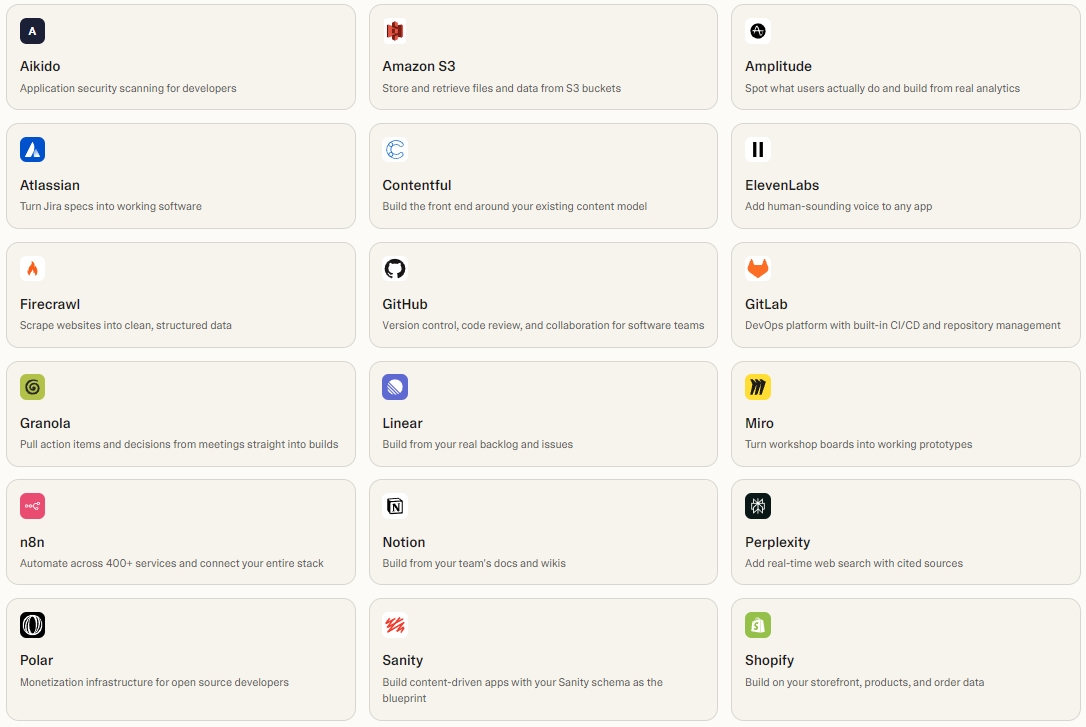
Lovable's integration layer connects the generated application to external services. The GitHub integration is bidirectional: you can push changes from Lovable to a repository and pull changes made locally back into the platform. This works through a GitHub App installation with scoped permissions. The platform creates a .github/workflows/ci.yml that runs type-check, lint, and tests on every push.
Stripe integration covers subscriptions, one-time payments, and webhooks. When you prompt Lovable to add a pricing page, it generates the checkout session creation endpoint, the success/cancel pages, and the webhook handler for subscription events. The database schema includes tables for customers, subscriptions, and prices with appropriate RLS policies.
Figma integration works in one direction: you can import designs as React components. The AI analyzes the Figma file structure and generates corresponding Tailwind-styled components. The fidelity depends on how closely the Figma file follows auto-layout and component conventions. Complex designs with absolute positioning often require manual cleanup.
Other integrations include SendGrid for transactional email, Sentry for error tracking, and Vercel for deployment. Each integration adds the necessary environment variables, client initialization code, and TypeScript types. The platform manages secrets through Supabase Vault, so keys never appear in the generated source code.
Deployment and Hosting Options
Lovable deploys to Vercel by default. The platform creates a vercel.json with build output configuration, environment variable mapping, and edge function routing for Supabase functions. Custom domains are configured through the Vercel dashboard or via the Lovable interface for paid plans. The deployment pipeline runs on every push to the connected GitHub branch.
You are not locked into Vercel. The build output is a standard Vite production bundle that runs on any static hosting provider — Netlify, Cloudflare Pages, AWS Amplify, or a traditional CDN with a Node server for API routes. The only platform-specific code is the vercel.json, which you can delete or replace.
Scroll horizontally to see all columns
| Target | Support Level | Notes |
|---|---|---|
| Vercel | Native | Zero-config, edge functions, preview deployments |
| Netlify | Manual config | Add netlify.toml, configure redirects |
| Cloudflare Pages | Manual config | Workers for API routes, D1 for database |
| Docker/Node | Full control | Build standalone, run anywhere |
| Static export | Limited | No server routes, client-only auth |
Environment variables are managed per environment in Vercel. Lovable syncs the Supabase URL, anon key, and service role key automatically. Stripe keys, SendGrid API keys, and Sentry DSN are added when you enable those integrations. The platform never commits secrets to the repository.
Developer Experience: Local Development and CI
Cloning a Lovable project locally gives you a standard Node.js project. Run npm install, copy .env.example to .env with your Supabase credentials, and npm run dev starts the Vite dev server. The Supabase CLI can run a local database instance for offline development, though most developers use the hosted project for simplicity.
The generated package.json includes scripts for type-checking (tsc --noEmit), linting (eslint), formatting (prettier --check), and testing (vitest). The GitHub Actions workflow runs these checks on every pull request. This means you can develop locally with the same quality gates that protect the main branch.
- npm run dev — Vite dev server with HMR
- npm run build — Production build to dist/
- npm run preview — Preview production build locally
- npm run lint — ESLint with React and TypeScript rules
- npm run typecheck — TypeScript compiler check
- npm run test — Vitest unit and integration tests
- npm run db:push — Push schema changes to Supabase
One friction point: the Supabase service role key is required for certain admin operations (user management, storage bucket creation). This key should never be used in client code. The generated project separates client and server environments clearly, but you must be careful not to expose the service role key in Vite's client bundle (VITE_ prefix). Use the Supabase dashboard for admin tasks when possible.
Extending the Generated Codebase
The most common question developers ask is whether they can extend Lovable-generated code without breaking the AI's ability to continue working on the project. The answer is yes, with caveats. The AI understands the existing codebase by reading files. As long as you follow the established patterns — TypeScript interfaces, component structure, query key conventions — the AI will generate compatible code.
Breaking changes happen when you introduce patterns the AI doesn't recognize. For example, switching from TanStack Query to SWR, or replacing Zustand with Redux Toolkit, will confuse the generator. It may produce code that imports the old libraries or mixes patterns. If you plan significant architectural changes, consider ejecting from Lovable and maintaining the project independently.
The AI also respects manual edits to existing files up to a point. If you modify a component's logic but keep the same interface, subsequent generations will preserve your changes. However, if you ask the AI to redesign that component, it may overwrite your work. The platform shows a diff before applying changes, so you can review and reject unwanted modifications.
Limitations and Trade-offs
No platform is without constraints. Lovable's opinionated stack means you cannot choose Vue, Svelte, or Solid. The backend is tied to Supabase — you cannot swap in Firebase, PlanetScale, or a custom Node/Go/Rust API without ejecting. For teams with existing investments in other stacks, this is a dealbreaker.
The AI's knowledge cutoff creates a maintenance burden. Libraries evolve. React 19, Tailwind v4, and TanStack Query v5 introduce breaking changes that the AI may not know about. You will need to upgrade dependencies manually and fix the resulting type errors. This is normal for any generated codebase, but it's worth factoring into your timeline.
Generated code is a starting point, not a finished product. Plan for the same refactoring and hardening you would do on any codebase you inherit.
Performance of the generated application is generally good because the stack is modern and the patterns are standard. However, the AI does not automatically implement advanced optimizations — virtualized lists, code splitting beyond route level, image optimization, or service workers. These are manual additions. The platform gives you a solid baseline; production hardening remains your responsibility.
When to Use Lovable vs. Traditional Development
Lovable shines for rapid prototyping, internal tools, MVPs, and projects where the team wants to move from idea to deployed application in hours rather than weeks. The AI handles boilerplate — auth, CRUD, routing, styling — so you can focus on business logic. Non-technical founders can build functional prototypes without hiring a development team initially.
Traditional development remains better for highly customized architectures, performance-critical applications, teams with strong existing stack preferences, and projects requiring deep integration with legacy systems. The time saved by AI generation diminishes as the project diverges from the platform's opinions.
Scroll horizontally to see all columns
| Factor | Favors Lovable | Favors Custom |
|---|---|---|
| Team React/TypeScript experience | Low to medium | High |
| Time to market pressure | High | Low |
| Architecture flexibility needed | Low | High |
| Existing backend investment | None | Significant |
| Long-term maintenance team | Small or solo | Large, specialized |
| Regulatory/compliance needs | Standard | Complex |
A hybrid approach works for many teams: use Lovable to scaffold the initial application with auth, database, and core CRUD, then eject and continue development locally. The generated code is clean enough that this transition is smooth. You lose the AI assistance but gain full control.
Pricing Tiers and What They Unlock
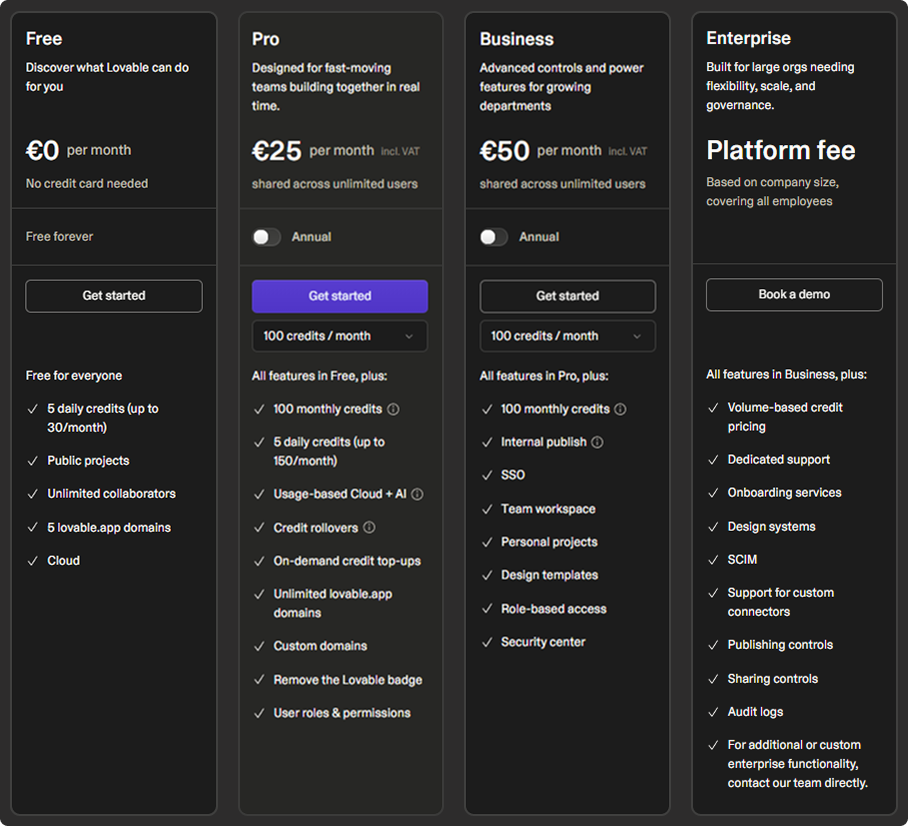
Lovable offers a free tier with limited daily generations, a Pro tier with higher limits and priority access, and an Enterprise tier with dedicated support, SSO, and custom contracts. The free tier is sufficient for learning the platform and building small projects. Pro becomes necessary when you hit the generation cap during active development.
All tiers generate the same code stack. The differences are in usage limits, deployment features (custom domains, preview deployments), and support SLAs. There are no feature flags in the generated code that restrict functionality based on your plan. This is a refreshing contrast to platforms that lock core capabilities behind enterprise tiers.
Team plans add seat-based billing and shared workspaces. Each member can collaborate on the same project with their own generation quota. The platform handles merge conflicts gracefully because each generation creates a new commit on a feature branch that you review before merging.
Educational discounts are available for students and educators. The application process requires verification through a .edu email or institutional affiliation. This makes the platform accessible for coursework and academic projects where budget is constrained.
Community, Documentation, and Support
Lovable's documentation covers the generated stack comprehensively — not just how to use the platform, but how to work with the code it produces. Guides explain Supabase RLS patterns, TanStack Query invalidation strategies, and Vercel deployment troubleshooting. The documentation is written for developers who need to maintain the output, not just for users who stay in the chat interface.
The community Discord is active with both Lovable staff and power users. Common questions get quick answers. The team shares upcoming features and breaking changes in advance. There is also a public roadmap where users vote on priorities. This transparency helps you plan around platform changes.
Support response times vary by tier. Free users rely on community and documentation. Pro users get email support with 24-hour SLA. Enterprise users get dedicated Slack channels and scheduled reviews. For most technical issues, the community and documentation are faster than formal support channels.
The platform also publishes a blog with deep dives on specific features — how the AI handles multi-file edits, how Supabase migrations are generated, how the GitHub sync works. These articles are valuable even if you don't use Lovable, because they explain practical patterns for AI-assisted development.
Migration Path: From Lovable to Independent Codebase
Ejecting from Lovable is straightforward because there is no proprietary runtime. The project is a standard Vite + React + TypeScript application with Supabase as a backend service. You clone the repository, remove the vercel.json if you are not using Vercel, and continue development. The only platform-specific dependency is the Lovable GitHub App for sync, which you can uninstall.
Before ejecting, verify that all environment variables are documented in .env.example. The platform manages some secrets automatically (Supabase service role for migrations), and these may not be in the example file. Create a checklist of required variables for each environment: development, staging, production.
- Clone the GitHub repository to your organization
- Remove .github/workflows/lovable-sync.yml if present
- Update vercel.json or create netlify.toml for your target
- Document all environment variables in .env.example
- Set up your own CI/CD pipeline
- Configure Supabase project ownership transfer if needed
- Update DNS for custom domains
- Remove Lovable GitHub App installation
Supabase project ownership is the only potential sticking point. If the project was created under Lovable's organization, you may need to transfer it to your own Supabase account. This is a manual process through Supabase support. Plan for this before you need to eject urgently.
After ejection, you lose the AI generation capability but gain complete freedom. The codebase does not degrade — it is standard React/TypeScript that any developer can maintain. Many teams use Lovable for the initial 80% and then take over for the final 20% of customization.
Final Assessment of Lovable Dev Languages
Lovable's language choices reflect a coherent, modern full-stack React ecosystem: TypeScript for safety, React for component model, Vite for speed, Tailwind for styling, Supabase for backend, and TanStack Query for server state. These are not arbitrary picks — they are the current consensus for productive React development. The platform's value is assembling them correctly and generating the glue code that connects them.
The stack is opinionated by design. You get React, TypeScript, and Supabase whether you want them or not. For teams aligned with these choices, Lovable removes days of setup and boilerplate. For teams committed to Vue, Go, or PostgreSQL without Supabase, the platform is not a fit. There is no configuration to change the output language or framework.
The generated code quality is high enough for production use with the usual caveats: review the AI output, add tests, harden security policies, and optimize performance for your specific load patterns. The platform gives you a running start, not a finished race. Whether that start is worth the subscription cost depends on how much you value the time saved versus the flexibility lost.
Frequently Asked Questions
Can I use Lovable with a backend other than Supabase?
No. The platform generates code that assumes Supabase for database, auth, realtime, and edge functions. You can replace the backend after ejecting, but the AI will continue generating Supabase-specific code while you use the platform.
Does Lovable support Vue, Svelte, or plain JavaScript?
The generated code is always React with TypeScript. There is no option to change the frontend framework or language. The system prompt locks the AI to this stack.
What happens to my code if I cancel my subscription?
Your GitHub repository and Supabase project remain yours. You lose access to the Lovable chat interface and generation credits, but the code continues to work. You can develop locally or deploy independently.
Can I use my own AI API keys with Lovable?
No. The platform uses its own Anthropic and OpenAI accounts. You cannot bring your own keys or choose specific model versions.
How does Lovable handle database migrations?
When you ask for schema changes, Lovable generates SQL migration files and applies them to your Supabase project. The TypeScript types are regenerated automatically. You can also write migrations manually in the Supabase dashboard.
Is the generated code compatible with React Native?
Not directly. The output targets web (Vite, React DOM, Tailwind). You could share business logic and types, but components and styling would need rewriting for React Native.
What version of React and TypeScript does Lovable use?
As of writing, projects use React 18 and TypeScript 5.x. The platform updates these dependencies periodically. Check the generated package.json for exact versions in your project.