

AI Development Tools
Lovable vs V0: Which AI App Builder Fits Your Workflow
A practical breakdown of two leading AI-powered development platforms for building React applications.


Senior Software Developer & Trading Technology Specialist
Ethan Parker is a software developer with over 8 years of experience in building web applications, trading tools, and financial technology solutions. He specializes in Python, JavaScript, API integrations, and trading automation, helping traders improve efficiency through innovative technology.
AI app builders have moved from novelty to necessity in the last year. Two names keep surfacing in conversations among founders, product managers, and developers who want to ship faster: Lovable and V0. Both promise to turn natural language into working React applications. Both integrate with modern tooling like Supabase, Tailwind, and Vercel. But they approach the problem from different angles, and those differences show up quickly once you move past a hello-world prototype.
Contents
- 1. What Lovable Actually Does
- 2. What V0 Actually Does
- 3. Core Philosophy Differences
- 4. Interface and Daily Workflow
- 5. Code Generation Quality
- 6. Backend and Database Handling
- 7. Authentication: Built-In vs Bring Your Own
- 8. Deployment and Hosting
- 9. Pricing Comparison
- 10. Team Collaboration Features
- 11. Learning Curve and Documentation
- 12. Use Cases Where Each Excels
- 13. Community and Ecosystem
- 14. Limitations You'll Hit
- 15. Code Ownership and Portability
- 16. AI Model Quality and Prompting
- 17. Final Assessment: Lovable vs V0
I've spent time with both platforms building real features — authentication flows, dashboards, data-heavy internal tools, and customer-facing landing pages. The short version: Lovable feels like a product engineer who wants to own the full stack. V0 feels like a senior frontend developer who hands you clean components and expects you to wire up the rest. Neither is universally better. The right choice depends on how much of the stack you want managed for you, how comfortable you are reading generated code, and whether you're building for yourself or a team.
This comparison covers the practical differences that show up in day-to-day work: code quality, backend handling, deployment, pricing, team workflows, and the moments where each platform saves or costs you time. I'll reference specific examples from actual builds rather than marketing claims.
What Lovable Actually Does
Lovable positions itself as a full-stack AI engineer. You describe what you want in plain English — "build a SaaS dashboard with user authentication, Stripe billing, and a Postgres database" — and it generates a complete project: React frontend, Supabase backend, authentication, database schema, edge functions, and deployment configuration. The platform maintains a persistent project state. You iterate by chatting with it, and it modifies files across the codebase accordingly.
The key architectural decision is that Lovable owns the project structure. It creates a Vite + React + TypeScript codebase with a conventional folder layout. Supabase integration is native — not an afterthought. When you ask for authentication, it sets up the auth tables, Row Level Security policies, email templates, and the frontend auth flow in one go. When you ask for a dashboard with charts, it installs Recharts, creates the components, and hooks them to Supabase queries.
You can view and edit the generated code directly in the browser-based IDE. Changes you make manually persist alongside AI changes. There's a GitHub sync feature that pushes the project to a repository you own, which means you can clone locally, run your own CI/CD, and treat it like any other codebase. The platform also includes a visual editor for certain UI adjustments, though I've found the chat interface more precise for complex changes.
What V0 Actually Does
V0, from Vercel, takes a different approach. It's a generative UI tool that produces React components — specifically, shadcn/ui components built with Tailwind CSS and Radix UI primitives. You describe a UI pattern: "a data table with sorting, filtering, and row selection" or "a multi-step onboarding form with validation" — and V0 returns production-ready component code. It doesn't create a project. It doesn't set up a database. It doesn't configure authentication. It gives you the frontend piece.
This is intentional. V0's philosophy is that developers want control over their stack. The generated components are copy-paste ready for any Next.js, Vite, or Remix project. They follow shadcn/ui conventions, which means they're customizable, accessible, and don't lock you into a proprietary component library. V0 also supports generating entire pages and layouts, but the mental model remains: you get frontend code, you integrate it.
V0 chat maintains context within a conversation, so you can refine a component iteratively — "make the table density compact," "add a column for status badges," "switch to server components." But each conversation is essentially stateless between sessions. There's no persistent project file system. You export code when you're satisfied and bring it into your own repository.
Core Philosophy Differences
The fundamental split is project ownership versus component delivery. Lovable wants to be your project. V0 wants to be your component library generator. This shows up in dozens of small ways.
Scroll horizontally to see all columns
| Aspect | Lovable | V0 |
|---|---|---|
| Output | Full project with backend | Frontend components only |
| State persistence | Persistent project files | Conversation-scoped |
| Backend setup | Native Supabase integration | None — you provide it |
| Deployment | One-click to Lovable cloud or Vercel | Manual — your pipeline |
| Code access | Browser IDE + GitHub sync | Copy-paste or download |
| Lock-in risk | Moderate (project structure) | Low (standard components) |
If you're a solo founder who wants to go from idea to deployed SaaS without touching infrastructure, Lovable's integrated approach saves weeks. If you're a frontend engineer on a team that already has a Next.js codebase, Supabase project, and CI/CD pipeline, V0's component-focused output fits your workflow without disruption.
Interface and Daily Workflow
Lovable's interface is a split view: chat on the left, file tree and code editor on the right, live preview at the bottom or in a separate tab. You type a request, watch files change in real time, and test in the preview. The chat history serves as a project log — you can scroll back to see what you asked for and when. There's a version history sidebar that lets you revert to previous states, which has saved me more than once when the AI went off track.
V0's interface is cleaner but simpler: a chat panel on the left, generated code on the right. No file tree, no live preview of a running app (though there's a component preview), no version history beyond the chat scroll. You copy the code when it looks right. The simplicity is deliberate — V0 doesn't need a file tree because it doesn't manage files. But it also means you lose the ability to say "revert the auth changes from three prompts ago" without manually finding that message.
One workflow difference that surprised me: Lovable encourages you to stay in its environment. You can run the dev server, see console logs, and even open browser dev tools on the preview. V0 expects you to leave. The workflow is: generate → copy → paste into your IDE → run locally → iterate. For developers who live in VS Code with Copilot, this feels natural. For product managers or designers who want to see a working thing without opening a terminal, Lovable's integrated preview is a meaningful advantage.
Both platforms handle follow-up prompts well, but Lovable's persistent state means it remembers your database schema, your component naming conventions, and your styling preferences across sessions. V0 starts fresh each conversation, though you can paste previous context or reference earlier components. For long-running projects, Lovable's memory is a genuine productivity multiplier.
Code Generation Quality
This is where opinions diverge sharply. Lovable generates a lot of code — sometimes too much. A simple feature request can touch ten files: routes, components, hooks, types, Supabase migrations, edge functions. The code is functional and follows reasonable conventions, but it's verbose. I've seen it create three custom hooks where one would do, or generate separate API route files for operations that could share a pattern. The upside: everything works together because it was generated in one pass. The downside: refactoring AI-generated sprawl takes time.
V0 generates less code by definition — just the component and its immediate dependencies. But the code quality is consistently higher. Components follow shadcn/ui patterns exactly: proper TypeScript interfaces, Radix primitives for accessibility, Tailwind classes organized logically, no unnecessary abstractions. The generated code reads like something a careful senior developer wrote. You can drop it into a codebase with confidence that it won't introduce weird bugs or style inconsistencies.
Lovable writes the code you'd write if you were rushing. V0 writes the code you'd write if you had time to care about craft.
That said, Lovable's code has improved noticeably over the last six months. Early versions produced fragile prop-drilling and inconsistent state management. Current output uses React Query for server state, Zustand for client state, and a consistent component composition pattern. It's not bad code — it's just more code than you'd write by hand, and some of it solves problems you might not have.
V0's limitation is scope. It generates a beautiful data table, but you still need to write the API route, the database query, the loading state, the error boundary, and the pagination logic. Lovable generates all of that in one go. The question is whether you'd rather review and trim a complete feature or assemble a feature from high-quality pieces.
Backend and Database Handling
This is Lovable's clearest win. Native Supabase integration means you describe data requirements in natural language — "users can create projects, projects have tasks, tasks have assignees and due dates" — and Lovable creates the tables, relationships, RLS policies, TypeScript types, and the frontend hooks to query and mutate that data. It handles migrations incrementally. When you ask for a new field, it generates a migration file and updates the types.
The RLS policy generation is particularly valuable. Writing correct row-level security policies by hand is error-prone. Lovable produces policies that actually work for common patterns: users see their own data, team members see team data, admins see everything. You can still review and adjust them, but the starting point is solid.
V0 has no backend story. Zero. You bring your own database, your own ORM, your own API layer. If you're using Supabase, you write the SQL, the types, and the client calls yourself — or you use Supabase's own AI assistant separately. Some developers prefer this separation. They argue that backend schema changes should be deliberate, version-controlled, and reviewed, not generated from a chat prompt. That's a valid architectural stance. But for speed, Lovable's integrated approach is hard to beat.
Authentication: Built-In vs Bring Your Own
Authentication is the feature that most exposes the philosophy difference. Lovable: you say "add auth with email/password and Google OAuth," and it configures Supabase Auth, creates the login/signup/reset pages, sets up protected routes, adds the auth context provider, and wires up the UI. Done. You can customize the styling, add fields to the signup flow, or swap providers through chat.
V0: you ask for a login form, and it gives you a beautiful shadcn/ui login form component with validation, loading states, and accessible markup. You then connect it to your auth provider — Supabase, Clerk, Auth.js, Firebase, whatever. The component is better designed than what Lovable generates by default. But you do the integration work.
For a team with an established auth strategy, V0's approach respects that investment. For a new project, Lovable's five-minute auth setup is compelling. I've seen Lovable generate auth flows that handle edge cases (email verification redirects, password reset flows, session persistence) correctly on the first try. That's hours saved.
Deployment and Hosting
Lovable offers one-click deployment to its own hosting (lovable.app subdomains) or to Vercel with automatic configuration. The Vercel integration detects the project type, sets build commands, configures environment variables from Lovable's secrets manager, and links the repository. Custom domains work on both targets. There's also a GitHub Pages option for static exports.
V0 doesn't deploy anything. It generates components for your Next.js app, and you deploy your Next.js app however you normally would — Vercel, Netlify, AWS, Docker, whatever. This isn't a deficiency; it's a boundary. V0 stops at code generation.
Lovable's deployment convenience comes with a caveat: the Lovable cloud hosting is fine for prototypes and internal tools, but I wouldn't run a production SaaS on it yet. The Vercel deployment path is the serious option, and it works well. Environment variable management through Lovable's UI is convenient for non-technical collaborators who shouldn't have Vercel dashboard access.
One deployment workflow I appreciate: Lovable's GitHub sync means every chat-driven change can be committed to a branch, triggering your normal CI/CD. You get the speed of AI iteration with the safety of your existing pipeline. V0 requires you to manually commit the pasted code, which is fine but adds friction for rapid iteration.
Pricing Comparison
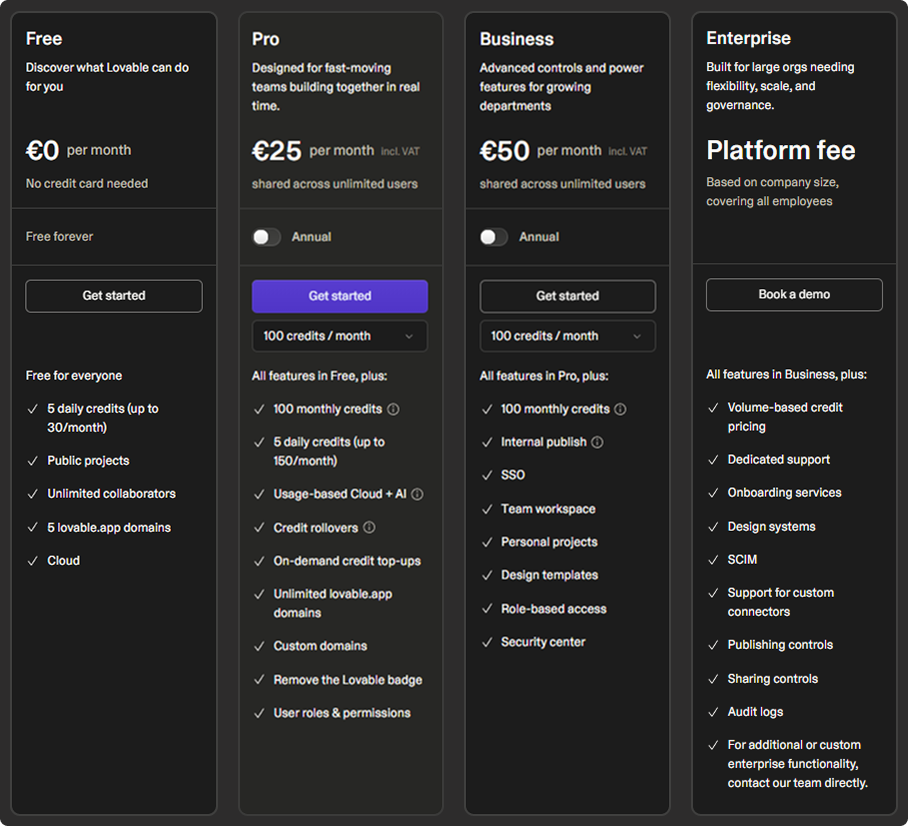
Lovable uses a credit-based model. The Free tier gives 50 credits monthly — enough for a small prototype. Pro at $20/month gives 500 credits. Launch at $50/month gives 2,000 credits. Scale at $100/month gives 5,000 credits. Enterprise is custom. Credits consume based on AI requests, file operations, and preview runtime. A typical feature build might cost 10-50 credits depending on complexity.
V0 is currently free during its beta/preview phase, with generous limits. Vercel has indicated paid tiers will come, likely tied to Vercel usage or a standalone subscription. For now, V0 is effectively free for individual developers. This makes the comparison lopsided on cost, but pricing models change.
Scroll horizontally to see all columns
| Plan | Lovable | V0 |
|---|---|---|
| Free tier | 50 credits/month | Generous beta access |
| Paid entry | $20/mo (500 credits) | TBA |
| Mid tier | $50/mo (2,000 credits) | TBA |
| High tier | $100/mo (5,000 credits) | TBA |
| Model | Credit-based consumption | Likely subscription |
The credit model means Lovable costs scale with usage intensity. A team building multiple features daily will hit limits faster than a solo founder shipping weekly. V0's eventual pricing will likely be per-seat or usage-based on Vercel's platform. Factor this in if you're budgeting for a team.
Team Collaboration Features
Lovable has built-in team workspaces. Multiple members can chat with the AI on the same project, see each other's prompts, and work in parallel — though parallel editing of the same files creates conflicts. There's a comment system on the preview for design review. Non-technical stakeholders can leave feedback without touching code. The GitHub sync means developers can pull changes, review locally, and push fixes that merge back into the Lovable project.
V0 has no team features in the traditional sense. You share conversations via link. Team members can fork a conversation and continue from there. But there's no shared project state, no collaborative editing, no review workflow. For a design-system team generating component variants, this works fine — each person generates what they need. For a product team building a feature together, Lovable's shared project is more practical.
Learning Curve and Documentation
Lovable has a steeper initial learning curve because there's more surface area: the chat interface, the file editor, the preview, the Supabase dashboard, the deployment settings, the GitHub sync, the secrets manager, the team settings. The documentation covers all of it, but you're learning a platform, not just a tool. The payoff is that once you're fluent, you can build entire features without leaving the environment.
V0's learning curve is nearly flat. If you know React and Tailwind, you understand the output immediately. The documentation is essentially "describe what you want." There are prompting tips — be specific about variants, mention shadcn/ui component names, specify server vs client components — but the mental model is trivial. The depth comes from knowing how to integrate the output, which is your existing knowledge.
Both platforms have active Discord communities. Lovable's is more diverse — founders, designers, PMs, developers. V0's skews heavily frontend engineers. For troubleshooting weird AI behavior, Lovable's community has more varied workarounds. For component-level questions, V0's community gives precise technical answers.
Use Cases Where Each Excels
After building with both, certain patterns emerged where one clearly outperforms the other.
- Lovable wins for: MVP SaaS products with auth, billing, and dashboard; internal tools with CRUD interfaces; founder-led projects with no engineering team; rapid prototyping for investor demos; projects where Supabase is the chosen backend.
- V0 wins for: Design system component generation; adding polished UI to existing Next.js apps; marketing pages and landing pages; component library maintenance; teams with strong frontend architecture opinions; accessibility-first projects where shadcn/ui's Radix foundation matters.
- Both handle adequately: Simple dashboards with charts; forms with validation; data display components; authentication UI (Lovable does the backend, V0 does the frontend).
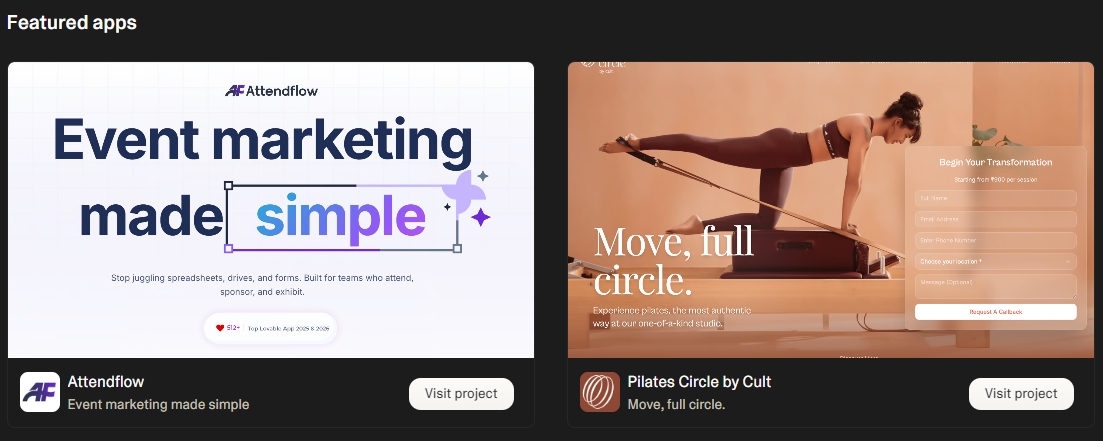
The hybrid approach is also real. I know teams that use Lovable to scaffold the full-stack skeleton — auth, database, routing, deployment — then switch to V0 for designing specific complex components like a kanban board or a sophisticated data grid, then paste those components back into the Lovable project. This works because both output standard React/TypeScript/Tailwind code.
There's no technical barrier to mixing them. The code is portable. The friction is context-switching between two chat interfaces and two mental models. For solo builders, picking one and going deep usually beats splitting attention.
Community and Ecosystem
Lovable has invested heavily in community: templates marketplace, community showcases, partner program, affiliate system, student discounts, and regular hackathons. The template library covers common SaaS patterns — CRM, project management, e-commerce, analytics dashboards. You can clone a template and customize it, which is often faster than prompting from scratch. The partner program connects agencies and freelancers with clients.
V0's ecosystem is the shadcn/ui ecosystem. Every component V0 generates is a shadcn/ui component. The entire Radix UI + Tailwind + TypeScript ecosystem applies. There are thousands of community components, extensive documentation, and a mature pattern library. V0 doesn't need its own template marketplace because the shadcn/ui community already provides patterns for almost everything.
Lovable's templates are more opinionated and full-stack. A "SaaS starter" template includes auth, billing, dashboard, settings, and landing page. A shadcn/ui pattern is just the dashboard UI. Different levels of abstraction for different needs.
Limitations You'll Hit
Both platforms have sharp edges. Knowing them upfront saves frustration.
- Lovable: Credit costs can spike during exploratory prompting; AI sometimes rewrites working code when you only wanted a small change; Supabase integration assumes you want Supabase (no PlanetScale, Neon, or raw Postgres); mobile responsiveness sometimes needs manual fixes; complex state management patterns (wizards, multi-step flows) can get messy; the browser IDE lacks advanced refactoring tools.
- V0: No project memory between sessions; no backend generation at all; component preview doesn't show real data states; accessibility is good but not perfect — test with screen readers; server component generation is improving but still inconsistent; no built-in way to manage design tokens across generated components; you'll copy-paste the same import boilerplate repeatedly.
The Lovable credit issue is real. During a two-hour building session with lots of "try this, no try that" prompting, I burned 200 credits. The Pro tier's 500 credits/month lasts about a week of active building. The Launch tier at $50 is the practical minimum for serious work. V0's current free access makes this a non-issue today, but assume it won't last.
Code Ownership and Portability
This matters for any serious project. Lovable's GitHub sync gives you a standard Vite + React + TypeScript repository. The only Lovable-specific code is a thin client library for realtime preview and some environment configuration. You can eject completely — clone the repo, remove the Lovable scripts, and you have a normal codebase. The Supabase project is yours. The Vercel project is yours. There's no vendor lock-in at the infrastructure level.
V0 has zero lock-in by design. You copy components into your repo. They have no runtime dependencies on V0. If Vercel shuts down V0 tomorrow, your components keep working. The shadcn/ui license is permissive. This is the strongest portability story possible.
One subtle point: Lovable's generated code includes patterns and conventions that are "Lovable-style" — specific hook names, component organization, state management choices. If you eject and continue manually, you'll either maintain those patterns or refactor them. V0's components follow shadcn/ui conventions, which are widely recognized and documented. A new developer joining a V0-influenced codebase will recognize the patterns faster.
Lovable gives you a codebase you can own. V0 gives you components you already understand.
AI Model Quality and Prompting
Both platforms use frontier models (Claude, GPT-4 variants) but with different system prompts and tooling. Lovable's system prompt includes the full project context: file tree, recent changes, database schema, environment variables. This context window advantage means it can make cross-file changes coherently — updating a database migration, the TypeScript types, the API route, and the frontend component in one prompt.
V0's context is the conversation history and the shadcn/ui component library documentation. It doesn't know your project. This means you must be explicit about your design system: "use our custom button variant," "follow our color tokens," "use the existing Table component from @/components/ui/table." V0 can't infer these things.
Prompting skills transfer but differ. Lovable rewards high-level feature descriptions: "add a team invitation flow with email notifications and role selection." V0 rewards component-level specificity: "create a combobox for role selection with search, using our design token variables, following the Select component pattern." The first is product thinking. The second is frontend engineering thinking.
Final Assessment: Lovable vs V0
If you're building a new full-stack application and want to move from idea to deployed product with minimal infrastructure decisions, Lovable is the stronger choice. Its integrated Supabase backend, authentication, deployment, and project persistence remove entire categories of work. The credit cost is the price of that integration. For a solo founder or small team shipping a SaaS MVP, the $50/month Launch tier pays for itself in saved engineering hours within the first week.
If you're a frontend engineer or team with an existing React/Next.js codebase, established backend, and deployment pipeline, V0 is the better tool. It generates higher-quality components faster than you'd write them, respects your architectural decisions, and introduces zero lock-in. The current free access makes it a no-brainer to try. Even when paid tiers arrive, the per-seat value for a frontend team is clear.
The hybrid workflow — Lovable for scaffolding, V0 for component refinement — is viable but adds context-switching overhead. Most teams will pick one primary tool based on their starting conditions. Start with the platform that matches your current gap: full-stack scaffolding (Lovable) or component velocity (V0). You can always bring the other in for specific tasks later.
Frequently Asked Questions
Can I use Lovable and V0 together on the same project?
Yes. Both generate standard React/TypeScript/Tailwind code. You can scaffold with Lovable, then generate specific components with V0 and paste them into the Lovable project. The code is fully portable.
Does V0 support backend generation like Lovable?
No. V0 only generates frontend components. You must provide your own backend, database, authentication, and API layer. Lovable includes native Supabase integration for all of these.
Which platform produces better code quality?
V0 consistently produces cleaner, more idiomatic component code following shadcn/ui patterns. Lovable generates more code across the full stack, which can be verbose but works together cohesively.
Is Lovable's credit system expensive for active development?
The Pro tier (500 credits/$20) suits light usage. Serious daily building typically needs the Launch tier (2,000 credits/$50) or Scale tier (5,000 credits/$100). Credits consume on AI requests, file operations, and preview runtime.
Can I export my Lovable project and continue without Lovable?
Yes. GitHub sync gives you a standard Vite + React + TypeScript repository. The Supabase project and Vercel deployment are yours. You can eject completely and maintain the codebase independently.
Does V0 require a Vercel account?
V0 is a Vercel product and works best with a Vercel account, but you can use generated components in any React/Next.js project deployed anywhere. The components have no runtime dependency on Vercel.
Which is better for non-technical founders?
Lovable. Its integrated preview, visual editor, chat-driven workflow, and full-stack generation let non-technical builders ship working applications without writing code. V0 requires frontend integration knowledge.
How do the communities compare for support?
Lovable's community includes founders, designers, PMs, and developers — broader but less technically deep. V0's community is primarily senior frontend engineers — narrower but with deeper technical expertise for component-level questions.