

AI Development Tools
Lovable France: AI App Builder for French Founders
Complete guide to Lovable's AI app builder for the French market, covering pricing, features, and local advantages.

Senior Software Developer & Trading Technology Specialist
Ethan Parker is a software developer with over 8 years of experience in building web applications, trading tools, and financial technology solutions. He specializes in Python, JavaScript, API integrations, and trading automation, helping traders improve efficiency through innovative technology.
French founders and product teams have watched the AI coding assistant space evolve rapidly over the past two years. Tools that generate React components, set up authentication, and deploy to production used to require stitching together multiple services. Lovable changed that equation by packaging the entire stack — frontend generation, backend provisioning, database setup, authentication, hosting, and custom domains — into a single conversational interface. For teams in Paris, Lyon, Bordeaux, or Lille, the platform now offers pricing in euros, data residency options that align with GDPR, and a growing community of French-speaking builders.
Contents
- 1. What Is Lovable and Why It Matters in France
- 2. Getting Started with Lovable in France
- 3. Lovable Pricing for French Users
- 4. Core Features: AI-Powered App Generation
- 5. Backend Integration with Supabase
- 6. Authentication and User Management
- 7. Hosting, Custom Domains, and Deployment
- 8. Security and GDPR Compliance for France
- 9. Lovable for French Founders and Product Managers
- 10. Community and Support in the French Market
- 11. Comparing Lovable to Alternatives in France
- 12. Integrations Relevant to French SaaS
- 13. Limitations and Honest Assessment
- 14. Final Assessment: Lovable in the French Context
The platform arrived in France at a moment when the local startup ecosystem is actively searching for ways to ship faster without expanding engineering headcount. French Tech initiatives, Bpifrance funding programs, and the rise of solo founder ventures have created demand for tools that compress the idea-to-MVP timeline from months to weeks. Lovable fits that niche by letting non-technical founders describe a product in natural language and watch a working application materialize in the browser, complete with a PostgreSQL database, row-level security, and a deployed URL.
What Is Lovable and Why It Matters in France
Lovable is an AI-powered application builder that generates full-stack web applications from natural language prompts. Unlike code assistants that operate inside an IDE, Lovable runs in the browser and manages the entire lifecycle: it writes React and TypeScript code, provisions a Supabase project for the backend, configures authentication providers, sets up row-level security policies, and deploys the result to a global edge network with a custom domain. The French market entry adds euro-denominated billing, French-language documentation, and compliance posture that respects European data protection requirements.
The significance for French teams goes beyond convenience. Many early-stage ventures in France operate with mixed technical and non-technical co-founders. A product manager in Station F can describe a marketplace concept on Monday, have a working prototype by Tuesday, and share a live link with potential users by Wednesday. That speed changes how French founders validate ideas, raise pre-seed rounds, and iterate based on real feedback rather than slide decks.
The platform's architecture relies on a few key technologies that French developers will recognize: React with TypeScript for the frontend, Vite as the build tool, Tailwind CSS for styling, and Supabase for the backend. This stack is already popular in the French developer community, which means teams can eject the code at any point and continue building with familiar tools. The generated codebase follows standard conventions — no proprietary runtime, no vendor lock-in at the code level.
Getting Started with Lovable in France
Signing up from France works the same way as anywhere else: visit the site, authenticate with GitHub or email, and start prompting. The onboarding flow asks about your role — founder, developer, designer, product manager — and tailors the initial experience accordingly. French users will notice the pricing page displays euros by default when accessed from a French IP address, and the free tier includes enough credits to build and deploy several small applications before hitting a paywall.
The first prompt is where most users feel the learning curve. Lovable responds best to structured descriptions: what the app does, who the users are, what data it stores, and what the key flows look like. A prompt like "Build a SaaS for French freelancers to invoice clients with Stripe payments, VAT calculation, and PDF export" produces a more complete starting point than "Make an invoicing app." The platform also accepts Figma links, screenshots, and rough wireframes as context, which designers in French agencies have found useful for handing off to developers.
After the initial generation, the interface splits into a chat panel on the left and a live preview on the right. Changes happen in real time — ask for a dark mode toggle, a new database table, or a Stripe checkout integration, and the preview updates within seconds. French teams working across time zones with contractors in Africa or North America appreciate that the shared project URL always reflects the latest state without manual deployments.
Lovable Pricing for French Users
Pricing is structured around monthly credits that power AI generations, with four tiers available in euros. The Free tier provides 50 credits per month — enough for experimentation and small prototypes. The Starter tier at €20 per month increases the allowance to 500 credits and adds priority generation speed. The Launch tier at €50 per month provides 2,000 credits, custom domains, and removes the Lovable branding from deployed apps. The Scale tier at €100 per month offers 5,000 credits, team collaboration features, and higher rate limits.
For French companies requiring dedicated infrastructure, SSO, audit logs, and custom contracts, the Enterprise tier operates on custom pricing. This tier includes data residency guarantees — a critical factor for French public sector contracts and regulated industries like fintech and healthtech where data must remain within EU borders. The enterprise sales team handles these discussions directly and can provide French-language contracts and invoices compliant with French accounting standards.
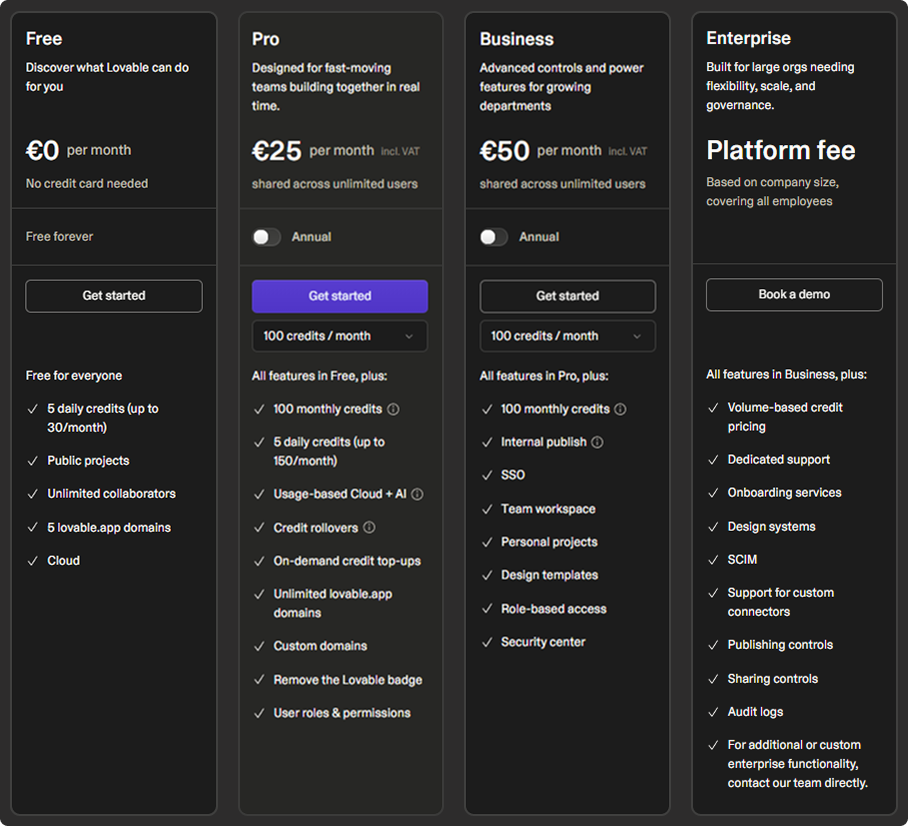
Credit consumption varies by complexity. A simple landing page might cost 5-10 credits. A multi-page SaaS with authentication, database schema, and payment integration could consume 100-200 credits for the initial build, with subsequent iterations costing 10-30 credits each. Teams quickly learn to batch related changes into single prompts to maximize credit efficiency. The platform shows remaining credits in the header, and email alerts fire at 80% and 100% usage.
Scroll horizontally to see all columns
| Tier | Monthly Price | Credits | Custom Domains | Team Features |
|---|---|---|---|---|
| Free | €0 | 50 | No | No |
| Starter | €20 | 500 | No | No |
| Launch | €50 | 2,000 | Yes | No |
| Scale | €100 | 5,000 | Yes | Yes |
| Enterprise | Custom | Custom | Yes | Yes |
Core Features: AI-Powered App Generation
The generation engine combines multiple AI models — primarily Claude and GPT variants — with a deterministic code synthesis layer that ensures the output compiles and runs. When you prompt for a feature, the system plans the necessary file changes, writes the code, runs type checking, and applies the result to the preview. If TypeScript errors appear, the engine attempts automatic fixes before presenting the result. This loop happens in seconds for most requests.
French developers who have used Cursor or GitHub Copilot will find the interaction model familiar but more ambitious in scope. Instead of completing a function or suggesting a component, Lovable creates entire routes, database migrations, API endpoints, and UI states in one go. The trade-off is less granular control during generation — you steer with follow-up prompts rather than editing code directly in the browser. However, the GitHub integration means you can clone the repository, make manual changes locally, and push them back. Lovable detects external changes and merges them into its internal state.
- Natural language to full-stack application generation
- Real-time preview with hot module replacement
- Automatic TypeScript compilation and error correction
- GitHub two-way sync for local development workflows
- Figma and screenshot import for design-to-code workflows
- Component library with shadcn/ui and Tailwind CSS primitives
- Responsive design defaults with mobile-first breakpoints
- Dark mode support generated automatically on request
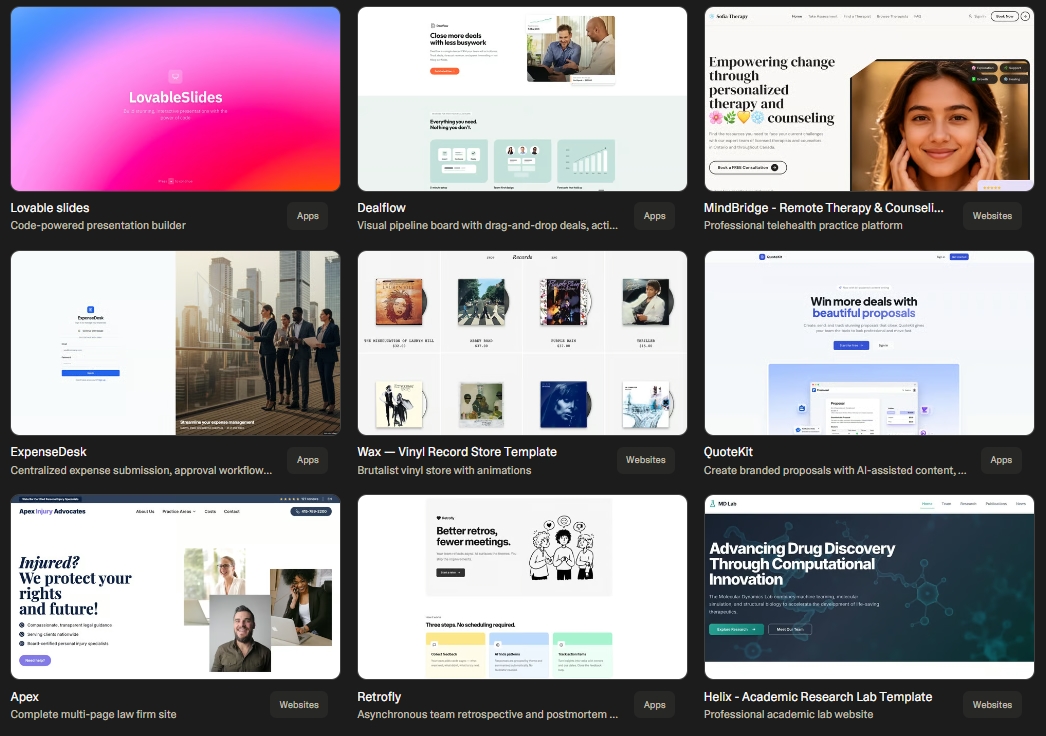
The component system builds on shadcn/ui, which means the generated UI components are accessible, customizable, and follow modern React patterns. French design teams appreciate that the output uses CSS variables for themming, making it straightforward to apply brand colors and typography. The platform also maintains a template gallery — starter kits for SaaS dashboards, marketplaces, directories, internal tools, and landing pages — each pre-configured with the appropriate database schema and authentication flow.
Backend Integration with Supabase
Every Lovable project provisions a Supabase project automatically. Supabase, built on PostgreSQL, provides the database, authentication, real-time subscriptions, storage, and edge functions. For French teams, this means the backend runs on infrastructure that can be hosted in EU regions — Frankfurt, London, or Paris — satisfying data residency requirements. The platform handles the Supabase project creation, schema migrations, row-level security policies, and API key management without exposing the complexity.
When you ask Lovable to add a feature like "user profiles with avatar upload," it creates the database table, the storage bucket, the RLS policies ensuring users only see their own data, the React components for the profile page, and the upload logic — all in one generation cycle. The Supabase dashboard remains accessible for direct database management, SQL queries, and monitoring. French developers who prefer writing raw SQL can do so; Lovable will detect schema changes on the next generation cycle.
The integration also supports Supabase Edge Functions for server-side logic that runs close to users. Lovable can generate Deno-based functions for webhooks, scheduled jobs, or third-party API integrations — useful for French SaaS products connecting to local payment providers like PayPlug or Mollie, or to French government APIs via FranceConnect.
Authentication and User Management
Authentication is one of the areas where Lovable saves the most time. The platform configures Supabase Auth with email/password, magic links, OAuth providers (Google, GitHub, GitLab, Azure, and more), and phone authentication via SMS. For French applications, the OAuth integration with Microsoft Entra ID (formerly Azure AD) is particularly relevant — many French enterprises use Entra ID for workforce identity, and B2B SaaS products often need to support enterprise SSO from day one.
The generated auth flow includes sign-up, login, password reset, email verification, and protected routes — all with proper redirect handling. Row-level security policies on the database enforce data isolation at the PostgreSQL level, not just in application code. This defense-in-depth approach matters for French fintech and healthtech applications where regulators expect database-level access controls.
- Email/password with secure password requirements
- Magic link authentication for frictionless login
- OAuth providers: Google, GitHub, GitLab, Microsoft, Apple
- Phone/SMS authentication via Twilio or Supabase native
- Enterprise SSO with SAML and OIDC (Enterprise tier)
- Multi-factor authentication with TOTP and WebAuthn
- Session management with configurable JWT expiry
- Automatic GDPR-compliant user data export and deletion
User management interfaces — admin dashboards for viewing users, impersonation for support, role-based access control — can be generated with a prompt like "Add an admin panel to manage users with role assignments and activity logs." The platform creates the necessary database tables, RLS policies, and React admin interface. French teams building B2B products find this valuable for delivering the admin features their enterprise customers expect without weeks of custom development.
Hosting, Custom Domains, and Deployment
Deployments happen automatically on every successful generation. The platform builds the Vite application, optimizes assets, and pushes to a global edge network with HTTPS, HTTP/2, and Brotli compression enabled by default. Free tier projects receive a subdomain on lovable.app. Launch, Scale, and Enterprise tiers support custom domains — configure DNS, and Lovable provisions the SSL certificate via Let's Encrypt automatically.
For French companies, the custom domain setup works with major French registrars like OVHcloud, Gandi, and Amen. The platform provides clear DNS instructions for A records and CNAME configurations. Enterprise customers can also bring their own certificates and configure advanced headers, CSP policies, and geo-routing rules. The edge network includes points of presence in Paris, ensuring low latency for users in metropolitan France and overseas territories.
Preview deployments for pull requests are available when the GitHub integration is connected. Each push to a feature branch generates a unique preview URL, allowing French product teams to share staging links with stakeholders before merging. The platform also supports environment variables — configure them in the Lovable dashboard, and they're injected at build time and available in Supabase Edge Functions.
Security and GDPR Compliance for France
Security architecture follows a shared responsibility model. Lovable secures the platform infrastructure, the build pipeline, the deployment network, and the default application headers. Supabase secures the database, authentication service, and real-time infrastructure. The application code — generated by AI but owned by you — is your responsibility to review. The platform encourages this by making the full codebase visible and exportable at any time.
GDPR compliance features are built into the Supabase layer: user data export via a single API call, right-to-be-forgotten deletion cascades through auth and storage, data processing agreements available for all tiers, and subprocessor transparency. For French companies subject to CNIL oversight, the ability to demonstrate technical measures — encryption at rest, encryption in transit, access logging, and data minimization — simplifies compliance documentation.
The platform also implements security headers by default: Content Security Policy, X-Frame-Options, Referrer-Policy, and Permissions-Policy. French security auditors (RSSI) will find these baseline protections adequate for most applications. Enterprise customers can customize headers further and enable additional protections like bot detection, rate limiting at the edge, and WAF rules.
Lovable for French Founders and Product Managers
Non-technical founders in France have historically faced a difficult choice: learn to code, find a technical co-founder, or pay an agency €30k-€100k for an MVP. Lovable introduces a fourth option — build the first version yourself in days, validate with real users, then decide whether to hire developers or continue iterating on the platform. Several French founders in the Station F and French Tech ecosystems have used this path to reach product-market fit before raising pre-seed rounds.
Product managers at French scale-ups use Lovable differently — not for production applications, but for rapid prototyping and internal tools. A PM at a French fintech can build a back-office dashboard for customer support in an afternoon instead of filing a ticket with the engineering team and waiting two sprints. The GitHub sync means engineers can review the prototype, extract reusable components, and integrate them into the main codebase without rewriting from scratch.
The shift from slide deck to working prototype in a single afternoon changes how French founders approach investor conversations. You show traction, not projections.
Designers in French agencies have adopted Lovable for client presentations. Instead of static Figma prototypes, they deliver clickable, data-driven demos that clients can interact with on their phones. The Figma import feature means design systems transfer directly — components, colors, spacing tokens — reducing the design-to-code handoff friction that plagues many French digital agencies.
Community and Support in the French Market
The French Lovable community has grown organically through Discord, Twitter/X, and local meetups. The official Discord includes a #france channel where builders share prompts, debug generation issues, and organize co-working sessions. French-language tutorials and prompt engineering guides have emerged from community members — not official documentation, but practical knowledge sharing that accelerates onboarding for new users.
Lovable's team participates in French tech events — VivaTech, French Tech events, and smaller community gatherings. The company has also launched a student program with French universities and coding bootcamps (Le Wagon, Wild Code School, 42) providing free credits for academic projects. This pipeline introduces the platform to the next generation of French developers before they enter the workforce.
- Discord #france channel for real-time help and showcase
- French-language community tutorials on YouTube and blogs
- Monthly virtual meetups for French builders
- Student credits program with French coding schools
- VivaTech and French Tech event presence
- GitHub Discussions for technical Q&A in English and French
- Email support with French-language responses on Enterprise tier
Support tiers vary by plan. Free and Starter users rely on community channels and documentation. Launch and Scale tiers receive prioritized email support with 24-hour response targets. Enterprise customers get a dedicated Slack channel, quarterly business reviews, and French-speaking technical account managers. The documentation is currently English-only, but the team has indicated French localization is on the roadmap for 2025.
Comparing Lovable to Alternatives in France
The French market has several alternatives at different abstraction levels. Bolt.new and v0.dev focus on frontend generation without backend provisioning — they produce React code but leave database, auth, and deployment to you. Replit offers a full IDE in the browser with AI assistance but requires more technical knowledge to orchestrate the stack. Cursor and GitHub Copilot are code-first tools for developers, not application builders for non-technical users.
Traditional French no-code platforms like Bubble, Webflow, and FlutterFlow operate at a higher abstraction level with visual editors. They excel at pixel-perfect design control and complex workflows but hit ceilings with custom logic, performance, and code ownership. Lovable sits in a different category: it generates real code you own, runs on standard infrastructure you control, and scales without platform migration. The trade-off is less visual control during generation — you describe intent rather than drag pixels.
Scroll horizontally to see all columns
| Platform | Code Ownership | Backend Included | GDPR Ready | French Pricing | Learning Curve |
|---|---|---|---|---|---|
| Lovable | Full | Yes (Supabase) | Yes | EUR | Low |
| Bolt.new | Full | No | Partial | USD | Low |
| v0.dev | Full | No | Partial | USD | Low |
| Replit | Full | Yes (built-in) | Partial | USD | Medium |
| Bubble | None | Yes (proprietary) | Yes | USD | Medium |
| Webflow | None | Limited | Yes | USD | Medium |
For French agencies building client projects, the code ownership distinction matters. With Lovable, you deliver a GitHub repository the client can host anywhere, modify with any developer, and maintain without ongoing platform fees. With Bubble or Webflow, the client remains tied to the platform's pricing and feature roadmap. This argument resonates with French procurement processes that favor open standards and vendor independence.
Integrations Relevant to French SaaS
French SaaS products often need integrations that differ from US-centric stacks. Lovable's generated code can connect to any REST or GraphQL API, but the platform has first-class integrations for the services French companies actually use. Stripe works globally, but French businesses also need PayPlug, Mollie, or GoCardless for SEPA direct debit. The AI can generate the integration code for these providers when prompted with the API documentation or a few example calls.
FranceConnect integration — the French government's identity provider used by 40 million citizens — is achievable through Supabase's OIDC support. Lovable can generate the authentication flow, token handling, and user profile mapping. This matters for French govtech, civic tech, and any B2G SaaS. Similarly, integration with French accounting APIs (Pennylane, QuickBooks France, Sage) follows the same pattern: describe the sync requirements, and the platform generates the webhook handlers and data models.
- Stripe (global cards, SEPA, local payment methods)
- PayPlug (French payment processor, popular with SMBs)
- Mollie (European payments, strong in France)
- GoCardless (SEPA direct debit for subscriptions)
- FranceConnect (government identity, OIDC integration)
- Pennylane / QuickBooks France / Sage (accounting sync)
- Sendinblue / Brevo (French email marketing, transactional)
- OVHcloud / Scaleway / Clever Cloud (French hosting alternatives)
The platform also generates code for French regulatory requirements: GDPR-compliant cookie consent banners (using didomi or tarteaucitron libraries), legal mentions pages (mentions légales), CGU/CGV templates, and accessibility compliance (RGAA) foundations. These aren't one-click features — you still need to customize the content — but the structural code saves hours of boilerplate work.
Limitations and Honest Assessment
Lovable is not a magic wand. Complex applications with intricate business logic, real-time collaboration features, or highly customized UI interactions will eventually require manual code intervention. The AI excels at CRUD applications, dashboards, marketplaces, directories, and content-driven products. It struggles with canvas-based editors, complex data visualizations, WebGL experiences, and anything requiring fine-grained control over rendering performance.
Credit costs can escalate for teams that iterate heavily without a clear product direction. A founder who prompts "make it blue" then "actually make it red" then "add a sidebar" burns credits on changes that a developer would handle in seconds locally. The platform rewards structured thinking — batch related changes, use the GitHub sync for fine-tuning, and treat credits as a budget for high-level feature generation rather than pixel-pushing.
The Supabase dependency is both a strength and a constraint. You get a battle-tested PostgreSQL backend with real-time, auth, and storage — but you're tied to Supabase's feature roadmap and pricing. If your application outgrows Supabase (multi-region writes, complex stored procedures, specific PostgreSQL extensions), migration is possible but non-trivial. French enterprises evaluating Lovable for long-term platforms should factor this into architecture decisions.
Final Assessment: Lovable in the French Context
Lovable fills a genuine gap in the French startup toolkit. For the solo founder in Nantes building a niche B2B SaaS, it compresses the MVP timeline from months to weeks. For the product manager at a Lyon scale-up, it unlocks internal tool velocity without engineering bottlenecks. For the agency in Bordeaux delivering client projects, it provides a code-ownership model that aligns with French procurement preferences. The euro pricing, EU data residency, and growing French community make it a credible local option rather than an imported tool with compliance friction.
The platform's trajectory suggests continued investment in the French market — localized documentation, French-speaking support, and integrations with the French digital ecosystem (FranceConnect, local payment providers, CNIL-aligned features). Teams adopting now benefit from early community influence on that roadmap. The main decision factor remains your product type: if you're building a standard web application with database, auth, and payments, Lovable is likely the fastest path to a production-ready French-market product. If you're building a game, a creative tool, or a highly specialized technical product, traditional development with AI-assisted coding (Cursor, Copilot) remains the better choice.
Frequently Asked Questions
Does Lovable support French language in the interface and documentation?
The interface and documentation are currently English-only. French-language documentation is on the roadmap for 2025. The AI understands French prompts and generates French-language UI text, error messages, and content when requested.
Can I host my Lovable application on French cloud providers like OVHcloud or Scaleway?
Yes. You own the generated code and can deploy it anywhere — OVHcloud, Scaleway, Clever Cloud, or your own infrastructure. The GitHub integration makes this straightforward: clone the repository, configure your CI/CD, and deploy. The Supabase backend remains hosted on Supabase's infrastructure (EU regions available), but you can also self-host Supabase if needed.
Is Lovable compliant with French GDPR requirements for health data (HDS certification)?
Supabase's infrastructure meets GDPR requirements, but HDS (Hébergeur de Données de Santé) certification for health data hosting in France requires specific provider accreditation. Supabase does not currently hold HDS certification. For French healthtech applications processing medical data, you would need to self-host Supabase on HDS-certified infrastructure or use a different backend.
How does Lovable pricing work for French VAT?
Lovable charges VAT based on your billing address. French businesses with a valid SIREN/SIRET and VAT number (TVA intracommunautaire) can provide it during checkout for reverse charge mechanism (auto-liquidation). B2C customers pay French VAT (20%) included in the displayed euro prices.
Can I use Lovable to build applications for French government contracts?
Yes, with conditions. The generated code can meet RGAA accessibility requirements, GDPR compliance, and data residency in France/EU. However, government contracts often require specific certifications (SecNumCloud, HDS, RGS) that apply to the hosting infrastructure, not the application code. You would need to deploy on certified infrastructure and ensure the full stack meets the tender requirements.
What happens to my application if I cancel my Lovable subscription?
You retain full ownership of the generated code in your GitHub repository. The deployed application on Lovable's hosting will be deactivated, but you can redeploy the same code to Vercel, Netlify, AWS, OVHcloud, or any static hosting provider. The Supabase project remains active separately — you manage its subscription directly with Supabase.
Does Lovable integrate with French design tools like Figma used by French agencies?
Yes. Lovable accepts Figma file links as context for generation. You can paste a Figma URL, and the AI will reference the designs for component structure, colors, spacing, and typography. The shadcn/ui component system used by Lovable aligns well with design systems built in Figma by French agencies.