

AI Development Tools
Lovable GPT: How AI Models Power the App Builder
A detailed look at the GPT integration behind Lovable's AI app builder and what it means for developers.


Senior Software Developer & Trading Technology Specialist
Ethan Parker is a software developer with over 8 years of experience in building web applications, trading tools, and financial technology solutions. He specializes in Python, JavaScript, API integrations, and trading automation, helping traders improve efficiency through innovative technology.
Lovable has positioned itself as one of the more ambitious AI app builders on the market, and the engine under the hood is what makes it work. The platform doesn't just wrap a single model — it orchestrates multiple large language models, including OpenAI's GPT series, to handle different stages of the development lifecycle. Understanding which models do what, and where the boundaries lie, helps set realistic expectations for what the tool can actually deliver.
Contents
- 1. How Lovable Orchestrates GPT Models
- 2. Supported GPT Versions and Model Selection
- 3. Code Generation Quality: What GPT Gets Right
- 4. Where GPT Struggles in the Lovable Context
- 5. Integration with Development Workflow
- 6. Pricing Tiers and GPT Access Levels
- 7. Comparison with Other AI Coding Tools
- 8. Security and Data Handling with GPT
- 9. Limitations That Won't Be Solved by Better Models
- 10. Practical Tips for Better GPT Results in Lovable
- 11. Final Assessment of Lovable GPT Integration
Most users interact with Lovable through a chat interface that feels familiar if you've used ChatGPT or Claude. But the similarity ends at the surface. When you describe a feature, the system breaks the request into planning, code generation, dependency resolution, and deployment steps. Different models handle different steps. GPT-4 class models typically own the heavy reasoning and code synthesis, while smaller or specialized models handle formatting, linting, and quick fixes. This orchestration is not marketed heavily, but it shows in the output quality.
The practical result is that you can prompt for a complete SaaS dashboard with authentication, database schema, and Stripe integration, and get a working codebase in minutes. The generated code uses React, TypeScript, Vite, and Tailwind by default, with Supabase as the backend. You can push to GitHub, deploy to Vercel or Netlify, and iterate from there. The GPT integration is what makes the initial generation coherent enough to actually run without hours of manual cleanup.
That said, the system has clear limits. Complex state management, custom backend logic, and non-standard architectural patterns still require developer intervention. The GPT models excel at boilerplate, standard patterns, and well-documented integrations. They struggle with novel algorithms, highly specific business logic, and anything that isn't well represented in training data. Knowing where the line falls saves significant frustration.
How Lovable Orchestrates GPT Models
Lovable doesn't publicly document its exact model routing logic, but the behavior is observable. When you start a new project, the initial planning phase uses a model with strong reasoning capability — likely GPT-4o or equivalent — to produce a specification, file structure, and implementation plan. This plan then gets broken into discrete code generation tasks. Each file or component may be generated in a separate model call, with context passed between steps.
The platform also maintains a project-level context that persists across chat turns. This includes the current file tree, recent changes, and any user-provided constraints like design system preferences or API contracts. That context gets injected into each model call, which is why the system can maintain consistency across a 50-file project better than a raw ChatGPT session could. The context window management is a significant engineering challenge that Lovable handles opaquely.
Error recovery is another area where model orchestration shows up. When a generated component fails type checking or the dev server reports an error, Lovable feeds the error back to a model — often a faster, cheaper one — to propose a fix. If that fails, it may escalate to a more capable model. This loop continues until the code compiles or a threshold is hit. The result feels like an autonomous agent, but it's really a carefully tuned pipeline.
Token costs are a real constraint. Generating a full application can consume hundreds of thousands of tokens across planning, generation, and iteration cycles. Lovable absorbs this cost on paid tiers but meters it through credit systems. Free tier users hit limits quickly on non-trivial projects. The credit model effectively rations access to the more expensive model tiers, which is why complex requests sometimes degrade in quality after a few iterations — the system may silently downshift to cheaper models.
Supported GPT Versions and Model Selection
As of 2024, Lovable's primary workhorse is GPT-4o for reasoning-heavy tasks, with GPT-4o-mini handling high-volume, lower-stakes generation like utility functions, type definitions, and style adjustments. The platform also integrates Anthropic's Claude models for certain tasks where they outperform GPT, particularly around code explanation and refactoring. Model selection is automatic — users don't choose which model handles a given request.
This automatic routing has trade-offs. On one hand, it removes decision fatigue and ensures the system uses the right tool for each subtask. On the other, advanced users can't force a specific model for a specific need. If you know GPT-4o handles your particular framework better than the default routing chooses, there's no override. Some competitors expose model selection; Lovable treats it as an implementation detail.
Scroll horizontally to see all columns
| Stage | Likely Model | Reason |
|---|---|---|
| Project planning | GPT-4o / Claude 3.5 Sonnet | Long-context reasoning, architecture decisions |
| Component generation | GPT-4o | Code synthesis with framework knowledge |
| Type fixing / linting | GPT-4o-mini | Fast, cheap, pattern-based corrections |
| Error recovery | GPT-4o-mini → GPT-4o | Escalation on repeated failures |
| Code explanation | Claude 3.5 Sonnet | Superior pedagogical output |
The table above reflects observed behavior, not official documentation. Lovable may adjust routing without notice as model capabilities and pricing change. What stays consistent is the tiered approach: expensive models for high-leverage decisions, cheaper models for volume work. This architecture is what makes the economics viable at scale.
Code Generation Quality: What GPT Gets Right
The strongest signal for GPT-powered generation is standard React patterns. Components with props, hooks, and TypeScript interfaces come out clean. Tailwind class composition is generally correct, though occasionally verbose. Supabase client initialization, Row Level Security policies, and basic query patterns are reliable. Stripe checkout sessions, webhook handlers, and customer portal integration work out of the box most of the time.
Authentication flows are a highlight. Lovable generates complete auth implementations — sign up, sign in, password reset, email verification, OAuth providers — with proper session handling and protected routes. The code follows Supabase Auth best practices and includes middleware for route protection. This alone saves days of boilerplate on a new project.
Database schema generation is another strong area. Describe your data model in natural language and you get SQL migrations, TypeScript types, and Supabase client helpers. Relations, indexes, and RLS policies are included. The system understands foreign keys, many-to-many through tables, and enum constraints. It's not perfect — complex polymorphic associations sometimes need manual correction — but it covers 80% of typical SaaS schemas.
The auth and database boilerplate alone justifies the tool for many projects. What used to take a weekend now takes an hour.
Responsive layouts using Tailwind's grid and flex utilities render correctly across breakpoints. Dark mode support, accessibility attributes, and focus management are included by default. The generated code passes basic linting and type checking without intervention. This baseline quality is what separates Lovable from earlier generation tools that produced code you'd rather rewrite than fix.
Where GPT Struggles in the Lovable Context
State management beyond React's built-in hooks is a consistent weak point. Complex forms with dependent fields, multi-step wizards, and optimistic UI updates often come out brittle. The generated code tends to overuse useState and underuse libraries like React Hook Form or Zustand that would be more appropriate. You'll typically refactor these areas.
Custom backend logic — anything beyond CRUD — requires manual work. Webhook signature verification, background job processing, third-party API orchestration, and complex permission systems are not reliably generated. The models lack project-specific context about your business rules, and the training data doesn't cover your proprietary APIs. Expect to write this code yourself.
Performance optimization is essentially absent. Generated queries fetch entire rows when select() would suffice. No pagination, no cursor-based loading, no query deduplication. Bundle size optimization, code splitting beyond route-level, and memoization are not applied. These are senior developer concerns that the models don't prioritize because they're not visible in the immediate output.
Scroll horizontally to see all columns
| Feature Category | Reliability | Typical Fix Effort |
|---|---|---|
| Auth flows | High | Minor config tweaks |
| Database schema | High | Occasional relation fixes |
| CRUD components | High | Styling adjustments |
| Stripe integration | Medium-High | Webhook handling |
| Complex forms | Medium | Refactor to React Hook Form |
| State machines | Low | Rewrite with XState or similar |
| Custom algorithms | Low | Manual implementation required |
| Performance tuning | Very Low | Senior dev work needed |
The reliability ratings assume standard implementations. Anything off the beaten path — legacy database integration, unusual authentication providers, custom deployment targets — drops reliability further. The models optimize for the happy path that appears most frequently in training data.

Templates serve as a quality floor. Lovable provides pre-built templates for dashboards, landing pages, e-commerce, and internal tools. These templates were likely generated with extra human review and serve as better starting points than blank prompts. Using a template close to your use case and iterating from there produces better results than prompting from scratch.
Integration with Development Workflow
The GitHub integration is where Lovable transitions from toy to tool. Every project can connect to a GitHub repository with bidirectional sync. Changes made in Lovable push as commits; changes pulled locally and pushed to GitHub appear in the Lovable interface. This means you can use Lovable for initial scaffolding and rapid iteration, then switch to VS Code for the parts the AI handles poorly.
The generated codebase is standard enough that any React developer can pick it up. No proprietary runtime, no lock-in framework, no hidden build steps. Vite, TypeScript, ESLint, Prettier — all standard configurations. You can eject at any point and continue without Lovable. This is a deliberate design choice that respects developer autonomy.
Deployment integrations with Vercel and Netlify work similarly. Connect your account, select a project, and deployments trigger on push. Environment variables sync from Lovable's project settings to the deployment platform. Custom domains configure through the provider. The pipeline is conventional, which means your existing DevOps knowledge applies directly.
Pricing Tiers and GPT Access Levels
Lovable's pricing directly maps to model access. The Free tier provides limited daily credits — enough for small experiments but exhausted quickly by real projects. The Starter tier ($20/month) increases the credit allocation and adds priority generation. The Launch tier ($50/month) further raises limits and includes team collaboration features. Scale ($100/month) and Enterprise (custom) tiers provide the highest credit volumes and dedicated support.
Credits consume differently depending on which models handle your requests. A complex project that triggers extensive GPT-4o usage burns credits faster than one handled mostly by GPT-4o-mini. The system doesn't expose per-model credit costs, so you learn the economics through experience. Heavy users on Starter often hit limits mid-project and must wait for daily reset or upgrade.
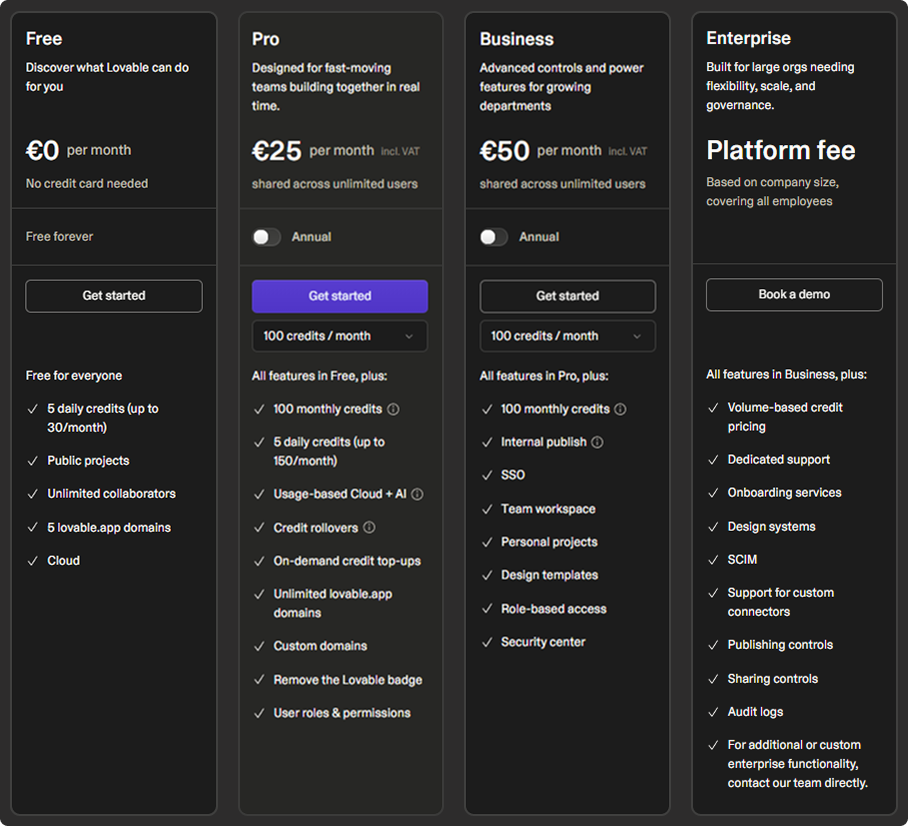
The Enterprise tier adds SSO, audit logs, private deployment options, and SLA-backed support. For organizations adopting Lovable as a standard tool, these features matter more than raw credit volume. The custom pricing reflects the additional infrastructure and compliance requirements.
Scroll horizontally to see all columns
| Tier | Monthly Cost | Best For |
|---|---|---|
| Free | $0 | Learning, tiny prototypes |
| Starter | $20 | Solo developers, side projects |
| Launch | $50 | Active builders, small teams |
| Scale | $100 | Production teams, agencies |
| Enterprise | Custom | Organizations with compliance needs |
Credit top-ups are available on paid tiers if you exhaust your monthly allocation before reset. The per-credit cost decreases at higher tiers. There's no rollover — unused credits expire monthly. This encourages consistent usage patterns but penalizes bursty workflows where you might build intensely for a week then pause.
Comparison with Other AI Coding Tools
Cursor and GitHub Copilot operate inside your IDE as autocomplete and chat assistants. They're excellent for line-level generation, refactoring, and explaining existing code. Lovable operates at the project level — it creates the file structure, writes multiple coordinated files, and runs the dev server. The tools are complementary. Many developers use Lovable for scaffolding and Cursor for detailed implementation work.
v0 by Vercel and Bolt.new are closer competitors. v0 focuses on UI components and design system generation with strong Tailwind and shadcn/ui integration. It's exceptional for individual components and pages but doesn't manage backend, database, or full project orchestration. Bolt.new runs a full WebContainer environment in the browser and supports more frameworks, but its model routing feels less polished for complex multi-file tasks.
Replit Agent targets a different audience — it's a full cloud IDE with AI assistance, aimed at beginners and educators. The environment handles everything including hosting, but the generated code quality for production applications lags behind Lovable's. Base44 is a newer entrant focused on business applications with a more opinionated architecture. Early impressions suggest strong domain modeling but less flexibility.
Lovable sits in a sweet spot: higher-level than Copilot, more full-stack than v0, more production-oriented than Replit.
Security and Data Handling with GPT
Code sent to GPT models includes your project context — file contents, prompts, and error messages. Lovable's privacy policy states that this data is not used to train OpenAI or Anthropic models. The API agreements with model providers include zero-retention provisions for enterprise tiers. On lower tiers, standard API data handling applies: providers may retain logs for abuse monitoring but not for training.
Secrets management is a practical concern. Lovable provides environment variable storage for API keys, database URLs, and other secrets. These are injected into the dev server and deployment environments but are not sent to the models during generation. The system prompts the models with placeholder values. This design prevents accidental credential leakage into model contexts.
For organizations with strict data residency or compliance requirements, the Enterprise tier offers private deployment options where the orchestration layer runs in your cloud account. The model API calls still route to OpenAI and Anthropic, but the context assembly, prompt engineering, and code execution stay within your infrastructure boundary. This is a significant architectural difference from the standard SaaS offering.
Limitations That Won't Be Solved by Better Models
Some limitations are structural, not model-capability issues. The chat interface is inherently linear — you describe, it generates, you refine. Real software development is non-linear: you jump between files, run tests, debug in the browser, refactor, and circle back. A chat transcript cannot capture this workflow efficiently. IDE-integrated agents like Cursor's Composer or GitHub Copilot Workspace address this better by operating in the editor context.
Context window limits, even at 128k or 200k tokens, constrain whole-project reasoning. A production codebase with 200 files exceeds what any current model can hold in context. Lovable uses retrieval and summarization to work around this, but the system cannot simultaneously reason about the auth system, the billing logic, and the real-time collaboration feature. Large-scale architectural changes require human decomposition.
The generated code reflects the average of training data — which means average patterns, average abstractions, average naming. Exceptional codebases have opinionated architecture, consistent conventions tailored to the domain, and deliberate trade-offs. Models don't have opinions; they have probabilities. The distinctive character of a well-crafted codebase comes from human decisions that models won't make.
Models generate the code a competent developer would write on a first pass. They don't generate the code that same developer writes after three refactors and a code review.
Practical Tips for Better GPT Results in Lovable
Start with a template close to your use case rather than a blank project. The template provides structural guardrails that keep the model on track. Then iterate with specific, scoped prompts — "add a user profile page with avatar upload" works better than "build the user dashboard." Scope limits the context the model needs to reason about and reduces hallucination surface area.
Provide existing code as reference when extending. If you've already built a pattern in the project — a specific form layout, a data fetching hook, an error boundary — paste the relevant file into the chat and say "follow this pattern." The model mimics structure far better than it invents it. This is the single highest-leverage technique for consistency.
Use the GitHub sync early and often. Commit the working baseline, then let Lovable attempt a risky change. If it breaks, revert in Git rather than asking the model to fix its own mess. The model often compounds errors when debugging its own output. Clean reverts are faster than iterative repair.
Learn the credit economics. A complex feature request on a large project can cost 500-1000 credits. On Starter tier with ~2000 daily credits, that's a significant chunk. Batch related changes into single prompts when possible. Separate prompts for "add the component" and "style the component" cost more than one prompt for "add and style the component."
- Start from templates, not blank projects
- Prompt with specific scope, not vague goals
- Reference existing project patterns explicitly
- Commit to Git before risky generations
- Batch related changes into single prompts
- Use GitHub for version control, not chat history
- Move to IDE for detailed implementation work
Final Assessment of Lovable GPT Integration
Lovable's GPT integration is genuinely useful for a specific slice of development work: the first 60% of a standard web application. Auth, database, routing, basic CRUD, standard integrations, responsive UI — the platform delivers working code for all of it. The model orchestration handles the complexity of coordinating multiple files and maintaining consistency across the stack. For solo founders, small teams, and agencies building SaaS products, this eliminates weeks of boilerplate.
The remaining 40% — business logic, performance, edge cases, architectural opinions — still requires a developer. The tool doesn't replace engineering judgment; it compresses the mechanical work that surrounds it. Teams that understand this boundary move fast. Teams that expect the AI to make good architectural decisions produce technical debt at unprecedented velocity.
The credit-based pricing aligns incentives reasonably: you pay for what you generate. But the opacity of per-model costs makes budgeting unpredictable. The Free tier is too limited for real evaluation; Starter is the minimum viable tier for serious use. Enterprise features address real organizational needs but at a price point that excludes smaller teams.
Compared to alternatives, Lovable occupies a distinct position: more ambitious than component generators, more production-ready than browser IDEs, more open than closed platforms. The GitHub sync and standard stack output are the features that keep it from being a walled garden. As long as the generated code remains standard React/TypeScript, the switching cost stays low — which is the healthiest dynamic for a tool in this category.
Frequently Asked Questions
Which GPT model does Lovable use for code generation?
Lovable primarily uses GPT-4o for complex reasoning and code synthesis, with GPT-4o-mini handling simpler tasks like type fixes and utility functions. The system automatically routes tasks without user control over model selection.
Can I use my own OpenAI API key with Lovable?
No, Lovable does not support bring-your-own-key. The platform manages model access and credit consumption through its own subscription tiers. Enterprise customers may discuss custom arrangements.
Does Lovable train on my code or prompts?
According to Lovable's privacy policy, user data is not used to train OpenAI or Anthropic models. API agreements include zero-retention provisions for enterprise tiers. Standard tiers follow provider data handling policies for abuse monitoring only.
How many credits does a typical project consume?
A small project (landing page, simple dashboard) may use 200-500 credits. A full SaaS with auth, database, payments, and multiple features can consume 2,000-5,000+ credits across iterations. Complex changes on large projects cost 500-1,000 credits per prompt.
Can I deploy Lovable projects without using their platform?
Yes. The generated code is a standard Vite + React + TypeScript project. You can clone the GitHub repository, run npm install, and deploy to any platform that supports Node.js builds — Vercel, Netlify, AWS, Docker, etc. No Lovable runtime is required.
What happens when I hit my credit limit?
On paid tiers, you can purchase credit top-ups at a per-credit rate that decreases with higher tiers. On the Free tier, you must wait for the daily reset. Unused credits do not roll over month to month.
Is Lovable suitable for non-technical founders?
Lovable lowers the barrier significantly but still requires technical literacy. You need to understand React components, TypeScript types, Supabase concepts, and Git workflows to effectively review, modify, and deploy the generated code. Non-technical users will hit walls quickly.