

AI App Development
Lovable for Non-Technical Founders: Building Apps Without Code
A practical guide to launching your startup idea with Lovable's no-code platform


Senior Software Developer & Trading Technology Specialist
Ethan Parker is a software developer with over 8 years of experience in building web applications, trading tools, and financial technology solutions. He specializes in Python, JavaScript, API integrations, and trading automation, helping traders improve efficiency through innovative technology.
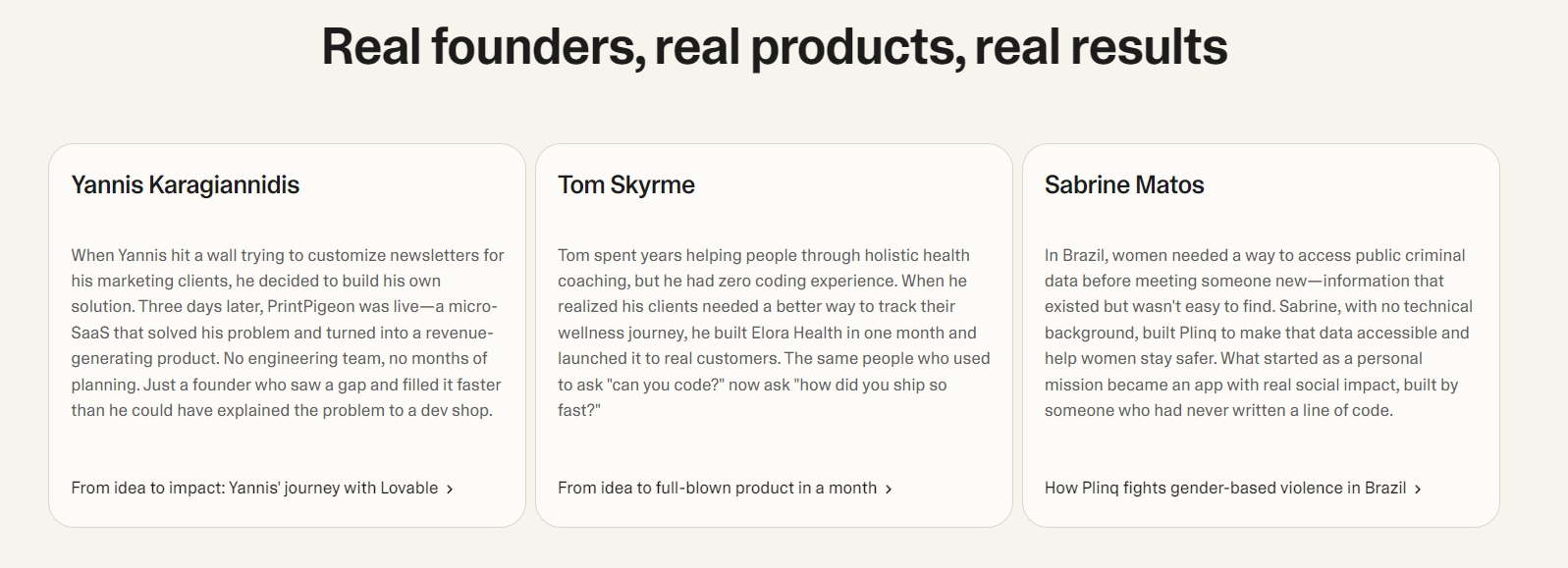
Most founders hit the same wall. They have a clear product vision, maybe even paying customers waiting, but no way to build the thing without hiring developers they cannot afford. Lovable changes that equation. It lets you describe an application in plain English and watches a working React frontend appear in the browser, backed by Supabase for database and auth, ready to deploy on day one.
Contents
- 1. How Lovable Works for Founders Who Don't Write Code
- 2. From Idea to Deployed MVP: A Typical Founder Journey
- 3. What You Still Need to Understand
- 4. Common Pitfalls and How to Avoid Them
- 5. Authentication and User Management Without the Headache
- 6. Payments and Revenue Logic
- 7. Design and Branding Without a Designer
- 8. Testing and Quality Assurance for Solo Founders
- 9. Scaling Beyond the MVP
- 10. Pricing Reality for Early-Stage Founders
- 11. When Lovable Is the Wrong Choice
- 12. Community and Learning Resources
- 13. Security and Compliance Considerations
- 14. Final Assessment of Lovable for Non-Technical Founders
This is not a prototype tool that spits out disposable code. The output is a real codebase — TypeScript, React, Vite, Tailwind — that you own. You can push it to GitHub, extend it with custom logic, or hand it to a developer later without starting over. For a non-technical founder, that distinction matters. You are not locked into a walled garden. You are building an asset.
The learning curve is genuine but manageable. You still need to think like a product person: data models, user flows, permission boundaries. Lovable handles the syntax. You handle the decisions. That split is where the leverage lives. This article walks through how non-technical founders actually use the platform, what trips them up, and where the real limits sit.
How Lovable Works for Founders Who Don't Write Code
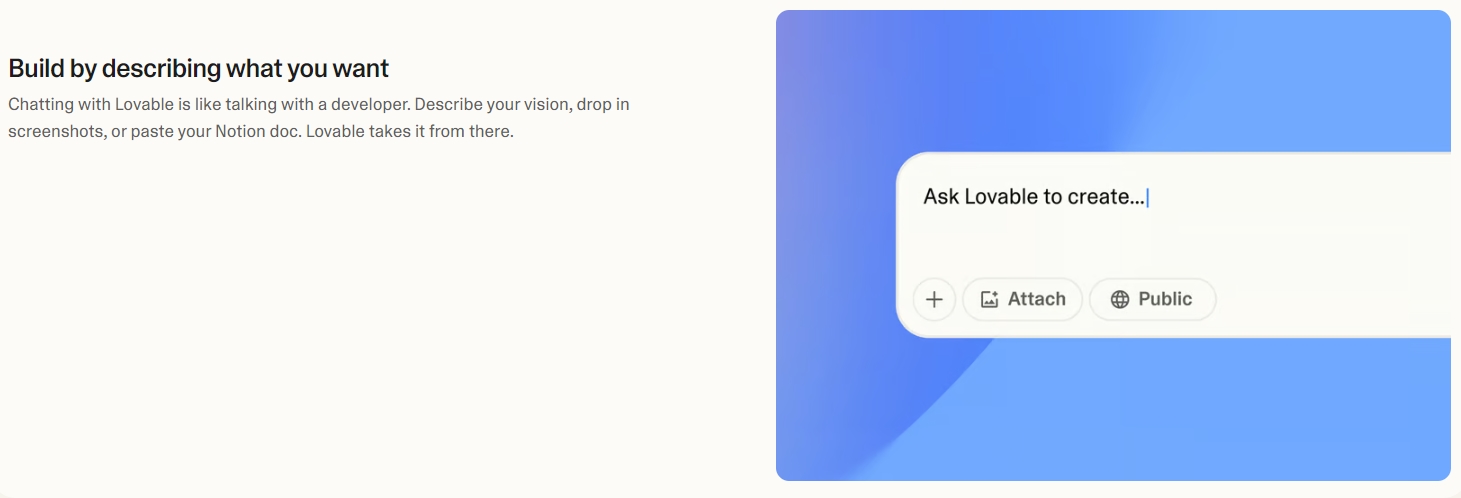
You start with a prompt. Something like: "Build a marketplace where dog walkers create profiles, pet owners book walks, and payments go through Stripe." Lovable generates the initial project structure — pages, components, database schema, API routes — and opens a live preview. You click around. You notice the booking flow misses a confirmation screen. You type: "Add a booking confirmation page with walk details and a cancel button." The preview updates. You keep iterating.
Under the hood, Lovable uses Claude and GPT models trained on modern web development patterns. It knows Supabase row-level security, Stripe webhook handling, React Query for data fetching. You do not need to know those terms. You need to know what your users should be able to do. The AI translates intent into implementation. When it gets stuck — complex multi-step logic, unusual third-party integrations — you can paste error messages back into the chat and it usually self-corrects.
The chat history becomes your project documentation. Every change is a commit you can revert. You can branch, experiment with a redesign, and merge back or discard. That safety net matters when you are learning. You cannot break production because there is no production until you click deploy. The free tier gives you five credits daily — enough for meaningful progress on a simple app — and paid plans scale with usage.
From Idea to Deployed MVP: A Typical Founder Journey
Week one usually looks like this. Day one: sign up, describe the core concept, get a working skeleton. Day two: refine the data model — users, listings, bookings, reviews — by asking Lovable to add fields and relationships. Day three: polish the UI. "Make the booking card show the walker's rating and photo." "Add a dark mode toggle." Day four: connect Supabase auth, test the signup flow, realize you forgot password reset, ask Lovable to add it. Day five: Stripe integration. "Add checkout for booking payments, 20% platform fee." Day six: deploy to Vercel, connect a custom domain, send the link to three beta users. Day seven: fix the bugs they find.
That timeline is optimistic but realistic for a focused founder. The platform removes the blank-page paralysis. You are never staring at an empty editor wondering where to start. You are always reacting to something that exists. That psychological shift — from creator to editor — is where non-technical founders gain the most speed.
What You Still Need to Understand
Lovable does not eliminate product thinking. You must decide: does a walker see all booking requests or only pending ones? Can a pet owner cancel after the walker accepts? What happens to the payment? These are business logic questions. The AI implements what you specify. If you specify nothing, it guesses — sometimes well, sometimes not. Founders who treat Lovable as a mind reader get frustrated. Founders who treat it as a very fast junior developer who needs clear specs get results.
Data modeling is the biggest hidden skill. You do not write SQL, but you do describe tables and relationships. "A booking belongs to a walker and a pet owner. A walker has many bookings. A review belongs to a booking." Lovable translates that into Supabase schema with foreign keys and row-level security policies. If you describe it wrong — say, you forget that a walker needs to see their own bookings but not others' — the generated policies will leak data. You catch this by testing as different users. The platform shows you the generated SQL. Learning to read it, even roughly, pays off fast.
Scroll horizontally to see all columns
| You Decide | Lovable Implements |
|---|---|
| Product scope and user flows | React components and routing |
| Data entities and relationships | Supabase schema and migrations |
| Permission rules per role | Row-level security policies |
| Third-party services to integrate | API routes and webhook handlers |
| UI/UX preferences and branding | Tailwind styling and responsive layouts |
| Deployment targets and domains | Vercel/Netlify config and CI |
Common Pitfalls and How to Avoid Them
The most frequent mistake: asking for too much in one prompt. "Build me an Airbnb clone with messaging, payments, reviews, calendar sync, and admin dashboard." Lovable will try. It will produce a sprawling, half-working mess. The fix is incremental. Start with listings and bookings only. Get that solid. Then add messaging. Then payments. Each feature is a separate chat session or a clear follow-up prompt. The platform handles context well, but context windows have limits. Smaller scopes mean cleaner code and easier debugging.
Second pitfall: ignoring the generated code. You can build surprisingly far without reading a line. But when something breaks — a Stripe webhook fails, a Supabase policy blocks a legitimate query — you need to at least locate the relevant file. Lovable shows you the file tree. Click the route handler. Read the error. Paste it back. The AI fixes it. But you have to know where to look. Spend an hour early on learning the project structure: routes, components, lib, hooks. It looks like a standard Vite React app because it is one.
The founders who succeed with Lovable treat it like pair programming with a senior engineer who types fast but needs your product direction.
Authentication and User Management Without the Headache
Auth is where most side projects die. Password reset flows, email verification, OAuth providers, session management — it is weeks of boring work. Lovable connects to Supabase Auth out of the box. You say: "Add Google and GitHub login, require email verification, add a profile page where users upload an avatar." Done. The generated code handles the OAuth callbacks, the email templates live in Supabase dashboard, the avatar uploads go to Supabase Storage. You configure the providers in Supabase once. The frontend just works.
Role-based access is similarly straightforward. "Admins can see all bookings and refund payments. Walkers only see their own bookings." Lovable writes the RLS policies. You test by creating two test accounts in Supabase dashboard, logging in as each, verifying the data isolation. This is the part non-technical founders often skip. Do not skip it. Data leaks in production are embarrassing and sometimes legally dangerous.
The platform also generates admin interfaces when asked. "Create an admin dashboard showing all users, bookings, revenue, with ability to ban users and refund payments." You get a protected route, data tables with sorting and pagination, action buttons that call the right API endpoints. It is not as polished as a dedicated admin panel like AdminJS, but for early stage it is often sufficient. You can always replace it later.
Payments and Revenue Logic
Stripe integration is one of Lovable's stronger suits. You describe the billing model: "Marketplace takes 20% commission. Walkers get paid out weekly via Stripe Connect. Pet owners pay upfront, funds held until walk completes." The AI generates the checkout session creation, the webhook handler for payment_intent.succeeded, the Connect onboarding flow for walkers, the payout schedule. You still need a Stripe account and to configure Connect in the dashboard. Lovable cannot do that for you. But the code it writes matches the current Stripe API version and follows best practices — idempotency keys, proper error handling, metadata for reconciliation.
Subscription billing works similarly. "SaaS with three tiers: Free, Pro $29/mo, Team $99/mo. Pro gets 10 projects, Team gets unlimited." Lovable creates the price IDs mapping, the customer portal link, the usage tracking. You handle the Stripe dashboard side: creating products, prices, setting up the billing portal. The division of labor is clean. The platform writes code. You configure the vendor.
Design and Branding Without a Designer
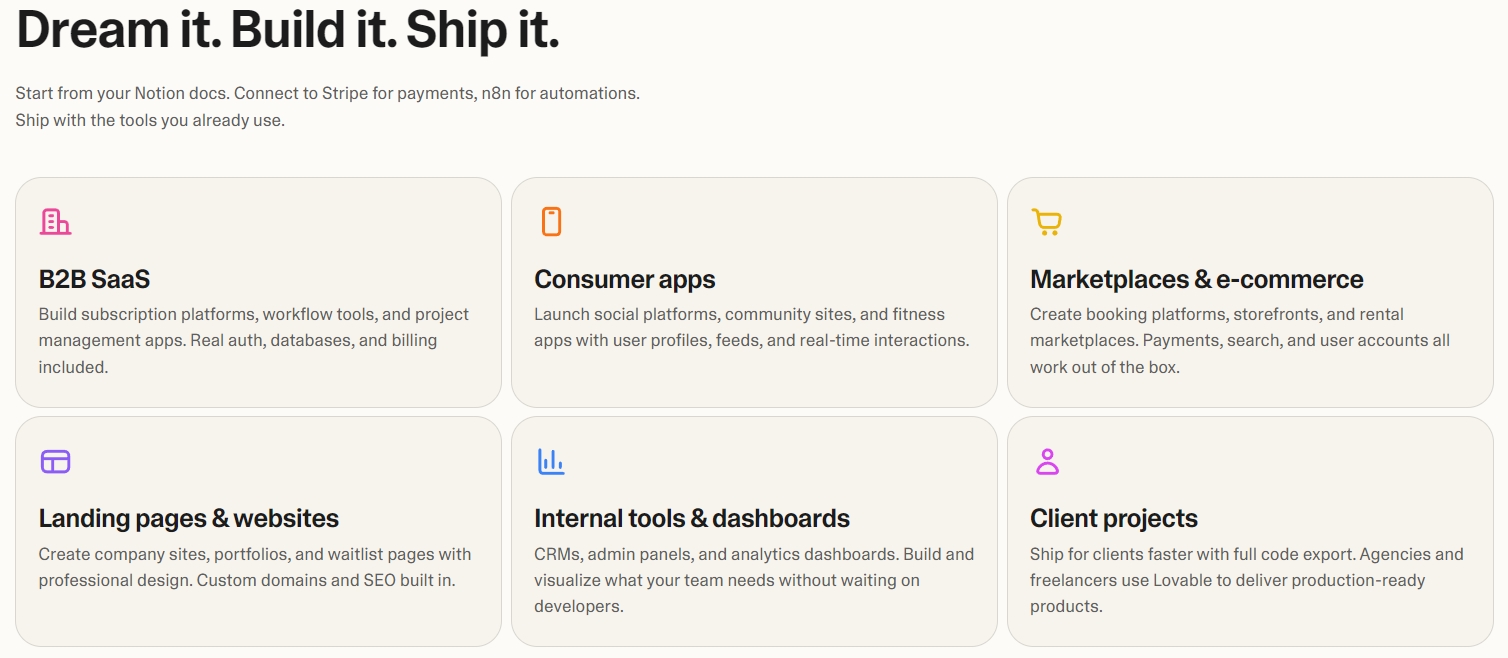
Tailwind CSS means every component is styleable via utility classes. Lovable generates clean, consistent UI by default — shadcn/ui components, proper spacing, responsive breakpoints. You customize by prompting: "Use our brand colors: primary #2563eb, secondary #0ea5e9. Rounded buttons, softer shadows. Font: Inter." The AI updates the Tailwind config and component classes. You can also paste a Figma link or describe a reference site: "Make the dashboard feel like Linear — dense, keyboard-first, dark mode default."
For founders with zero design sense, the default theme is production-acceptable. It looks like a modern SaaS product. You can ship with it and hire a designer later to refine. That is a valid strategy. Many founders waste months on visual polish before validating demand. Lovable lets you defer that decision without looking amateur.
Component-level control is available when you need it. "On the booking card, move the walker photo to the left, make the rating stars larger, add a 'favorite' heart icon." Lovable finds the component file, makes the edits, preserves the rest. You are not fighting a rigid template system. The code is yours to modify at any granularity.
Testing and Quality Assurance for Solo Founders
You are the QA team. Lovable does not write tests automatically, though you can ask: "Add Vitest unit tests for the booking utility functions" or "Add Playwright e2e tests for the signup flow." It will generate decent coverage. But most non-technical founders skip automated testing initially. The pragmatic approach: manual test the happy paths thoroughly. Create a checklist. Sign up as user A. Sign up as user B. Complete a booking end-to-end. Try to break it — submit empty forms, navigate back during payment, refresh mid-flow. Fix what breaks.
Error boundaries and toast notifications are included by default. When something fails, users see a friendly message, not a white screen. You can customize the copy: "Something went wrong booking your walk. Please try again or contact support." The platform also integrates with Sentry if you add the DSN. That gives you production error tracking without writing instrumentation code.
Scaling Beyond the MVP
The code Lovable produces is standard React/TypeScript. When you hire a developer, they inherit a normal codebase — not a proprietary format. They can add features, write tests, set up CI/CD, optimize bundle size. The GitHub integration means every Lovable change is a commit. Your developer sees the full history. They can work in their local IDE, push to the same repo, and Lovable continues to function for you. The platform does not gatekeep the code.
Database migrations are a consideration. Supabase uses Postgres. Lovable generates migration files for schema changes. As the app grows, you may need manual migrations — adding indexes, altering columns, backfilling data. A developer handles that. You can still use Lovable for frontend features while the backend evolves separately. The integration points (API routes, Supabase client) stay stable.
Lovable is not a trap. It is a head start. The exit ramp is standard Git and standard hosting.
Pricing Reality for Early-Stage Founders
The free tier gives five credits per day. A credit roughly equals one AI interaction — a prompt and its response. Building a simple MVP might consume 50-100 credits over two weeks. That fits in free if you pace it. The Pro plan at $29/month gives 100 credits monthly plus higher rate limits. The Launch plan at $99/month gives 500 credits. Enterprise is custom. Most solo founders stay on Free or Pro until they have revenue. The costs are predictable and low compared to a developer salary.
Supabase and Vercel have their own free tiers that cover early usage. Supabase free: 500MB database, 1GB file storage, 50k monthly active users. Vercel free: unlimited personal projects, 100GB bandwidth. You can run a real business on $0 infrastructure for a surprisingly long time. The main cost becomes your time.
Scroll horizontally to see all columns
| Stage | Lovable | Supabase | Vercel | Stripe | Total |
|---|---|---|---|---|---|
| MVP (Free tiers) | $0 | $0 | $0 | 2.9% + 30¢ | Transaction only |
| Early traction | $29 | $25 | $0 | 2.9% + 30¢ | ~$54 + fees |
| Growing revenue | $99 | $25 | $20 | 2.9% + 30¢ | ~$144 + fees |
When Lovable Is the Wrong Choice
It is not for everything. Highly algorithmic products — real-time collaboration, complex canvas editors, video processing, ML inference — exceed what the AI reliably generates. You can still use Lovable for the surrounding app (auth, dashboard, billing) and hire for the hard core. But if your entire value prop is a novel technical feat, Lovable is the wrong starting point.
Native mobile apps are another gap. Lovable builds responsive web apps. They work in mobile browsers and can be wrapped in Capacitor or Expo for app stores, but that wrapping and native feature access (push notifications, camera, offline sync) requires manual work. If mobile-first is non-negotiable, consider Expo with AI assistance instead, or budget for a mobile developer after validating on web.
Teams with strong engineering culture sometimes find Lovable slower than writing code directly. If you have two senior React developers, they will outpace the chat interface for complex features. Lovable shines when the bottleneck is engineering capacity, not engineering skill. Solo founders, designer-founder pairs, product managers building internal tools — that is the sweet spot.
Community and Learning Resources
The Discord community is active. Founders share prompts that worked, debug each other's RLS policies, post launch announcements. The team ships updates weekly — new integrations, better code generation, UI improvements. The documentation covers the basics but the real knowledge lives in Discord and the template gallery. Templates are complete starter projects: "SaaS with Stripe," "Marketplace with Connect," "AI Chat App." You can clone one and modify instead of starting from zero. That alone saves days.
Guides on the site walk through specific patterns: row-level security deep dive, Stripe Connect setup, custom domain configuration, GitHub workflow. They are written for non-technical readers — no assumed knowledge of Docker, Kubernetes, or CI/CD pipelines. The learning curve is real but the material exists. You are not figuring it out alone.
One underrated resource: the generated code itself. When Lovable does something clever — a custom hook for optimistic updates, a reusable form component with Zod validation — copy that pattern. Build your own mental library. After a few projects, you start recognizing the shapes. You become a better prompter because you know what good output looks like.
Security and Compliance Considerations
You are the data controller. Lovable and Supabase are processors. That means GDPR, CCPA, HIPAA — if they apply to your users — are your responsibility. The platform gives you tools: RLS for data isolation, Supabase Auth for consent logs, audit logs via Postgres triggers. But you must configure them correctly. If you handle health data, you need a BAA with Supabase (available on Pro plan). If you process European users, you need a DPA. These are not Lovable settings. They are vendor agreements you sign.
Secrets management matters. API keys, Stripe secrets, Supabase service role keys — never hardcode them. Lovable uses environment variables. Vercel and Supabase dashboards store them encrypted. Rotate keys periodically. The platform does not enforce rotation. That discipline is on you. A leaked service role key bypasses all RLS. Treat it like a root password.
Security is not a feature you add later. It is a set of decisions you make every time you define who sees what data.
Final Assessment of Lovable for Non-Technical Founders
Lovable delivers on its core promise: a non-technical founder can build and deploy a real, revenue-capable web application without hiring developers. The code quality is production-grade. The stack is modern and hireable. The pricing is accessible. The main cost is your time learning to think in product specs rather than feature wishes. Founders who invest that time — typically two to three weeks of focused work — gain a working MVP and a codebase they own. Founders who expect magic without clarity get frustrated and quit. The tool rewards precision. If you can describe what you want clearly, Lovable builds it. That is a genuine shift in what is possible for solo founders.
Frequently Asked Questions
Can I really build a complete app without writing any code?
Yes, for the vast majority of SaaS, marketplace, and internal tool use cases. You describe features in plain English and Lovable generates the React/TypeScript codebase. You never need to write code unless you want to customize something the AI cannot handle.
What happens when I need a feature Lovable cannot build?
You have the full codebase. You can hire a developer to extend it, or learn to add the feature yourself. The code is standard React with Supabase — any competent web developer can work with it. You are not locked into the platform.
How much does it cost to run an app built with Lovable?
Lovable plans range from free to $99/month. Supabase and Vercel have generous free tiers covering early usage. Stripe takes 2.9% + 30¢ per transaction. Many founders run real businesses for under $60/month in platform costs until significant scale.
Do I own the code Lovable generates?
Yes. Every project is a standard Git repository. You can push to GitHub, download locally, or deploy anywhere. Lovable claims no ownership or licensing restrictions on the output.
Can Lovable build native iOS and Android apps?
Not directly. It builds responsive web applications. You can wrap the web app with Capacitor or Expo for app store distribution, but native features (push notifications, camera, offline) require additional native code.
What if Lovable generates buggy or insecure code?
You test the live preview before deploying. Supabase row-level policies handle data isolation. You can paste error messages back to Lovable for fixes. For production apps, a security review by a developer is recommended before handling sensitive data.
How long does it take to learn Lovable well enough to ship?
Most non-technical founders ship a usable MVP in 2-3 weeks of part-time work. The first week is learning the prompting rhythm and Supabase basics. Speed improves rapidly after the first project.